



 Chat with AI
Exam 22: Long-Run Economic Growth: Sources and Policies

Exam 1: Economics: Foundations and Models447 Questions
Exam 2: Trade-Offs, comparative Advantage, and the Market System492 Questions
Exam 3: Where Prices Come From: the Interaction of Demand and Supply476 Questions
Exam 4: Economic Efficiency, government Price Setting, and Taxes420 Questions
Exam 5: Externalities, environmental Policy, and Public Goods263 Questions
Exam 6: Elasticity: the Responsiveness of Demand and Supply294 Questions
Exam 7: The Economics of Health Care338 Questions
Exam 8: Firms,the Stock Market,and Corporate Governance522 Questions
Exam 9: Comparative Advantage and the Gains From International Trade377 Questions
Exam 10: Consumer Choice and Behavioral Economics300 Questions
Exam 11: Technology,production,and Costs327 Questions
Exam 12: Firms in Perfectly Competitive Markets296 Questions
Exam 13: Monopolistic Competition: the Competitive Model in a More Realistic Setting272 Questions
Exam 14: Oligopoly: Firms in Less Competitive Markets258 Questions
Exam 15: Monopoly and Antitrust Policy279 Questions
Exam 16: Pricing Strategy261 Questions
Exam 17: The Markets for Labor and Other Factors of Production281 Questions
Exam 18: Public Choice, taxes, and the Distribution of Income258 Questions
Exam 19: Gdp: Measuring Total Production and Income261 Questions
Exam 20: Unemployment and Inflation291 Questions
Exam 21: Economic Growth, the Financial System, and Business Cycles253 Questions
Exam 22: Long-Run Economic Growth: Sources and Policies262 Questions
Exam 23: Aggregate Expenditure and Output in the Short Run301 Questions
Exam 24: Aggregate Demand and Aggregate Supply Analysis286 Questions
Exam 25: Money,banks,and the Federal Reserve System281 Questions
Exam 26: Monetary Policy275 Questions
Exam 27: Fiscal Policy306 Questions
Exam 28: Inflation, unemployment, and Federal Reserve Policy257 Questions
Exam 29: Macroeconomics in an Open Economy278 Questions
Exam 30: The International Financial System258 Questions
Select questions type


All of the following are reasons why China is unlikely to maintain high enough rates of productivity growth to catch-up with the standard of living in the United States except
(Multiple Choice)
4.7/5  (84)
(84) Would you expect to see higher or lower growth rates for countries that start out with a relatively low level of real GDP per capita? Explain using the concept of "catch-up" and support your answer with a graph.
(Essay)
4.9/5 (80)
(80) Table 22-4
Country Real GDP per Capita (in 1996 dollars) Growth in Real GDP per Capita, 1960-2000 Botswana \ 958 5.29\% Thailand 1,091 4.70\% Japan 4,544 4.32\% Guatemala 2,344 1.29\%
-Refer to Table 22-4.In the table above,which countries are consistent with the predictions of the economic growth model?
(Multiple Choice)
4.8/5 (74)
(74) Figure 22-4  -Refer to Figure 22-4.The movement from A to B to C illustrates
 (Multiple Choice)
4.9/5 (78)
(78) Policies to promote growth by increasing saving and investment work through
(Multiple Choice)
4.7/5 (82)
(82) The productivity slowdown experience in the United States from the mid-1970s to the mid-1990s occurred in all high-income countries.
(True/False)
4.8/5 (73)
(73) Consider two countries,Alpha and Beta.In Alpha,real GDP per capita is $6,000.In Beta,real GDP per capita is $9,000.Based on the economic growth model,what would you predict about the growth rates in real GDP per capita across these two countries?
(Multiple Choice)
4.9/5 (79)
(79) The Soviet Union consistently increased the amount of capital available to its workers,but found that increases in capital resulted in progressively smaller and smaller increases in GDP per worker.This phenomenon is referred to as
(Multiple Choice)
4.9/5 (68)
(68) Which of the following policies would not help promote economic growth?
(Multiple Choice)
4.8/5 (81)
(81) Suppose that an increase in capital per hour worked from $15,000 to $20,000 increases real GDP per hour worked by $500.If capital per hour worked increases further to $25,000,by how much would you expect real GDP per hour worked to increase if there are diminishing returns?
(Multiple Choice)
4.7/5 (69)
(69) Figure 22-2 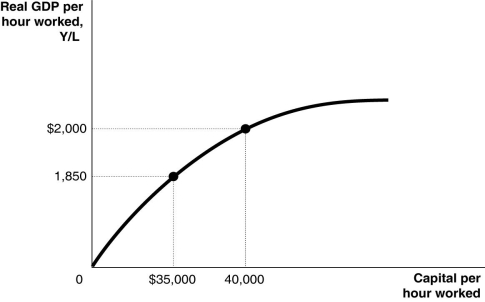 -Refer to Figure 22-2.Based on the per-worker production function above,if the economy raises capital per hour worked from $35,000 to $40,000,by how much will real GDP per hour worked increase?
 (Multiple Choice)
4.9/5 (81)
(81) The "new economy" that emerged in the mid-1990s is based on
(Multiple Choice)
4.9/5 (76)
(76) ________ is considered a high income country,________ a developing country,and ________ a newly industrializing country.
(Multiple Choice)
4.8/5 (69)
(69) Describe the process of "creative destruction" using a specific example.
(Essay)
4.7/5 (92)
(92) According to Joseph Schumpeter,economic growth is achieved through
(Multiple Choice)
4.8/5 (76)
(76) Explain how advances in technology are critical to sustaining economic growth,even if capital per hour worked is consistently increasing.Provide a graph of a per-worker production function to support your answer.
(Essay)
4.8/5 (80)
(80) 
Filters
- Essay(0)
- Multiple Choice(0)
- Short Answer(0)
- True False(0)
- Matching(0)