



 Chat with AI
Exam 22: Long-Run Economic Growth: Sources and Policies

Exam 1: Economics: Foundations and Models447 Questions
Exam 2: Trade-Offs, comparative Advantage, and the Market System492 Questions
Exam 3: Where Prices Come From: the Interaction of Demand and Supply476 Questions
Exam 4: Economic Efficiency, government Price Setting, and Taxes420 Questions
Exam 5: Externalities, environmental Policy, and Public Goods263 Questions
Exam 6: Elasticity: the Responsiveness of Demand and Supply294 Questions
Exam 7: The Economics of Health Care338 Questions
Exam 8: Firms,the Stock Market,and Corporate Governance522 Questions
Exam 9: Comparative Advantage and the Gains From International Trade377 Questions
Exam 10: Consumer Choice and Behavioral Economics300 Questions
Exam 11: Technology,production,and Costs327 Questions
Exam 12: Firms in Perfectly Competitive Markets296 Questions
Exam 13: Monopolistic Competition: the Competitive Model in a More Realistic Setting272 Questions
Exam 14: Oligopoly: Firms in Less Competitive Markets258 Questions
Exam 15: Monopoly and Antitrust Policy279 Questions
Exam 16: Pricing Strategy261 Questions
Exam 17: The Markets for Labor and Other Factors of Production281 Questions
Exam 18: Public Choice, taxes, and the Distribution of Income258 Questions
Exam 19: Gdp: Measuring Total Production and Income261 Questions
Exam 20: Unemployment and Inflation291 Questions
Exam 21: Economic Growth, the Financial System, and Business Cycles253 Questions
Exam 22: Long-Run Economic Growth: Sources and Policies262 Questions
Exam 23: Aggregate Expenditure and Output in the Short Run301 Questions
Exam 24: Aggregate Demand and Aggregate Supply Analysis286 Questions
Exam 25: Money,banks,and the Federal Reserve System281 Questions
Exam 26: Monetary Policy275 Questions
Exam 27: Fiscal Policy306 Questions
Exam 28: Inflation, unemployment, and Federal Reserve Policy257 Questions
Exam 29: Macroeconomics in an Open Economy278 Questions
Exam 30: The International Financial System258 Questions
Select questions type


In a small Asian country,it is estimated that changing the level of capital from $8 million to $12 million will increase real GDP from $4 million to $6 million.What level of GDP would you expect the economy to be able to reach if spending on capital continued to rise to $16 million,assuming no technological change and no change in the hours of work?
(Multiple Choice)
4.9/5  (84)
(84) GDP in a country grew from $10 billion to $14 billion over the span of 5 years.The average annual growth rate of GDP was
(Multiple Choice)
4.8/5 (87)
(87) All of the following policies are ways for a country to promote long-run economic growth except
(Multiple Choice)
4.7/5 (78)
(78) Figure 22-1 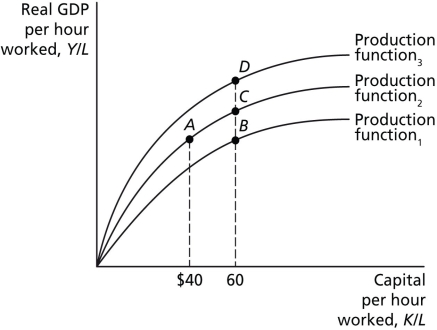 -Refer to Figure 22-1.Suppose the per-worker production function in the figure above represents the production function for the U.S.economy.If the United States decided to double its support of university research,this would cause a movement from
 (Multiple Choice)
4.9/5 (74)
(74) According to Joseph Schumpeter,which of the factors of production is central to economic growth?
(Multiple Choice)
4.8/5 (82)
(82) To what do economists attribute the rapid growth of labor productivity in the United States relative to other countries?
(Multiple Choice)
4.9/5 (81)
(81) Explain the meaning of the word "convergence" in the context of economic growth and standards of living.
(Essay)
4.8/5 (70)
(70) The easiest way for a country to obtain access to technology is through
(Multiple Choice)
4.7/5 (77)
(77) By offering less generous unemployment insurance programs,the United States can expect
(Multiple Choice)
4.9/5 (73)
(73) Robert Lucas argues that there are ________ returns to human capital,and these productivity increases are not completely captured by individuals as they decide how much education to purchase.As a result,the market produces ________ education and training.
(Multiple Choice)
4.8/5 (69)
(69) According to the World Bank,in 2006,China's GDP was approximately $2.7 trillion (or $2,700 billion).That same year,India's GDP was approximately $906.3 billion.With which of the following populations would China's standard of living have been considered higher than India's that year?
(Multiple Choice)
4.9/5 (76)
(76) Small differences in economic growth rates result in small differences in living standards.
(True/False)
4.8/5 (86)
(86) According to Nobel laureate Douglass North,one reason why the Industrial Revolution occurred in England before many other countries was because the king in England consistently maintained control over the court system and the government.
(True/False)
4.7/5 (83)
(83) The purchase or building by a corporation of a facility in a foreign country is called
(Multiple Choice)
5.0/5 (89)
(89) Significant economic growth did not begin in the world until
(Multiple Choice)
4.9/5 (74)
(74) If real GDP in the United States is growing at an annual rate of 3.2% per capita and Bolivia's real GDP per capita is growing at a rate of 1.3%,which of the following would we expect in the long run? Assume real GDP per capita in the United States begins at a level above that of real GDP per capita in Bolivia.
(Multiple Choice)
4.9/5 (78)
(78) Most economic growth in the world occurred between 1,000,000 B.C.and 1300 A.D.
(True/False)
4.9/5 (70)
(70) According to Douglass North,the Industrial Revolution occurred in England because
(Multiple Choice)
4.9/5 (74)
(74) Compared to the previous 20 years,productivity growth in the United States increased between 1996 and 2014.
(True/False)
4.8/5 (62)
(62) Recent rapid economic growth in India and China has reduced the amount of "brain drain" in those countries.
(True/False)
4.8/5 (73)
(73) 
Filters
- Essay(0)
- Multiple Choice(0)
- Short Answer(0)
- True False(0)
- Matching(0)