



 Chat with AI
Exam 22: Long-Run Economic Growth: Sources and Policies

Exam 1: Economics: Foundations and Models447 Questions
Exam 2: Trade-Offs, comparative Advantage, and the Market System492 Questions
Exam 3: Where Prices Come From: the Interaction of Demand and Supply476 Questions
Exam 4: Economic Efficiency, government Price Setting, and Taxes420 Questions
Exam 5: Externalities, environmental Policy, and Public Goods263 Questions
Exam 6: Elasticity: the Responsiveness of Demand and Supply294 Questions
Exam 7: The Economics of Health Care338 Questions
Exam 8: Firms,the Stock Market,and Corporate Governance522 Questions
Exam 9: Comparative Advantage and the Gains From International Trade377 Questions
Exam 10: Consumer Choice and Behavioral Economics300 Questions
Exam 11: Technology,production,and Costs327 Questions
Exam 12: Firms in Perfectly Competitive Markets296 Questions
Exam 13: Monopolistic Competition: the Competitive Model in a More Realistic Setting272 Questions
Exam 14: Oligopoly: Firms in Less Competitive Markets258 Questions
Exam 15: Monopoly and Antitrust Policy279 Questions
Exam 16: Pricing Strategy261 Questions
Exam 17: The Markets for Labor and Other Factors of Production281 Questions
Exam 18: Public Choice, taxes, and the Distribution of Income258 Questions
Exam 19: Gdp: Measuring Total Production and Income261 Questions
Exam 20: Unemployment and Inflation291 Questions
Exam 21: Economic Growth, the Financial System, and Business Cycles253 Questions
Exam 22: Long-Run Economic Growth: Sources and Policies262 Questions
Exam 23: Aggregate Expenditure and Output in the Short Run301 Questions
Exam 24: Aggregate Demand and Aggregate Supply Analysis286 Questions
Exam 25: Money,banks,and the Federal Reserve System281 Questions
Exam 26: Monetary Policy275 Questions
Exam 27: Fiscal Policy306 Questions
Exam 28: Inflation, unemployment, and Federal Reserve Policy257 Questions
Exam 29: Macroeconomics in an Open Economy278 Questions
Exam 30: The International Financial System258 Questions
Select questions type


Figure 22-2 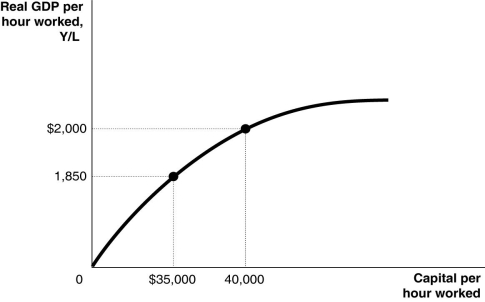 -Refer to Figure 22-2.Assuming no technological change,if the United States increases capital per hour worked by $40,000 every year between 2012 and 2016,we would expect to see
 (Multiple Choice)
4.8/5  (85)
(85) Georg,a German citizen,just purchased 10 shares of stock in Microsoft,a U.S.company.This purchase is an example of
(Multiple Choice)
4.7/5 (76)
(76) Globalization is defined as the process of countries becoming ________ open to foreign trade and ________ open to foreign investment.
(Multiple Choice)
4.9/5 (76)
(76) In the United States,the number of hours worked per person has decreased since 1800.How would growth rates since 1800 be different if they were calculated for real GDP per capita instead of GDP per hour worked?
(Essay)
4.9/5 (66)
(66) Which of the following accurately describes economic growth and standards of living between 1,000,000 B.C.and 1300 A.D.?
(Multiple Choice)
4.8/5 (77)
(77) Figure 22-4  -Refer to Figure 22-4.Within a country,the impact of wars and revolutions and their subsequent destruction of capital is reflected in the per-worker production function in the figure above by a movement from
 (Multiple Choice)
4.9/5 (71)
(71) From 1990-2014,productivity growth in the United States was ________ the growth rates of other high-income countries.
(Multiple Choice)
4.8/5 (71)
(71) In 2014,South America had a lower average GDP per capita than any other continent.
(True/False)
4.9/5 (81)
(81) Which of the following can explain why some countries have not experienced relatively high growth rates in real GDP per capita despite relatively low initial levels of real GDP per capita?
(Multiple Choice)
4.7/5 (81)
(81) In the long run,________ differences in economic growth rates result in ________ differences in GDP per capita.
(Multiple Choice)
4.8/5 (94)
(94) Article Summary
Due in part to a lackluster economy,Mexico is experiencing an exodus of some of its brightest and most educated citizens.More than 20 percent of Mexicans with bachelor's degrees are living in the United States,28 percent working on higher education degrees are doing so in the United States,and 27 percent of Mexicans with doctorates are working in the United States.The three main reasons given for this exodus are money,politics,and safety.Pay gaps are wide between university positions in the two countries,scholarship money is scarce in Mexico and is subject to political bureaucracy and nepotism,and a 2014 study from Mexico's National Autonomous University reported that 76 percent of high-skilled workers stated that violence was a reason for their departure from the country.
-Refer to the Article Summary.In Mexico,many educated workers are leaving the country,but in some countries,less-educated workers are the primary workers who leave.Should an outflow of workers leave a country with a smaller but more productive workforce and the capital per hour worked does not change,there would be ________ the per-worker production function in that country.
(Multiple Choice)
4.8/5 (75)
(75) Table 22-5
Country Real GDP per Capita in ( dollars) Growth in Real GDP per Capita 1960-2000 Belgium \ 7,778 5.02\% France 7,824 4.53\% Canada 10,383 3.88\% Denmark 10,988 3.47\%
-Refer to Table 22-5.Consider the statistics in the table above in describing the industrialized countries.Are these consistent with the economic growth model? Briefly explain.
(Essay)
4.8/5 (81)
(81) Between 1990 and 2014,which of these leading industrial countries of the world had the highest average annual growth rate in GDP per capita?
(Multiple Choice)
4.9/5 (77)
(77) In the long run,a country will experience an increasing standard of living only if it experiences
(Multiple Choice)
4.9/5 (73)
(73) Despite the improvements in information technology,productivity growth since 2006 has fallen to an even lower rate than during the period of slow growth from the mid-1970s to the mid-1990s.
(True/False)
4.8/5 (86)
(86) 
Filters
- Essay(0)
- Multiple Choice(0)
- Short Answer(0)
- True False(0)
- Matching(0)