



 Chat with AI
Exam 21: Dry Regions: the Geology of Deserts

Exam 1: Cosmology and the Birth of the Earth60 Questions
Exam 2: Journey to the Center of the Earth60 Questions
Exam 3: Drifting Continents and Spreading Seas60 Questions
Exam 4: The Way the Earth Works: Plate Tectonics63 Questions
Exam 5: Patterns in Nature: Minerals60 Questions
Exam 6: Up From the Inferno: Magma and Igneous Rocks60 Questions
Exam 7: Pages of Earths Past: Sedimentary Rocks60 Questions
Exam 8: Metamorphism: a Process of Change60 Questions
Exam 9: The Wrath of Vulcan: Volcanic Eruptions60 Questions
Exam 10: A Violent Pulse: Earthquakes60 Questions
Exam 11: Crags,cracks,and Crumples: Crustal Deformation and Mountain Building60 Questions
Exam 12: Deep Time: How Old Is Old60 Questions
Exam 13: A Biography of the Earth60 Questions
Exam 14: Squeezing Power From a Stone: Energy Resources63 Questions
Exam 15: Riches in Rock: Mineral Resources61 Questions
Exam 16: Unsafe Ground: Landslides and Other Mass Movements60 Questions
Exam 17: Streams and Floods: the Geology of Running Water60 Questions
Exam 18: Restless Realm: Oceans and Coasts60 Questions
Exam 19: A Hidden Reserve: Groundwater60 Questions
Exam 20: An Envelope of Gas: the Earths Atmosphere and Climate60 Questions
Exam 21: Dry Regions: the Geology of Deserts60 Questions
Exam 22: Amazing Ice: Glaciers and Ice Ages60 Questions
Exam 23: Global Change in the Earth System59 Questions
Exam 24: Introducing Rocks30 Questions
Exam 25: a Surface Veneer: Sediments and Soils31 Questions
Exam 26: the Rock Cycle in the Earth System30 Questions
Exam 27: the Earths Interior, Revisited: Seismic Layering, Gravity, and the Magnetic Field30 Questions
Exam 28: Memories of Past Life: Fossils and Evolution30 Questions
Exam 29: Ever-Changing Landscapes and the Hydrologic Cycle30 Questions
Exam 30: Prelude: and Just What Is Geology30 Questions
Select questions type


Compared with humid climates,the rates of chemical weathering in deserts are ________.
(Multiple Choice)
4.9/5  (92)
(92) Native Americans produced petroglyphs by etching into ________.
(Multiple Choice)
4.9/5 (88)
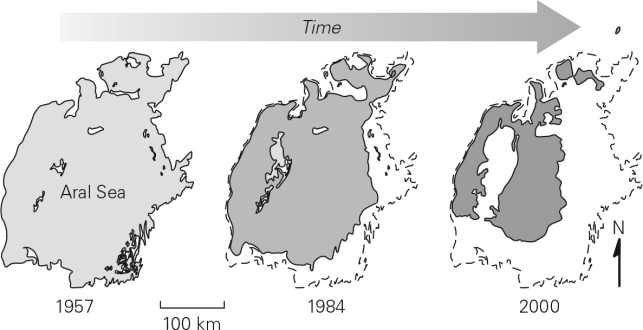
(88) 
In the figure below,the sand grains are being transported by ________. 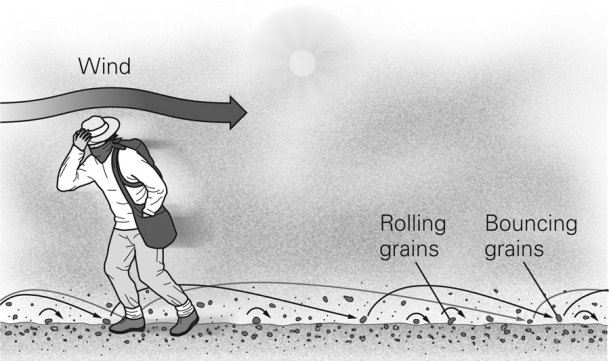
(Multiple Choice)
5.0/5 (84)
(84) As shown in the figure below,wind erosion can create a faceted rock known as a ________. 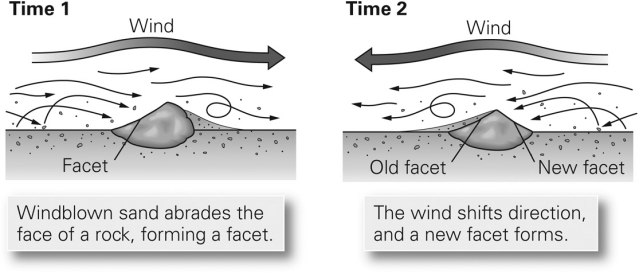
(Multiple Choice)
4.7/5 (86)
(86) What is a desert? Explain how a desert could be formed at one of the poles.
(Essay)
4.9/5 (80)
(80) After extensive erosion of a hill in a desert environment,the small remnant surrounded by alluvium-filled basins is known as a(n)________.
(Multiple Choice)
4.7/5 (77)
(77) Evaporite deposits in coastal,subtropical regions derived from the evaporation of seawater stranded above high tide are termed ________.
(Multiple Choice)
4.8/5 (79)
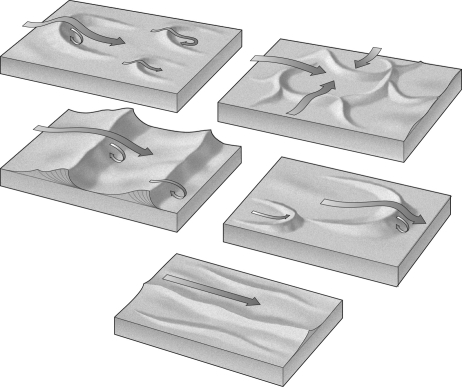
(79) 
Which of the following hazards could lead to desertification?
(Multiple Choice)
4.9/5 (92)
(92) The deserts found in the western United States are primarily the result of being located ________.
(Multiple Choice)
4.9/5 (76)
(76) According to the textbook,the highest recorded temperature on the Earth was in a ________.
(Multiple Choice)
4.8/5 (70)
(70) What is desert varnish? How does it form? Why doesn't one find desert varnish in humid climates?
(Essay)
4.8/5 (78)
(78) An apron-shaped pile of alluvium that forms at the mouth of a canyon is known as a(n)________.
(Multiple Choice)
4.8/5 (82)
(82) 
Filters
- Essay(0)
- Multiple Choice(0)
- Short Answer(0)
- True False(0)
- Matching(0)