



 Chat with AI
Exam 11: Solutions: Properties and Behavior

Exam 1: Matter and Energy: The Origin of the Universe103 Questions
Exam 2: Atoms, Ions, and Molecules: Matter Starts Here144 Questions
Exam 3: Stoichiometry: Mass, Formulas, and Reactions141 Questions
Exam 4: Solution Chemistry: The Hydrosphere148 Questions
Exam 5: Thermochemistry: Energy Changes in Reactions139 Questions
Exam 6: Properties of Gases: The Air We Breathe164 Questions
Exam 7: A Quantum Model of Atoms: Waves and Particles166 Questions
Exam 8: Chemical Bonds: What Makes a Gas a Greenhouse Gas156 Questions
Exam 9: Molecular Geometry: Shape Determines Function188 Questions
Exam 10: Intermolecular Forces: The Uniqueness of Water165 Questions
Exam 11: Solutions: Properties and Behavior150 Questions
Exam 12: Solids: Crystals, Alloys, and Polymers130 Questions
Exam 13: Chemical Kinetics: Reactions in the Atmosphere155 Questions
Exam 14: Chemical Equilibrium: How Much Product Does a Reaction Really Make111 Questions
Exam 15: Acidbase Equilibria: Proton Transfer in Biological Systems122 Questions
Exam 16: Additional Aqueous Equilibria: Chemistry and the Oceans127 Questions
Exam 17: Thermodynamics: Spontaneous and Nonspontaneous Reactions and Processes186 Questions
Exam 18: Electrochemistry: The Quest for Clean Energy167 Questions
Exam 19: Nuclear Chemistry: Applications to Energy and Medicine165 Questions
Exam 20: Organic and Biological Molecules: the Compounds of Life168 Questions
Exam 21: The Main Group Elements: Life and the Periodic Table96 Questions
Exam 22: Transition Metals: Biological and Medical Applications142 Questions
Select questions type


Which of the following is a colligative property?
I. osmotic pressure
II. molar mass
III. density
IV. freezing point depression
V. boiling point
(Multiple Choice)
4.9/5  (86)
(86) Magnesium chloride is often used to melt ice on sidewalks. Considering that the solubility of magnesium chloride (95.21 g/mol) in water is 54.3 g per 100.0 g of water, what is the lowest temperature that you would expect to be able to melt ice with magnesium chloride? Assume ideal behavior. Kf (water) 1.86C/m
(Multiple Choice)
4.9/5 (76)
(76) What is the vapor pressure of an aqueous solution that has a solute mol fraction of 0.100? The vapor pressure of water is 25.756 mm Hg at 25C.
(Multiple Choice)
4.8/5 (73)
(73) The freezing point of a 0.0925 m solution of ammonium chloride was found to be 0.325C. What is the actual van't Hoff factor for this salt at this concentration compared to the ideal one of 2? Kf (water) 1.86C/m
(Multiple Choice)
4.8/5 (89)
(89) A medical company separates methanol (CH3OH)) and ethanol (CH3CH2OH) by distillation. In one run, the starting solution was 25% methanol and 75% ethanol by mass at 25C. In the liquid, the mole ratio of methanol to ethanol was ________, and in the vapor it was ________. The vapor pressures for methanol and ethanol at this temperature are 92 torr and 45 torr, respectively.
(Multiple Choice)
4.9/5 (70)
(70) Which of the solutions shown here will have the lowest vapor pressure? White circles indicate solvent molecules; black circles indicate molecules of a nonvolatile solute.
(Multiple Choice)
4.8/5 (82)
(82) Which solution, if either, would create the higher osmotic pressure (compared to pure water): one prepared from 1.0 g of NaCl in 10 mL of water or 1.0 g of CsBr in 10 mL of water?
(Multiple Choice)
4.8/5 (88)
(88) Eugenol is a nonelectrolyte that contributes to the flavor of spices such as clove, nutmeg, cinnamon, and basil. A 328 mg sample of eugenol was dissolved in 10.0 g of chloroform (Kb 3.63C/m), increasing the boiling point of the chloroform by 0.726C. What is the molar mass of eugenol?
(Multiple Choice)
4.8/5 (79)
(79) A solution is made by dissolving 100 g of essentially nonvolatile ethylene glycol (C2H6O2) in 500 g of water. What is the resulting freezing point of the solution (Kf 1.86C/m)?
(Multiple Choice)
4.7/5 (88)
(88) Indicate which aqueous solution has the fastest evaporation rate.
(Multiple Choice)
4.8/5 (84)
(84) In the diagram below, one beaker contains pure water and the other contains an equal volume of seawater. Seawater has various salts dissolved in it. The beakers are sitting in a totally enclosed chamber, and the outside temperature and pressure are held constant. Identify the statements below about this situation that are not correct.  I. Water will be transferred from the pure water beaker to the seawater beaker.
II. Water will be transferred from the seawater beaker to the pure water beaker.
III.The vapor pressure of the pure water is higher than the vapor pressure of the seawater.
IV. Pure water evaporates at a faster rate than seawater.
V. Water in the gas phase condenses into both beakers at the same rate.
I. Water will be transferred from the pure water beaker to the seawater beaker.
II. Water will be transferred from the seawater beaker to the pure water beaker.
III.The vapor pressure of the pure water is higher than the vapor pressure of the seawater.
IV. Pure water evaporates at a faster rate than seawater.
V. Water in the gas phase condenses into both beakers at the same rate. (Multiple Choice)
4.8/5 (93)
(93) A solution is prepared by mixing 50 g of methanol (CH3OH) with 50 g of ethanol (CH3CH2OH). Use the following data to determine the vapor pressure of this solution at 20C. Substance
Vapor Pressure at 20C (torr)
Methanol
92
Ethanol
45
(Multiple Choice)
4.8/5 (87)
(87) Which intermolecular interactions are likely to result in the highest vapor pressure of a substance?
(Multiple Choice)
5.0/5 (71)
(71) Predict which of the following ionic compounds has the highest melting point.
(Multiple Choice)
4.9/5 (75)
(75) Rank the following ionic compounds in order of increasing lattice energy (largest lattice energy is the most negative): MgF2, MgCl2, MgBr2, and MgI2.
(Essay)
4.9/5 (75)
(75) Why would you expect or predict sodium fluoride to have the lowest solubility in water compared to the other sodium halide salts?
(Multiple Choice)
4.7/5 (64)
(64) Determine the molarity of an aspirin solution that produces an osmotic pressure of 0.0555 atm at 25C (i 1).
(Short Answer)
4.8/5 (73)
(73) Rank the following compounds in order of increasing attraction between their ions: KBr, SrBr2, and CsBr.
(Multiple Choice)
4.8/5 (76)
(76) Ion interaction energies are determined by Coulomb's law given by the equation: 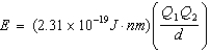 Based on this equation, what two factors dictate the strength of ion-ion interactions?
 (Essay)
4.8/5 (92)
(92) A 300 mg sample of caffeine was dissolved in 10.0 g of camphor (Kf 39.7C/m), decreasing the freezing point of camphor by 3.07C. What is the molar mass of caffeine?
(Multiple Choice)
4.8/5 (83)
(83) 
Filters
- Essay(0)
- Multiple Choice(0)
- Short Answer(0)
- True False(0)
- Matching(0)