



 Chat with AI
Exam 19: Current Issues in Macro Theory and Policy

Exam 1: Limits, Alternatives, and Choices212 Questions
Exam 2: The Market System and the Circular Flow141 Questions
Exam 3: Demand, Supply, and Market Equilibrium202 Questions
Exam 4: Market Failures: Public Goods and Externalities155 Questions
Exam 5: Governments Role and Government Failure148 Questions
Exam 6: An Introduction to Macroeconomics123 Questions
Exam 7: Measuring Domestic Output and National Income157 Questions
Exam 8: Economic Growth114 Questions
Exam 9: Business Cycles, Unemployment, and Inflation143 Questions
Exam 10: Basic Macroeconomic Relationships142 Questions
Exam 11: The Aggregate Expenditures Model143 Questions
Exam 12: Aggregate Demand and Aggregate Supply152 Questions
Exam 13: Fiscal Policy, Deficits, and Debt164 Questions
Exam 14: Money, Banking, and Financial Institutions130 Questions
Exam 15: Money Creation127 Questions
Exam 16: Interest Rates and Monetary Policy174 Questions
Exam 17: Financial Economics136 Questions
Exam 18: Extending the Analysis of Aggregate Supply135 Questions
Exam 19: Current Issues in Macro Theory and Policy134 Questions
Exam 20: International Trade151 Questions
Exam 21: The Balance of Payments, Exchange Rates, and Trade Deficits152 Questions
Exam 22: The Economics of Developing Countries135 Questions
Select questions type


In the rational expectations view, the best approach to fiscal policy is for the government to:
(Multiple Choice)
4.9/5  (66)
(66) New classical economics suggests that in the long-run changes in aggregate demand will cause:
(Multiple Choice)
4.7/5 (86)
(86) 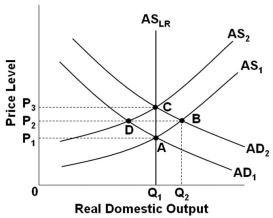 Refer to the graph above. Assume that the economy is in initial equilibrium where AD1 intersects AS1. If there is an unanticipated increase in aggregate demand, then according to new classical economics the economy will self-correct with a:
 (Multiple Choice)
4.8/5 (89)
(89) If the money supply growth is set at a slower pace than the growth of real GDP, then inflation will occur.
(True/False)
4.8/5 (83)
(83) A mainstream criticism of the rational expectations theory is that:
(Multiple Choice)
4.8/5 (76)
(76) Monetarists and rational expectation theorists believe that cost-push inflation as impossible in the long run in the absence of excessive money supply growth.
(True/False)
4.9/5 (84)
(84) Mainstream economists contend that the a policy rule based on the equation of exchange breaks down because:
(Multiple Choice)
4.7/5 (84)
(84) The average number of times per year that a dollar bill is used to pay for final goods and services is the:
(Multiple Choice)
4.8/5 (71)
(71) A coordination failure is said to occur when people do not reach a mutually beneficial equilibrium because they lack some way to jointly coordinate their actions to achieve it.
(True/False)
4.8/5 (82)
(82) If the money supply rises from $600 billion to $800 billion and nominal GDP stays unchanged at $4,800 billion, then the income velocity of money:
(Multiple Choice)
4.7/5 (95)
(95) The key implication for macroeconomic instability is that efficiency wages:
(Multiple Choice)
4.9/5 (89)
(89) Which economic perspective would be most closely associated with the view that discretionary monetary policy is an effective force for stabilizing the economy?
(Multiple Choice)
4.8/5 (74)
(74) Assume that M is $200 billion and V is 6. If V increases by 15 percent, then, according to the monetarist equation, nominal GDP will have increased by:
(Multiple Choice)
4.7/5 (81)
(81) Which of the following ideas is associated with mainstream economics?
(Multiple Choice)
5.0/5 (75)
(75) An idea from monetarism which has been absorbed into mainstream macroeconomics would be the:
(Multiple Choice)
4.8/5 (81)
(81) Which of the following is a likely result of firms paying efficiency wages?
(Multiple Choice)
4.8/5 (77)
(77) The equation of exchange suggests that if the velocity of money and the quantity of goods and services are held constant, a(n):
(Multiple Choice)
4.9/5 (81)
(81) 
Filters
- Essay(0)
- Multiple Choice(0)
- Short Answer(0)
- True False(0)
- Matching(0)