



 Chat with AI
Exam 19: Current Issues in Macro Theory and Policy

Exam 1: Limits, Alternatives, and Choices212 Questions
Exam 2: The Market System and the Circular Flow141 Questions
Exam 3: Demand, Supply, and Market Equilibrium202 Questions
Exam 4: Market Failures: Public Goods and Externalities155 Questions
Exam 5: Governments Role and Government Failure148 Questions
Exam 6: An Introduction to Macroeconomics123 Questions
Exam 7: Measuring Domestic Output and National Income157 Questions
Exam 8: Economic Growth114 Questions
Exam 9: Business Cycles, Unemployment, and Inflation143 Questions
Exam 10: Basic Macroeconomic Relationships142 Questions
Exam 11: The Aggregate Expenditures Model143 Questions
Exam 12: Aggregate Demand and Aggregate Supply152 Questions
Exam 13: Fiscal Policy, Deficits, and Debt164 Questions
Exam 14: Money, Banking, and Financial Institutions130 Questions
Exam 15: Money Creation127 Questions
Exam 16: Interest Rates and Monetary Policy174 Questions
Exam 17: Financial Economics136 Questions
Exam 18: Extending the Analysis of Aggregate Supply135 Questions
Exam 19: Current Issues in Macro Theory and Policy134 Questions
Exam 20: International Trade151 Questions
Exam 21: The Balance of Payments, Exchange Rates, and Trade Deficits152 Questions
Exam 22: The Economics of Developing Countries135 Questions
Select questions type


If the velocity of money remains unchanged and the economy is at full employment, then the equation of exchange predicts that a rise in the money supply will:
(Multiple Choice)
4.8/5  (84)
(84) Mainstream economists identify wage-price rigidities as one cause of economic instability.
(True/False)
4.7/5 (72)
(72) The theory of rational expectations calls for monetary policy rules because:
(Multiple Choice)
4.7/5 (84)
(84) The notion that the annual rate of increase in the money supply should be equal to the potential annual growth rate of real GDP best describes the:
(Multiple Choice)
4.8/5 (72)
(72) According to the Taylor rule, if real GDP rises by 1 percent above potential GDP, the Fed should raise:
(Multiple Choice)
4.8/5 (65)
(65) If the economy's real output is growing by 2.5 percent a year, then in order to maintain price stability a monetarist would most likely recommend that money supply should be:
(Multiple Choice)
4.7/5 (78)
(78) According to rational expectations theory, the cause of observed instability in the private economy would most likely be due to:
(Multiple Choice)
4.9/5 (84)
(84) The key implication for macroeconomic instability is that insider-outside relationships in the labor market:
(Multiple Choice)
4.8/5 (76)
(76) Mainstream economists think that the best way to stabilize the economy is to shift aggregate supply.
(True/False)
4.7/5 (79)
(79) Dividing nominal gross domestic product (GDP) by the money supply (M) is a way to obtain the:
(Multiple Choice)
4.9/5 (89)
(89) An efficiency wage is an above-market wage that spurs greater work effort and gives the firm more profits because of lower wage costs per unit of output.
(True/False)
4.9/5 (71)
(71) Monetarists believe that a monetary policy rule will tend to lead to inflation.
(True/False)
4.9/5 (81)
(81) 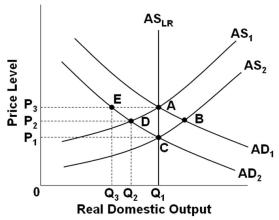 Refer to the above graph. Assume that the economy is in initial equilibrium where AD1 intersects AS1. If there is a decrease in aggregate demand to AD2, then according to mainstream economists, if prices and wages are not flexible, this will result in an equilibrium at point:
 (Multiple Choice)
4.9/5 (90)
(90) New classical economists see the economy as incapable of self-correction when disturbed and pushed away from its full-employment level of real output.
(True/False)
4.8/5 (88)
(88) One of the basic assumptions of rational expectations theory is that:
(Multiple Choice)
4.7/5 (78)
(78) According to mainstream economists the basic determinant of real output, employment, and the price level is:
(Multiple Choice)
4.8/5 (79)
(79) Mainstream economists believe that economic instability is primarily due to unexpected changes in consumer spending.
(True/False)
4.9/5 (74)
(74) Monetarists base their assessment of the speed of adjustment for self-correction in the economy on:
(Multiple Choice)
4.8/5 (64)
(64) Which of the following is the basic equation underlying aggregate expenditures?
(Multiple Choice)
4.9/5 (75)
(75) 
Filters
- Essay(0)
- Multiple Choice(0)
- Short Answer(0)
- True False(0)
- Matching(0)