



 Chat with AI
Exam 19: Current Issues in Macro Theory and Policy

Exam 1: Limits, Alternatives, and Choices212 Questions
Exam 2: The Market System and the Circular Flow141 Questions
Exam 3: Demand, Supply, and Market Equilibrium202 Questions
Exam 4: Market Failures: Public Goods and Externalities155 Questions
Exam 5: Governments Role and Government Failure148 Questions
Exam 6: An Introduction to Macroeconomics123 Questions
Exam 7: Measuring Domestic Output and National Income157 Questions
Exam 8: Economic Growth114 Questions
Exam 9: Business Cycles, Unemployment, and Inflation143 Questions
Exam 10: Basic Macroeconomic Relationships142 Questions
Exam 11: The Aggregate Expenditures Model143 Questions
Exam 12: Aggregate Demand and Aggregate Supply152 Questions
Exam 13: Fiscal Policy, Deficits, and Debt164 Questions
Exam 14: Money, Banking, and Financial Institutions130 Questions
Exam 15: Money Creation127 Questions
Exam 16: Interest Rates and Monetary Policy174 Questions
Exam 17: Financial Economics136 Questions
Exam 18: Extending the Analysis of Aggregate Supply135 Questions
Exam 19: Current Issues in Macro Theory and Policy134 Questions
Exam 20: International Trade151 Questions
Exam 21: The Balance of Payments, Exchange Rates, and Trade Deficits152 Questions
Exam 22: The Economics of Developing Countries135 Questions
Select questions type


The idea that business fluctuations are primarily caused by factors affecting aggregate supply rather than aggregate demand is a central tenet of:
(Multiple Choice)
4.8/5  (97)
(97) 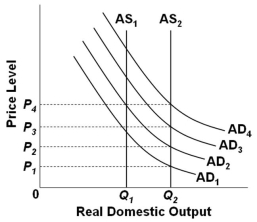 Refer to the graph above. Assume that the economy is initially in equilibrium at the intersection of AD1 and AS1. Suppose that there is economic growth which shifts AS1 to AS2. Mainstream economists would suggest that the application of a monetary rule to keep prices constant might produce demand-pull inflation because the investment spending might:
 (Multiple Choice)
4.9/5 (79)
(79) Real-business cycle theory views changes in resource availability and technology as shifting aggregate demand and thus causing macroeconomic instability.
(True/False)
4.9/5 (81)
(81) From a rational expectations perspective, an easy money policy is likely to be completely:
(Multiple Choice)
4.8/5 (84)
(84) From the mainstream perspective, instability in the economy is due to:
(Multiple Choice)
4.9/5 (93)
(93) Rational expectations theory suggests that people make consistent forecasting errors regarding the effects of policy.
(True/False)
4.9/5 (90)
(90) Which of the following contributes to the downward inflexibility of wages, according to mainstream economists?
(Multiple Choice)
5.0/5 (83)
(83) 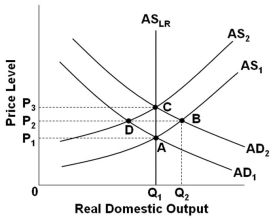 Refer to the graph above. Assume that the economy is in initial equilibrium where AD1 intersects AS1. If there is an unanticipated increase in aggregate demand and the economy self-corrects, then the adaptive-expectations adjustment path would go from point:
 (Multiple Choice)
4.9/5 (76)
(76) Which of the following economic perspectives would be most opposed to a balanced-budget rule?
(Multiple Choice)
4.9/5 (89)
(89) In real-business-cycle theory, real output can change without a change in the price level.
(True/False)
4.9/5 (81)
(81) Monetarists recommend that the supply of money should be increased at a constant rate each year, proportionate with the long-run growth of real output.
(True/False)
4.9/5 (98)
(98) 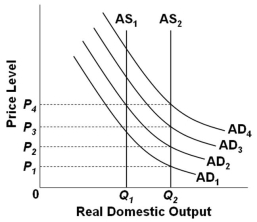 Refer to the graph above. Assume that the economy is initially in equilibrium at the intersection of AD1 and AS1. Suppose that there is economic growth which shifts AS1 to AS2. With the shift from AS1 to AS2, the monetary rule would call for an increase in the money supply such that:
 (Multiple Choice)
4.9/5 (80)
(80) 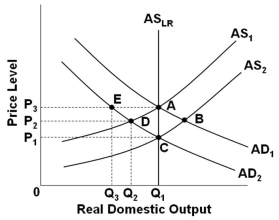 Refer to the graph above. Assume that the economy is in initial equilibrium where AD1 intersects AS1. If there is an unanticipated decrease in aggregate demand to AD2, then in the view of new classical economics the economy will:
 (Multiple Choice)
4.8/5 (75)
(75) Mainstream economists contend that monetary policy tends to be destabilizing, in contrast to monetarists who believe that monetary policy is a stabilizing factor.
(True/False)
4.9/5 (70)
(70) In rational expectations theory, a fully anticipated change in aggregate demand or in the price level results in no change in real output.
(True/False)
4.9/5 (71)
(71) One reason why the lowest wage rate is not necessarily the same as the efficiency wage is that workers might:
(Multiple Choice)
4.9/5 (84)
(84) 
Filters
- Essay(0)
- Multiple Choice(0)
- Short Answer(0)
- True False(0)
- Matching(0)