



 Chat with AI
Exam 4: Equilibrium

Exam 1: The Big Ideas253 Questions
Exam 2: The Power of Trade and Comparative239 Questions
Exam 3: Supply and Demand249 Questions
Exam 4: Equilibrium256 Questions
Exam 5: Elasticity and Its Applications271 Questions
Exam 6: Taxes and Subsidies225 Questions
Exam 7: The Price System275 Questions
Exam 8: Price Ceilings and Floors327 Questions
Exam 9: International Trade195 Questions
Exam 10: Externalities- When the Price Is Not Right273 Questions
Exam 11: Costs and Profit Maximization Under Competition217 Questions
Exam 12: Competition and the Invisible Hand144 Questions
Exam 13: Monopoly233 Questions
Exam 14: Price Discrimination262 Questions
Exam 15: Oligopoly and Game Theory218 Questions
Exam 16: Competing for Monopoly160 Questions
Exam 17: Monopolistic Competition and Advertising113 Questions
Exam 18: Labor Markets262 Questions
Exam 19: Public Goods and the Tragedy of the Commons244 Questions
Exam 20: Political Economy and Public Choice306 Questions
Exam 21: Economics, Ethics, and Public Policy241 Questions
Exam 22: Managing Incentives263 Questions
Exam 23: Stock Markets and Personal Finance271 Questions
Exam 24: Price Discrimination151 Questions
Exam 25: Consumer Choice145 Questions
Select questions type


Suppose that a market is characterized as follows: consumers are willing and able to purchase 100 units and sellers are willing and able to sell 70 units. Which of the following statements are true?
(Multiple Choice)
4.7/5  (84)
(84) In markets for manufactured goods, a new form of 3-D printing that lowers production costs will lead to:
(Multiple Choice)
4.8/5 (84)
(84) If the demand increases, what happens with the supply curve?
(Multiple Choice)
4.8/5 (79)
(79) The equilibrium price will increase if demand and supply both increase by equal amounts.
(True/False)
4.9/5 (77)
(77) Use the following to answer questions:
Figure: Price and Quantity 2 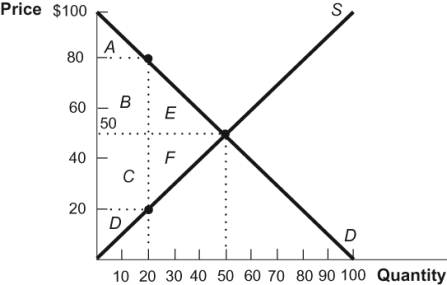 -(Figure: Price and Quantity 2) At a cost of $20 per unit in the diagram, the value of the unexploited gains from trade is represented by areas:
 (Multiple Choice)
4.8/5 (75)
(75) When demand increases there is a ______ at the old equilibrium price, which puts ______ pressure on price until the market reaches the new equilibrium.
(Multiple Choice)
4.8/5 (74)
(74) A market can be described by the equations Qd = 100 - P and Qs = -20 + P. At a price of $40, will this market experience a shortage or a surplus and what is the amount of this shortage or surplus?
(Essay)
4.9/5 (82)
(82) Use the following to answer questions:
Figure: Demand, Supply Shifts  -(Figure: Demand, Supply Shifts) In the figure, the initial demand curve is D1 and the initial supply curve is S1. Suppose this depicts the market for corn. How does the market change when flooding in Iowa destroys a significant amount of the corn crop.
 (Multiple Choice)
4.9/5 (73)
(73) Before his pioneering experiments on market equilibrium, Vernon Smith believed that the market equilibrium concept:
(Multiple Choice)
4.8/5 (63)
(63) The growing economies of China and India have increased the demand for:
(Multiple Choice)
5.0/5 (88)
(88) When there is a shortage, sellers have an incentive to ______ their price and buyers have an incentive to offer a ______ price.
(Multiple Choice)
4.8/5 (84)
(84) Consumers who traded in a used car for a new vehicle under the Cash-for-Clunkers program received a voucher worth up to $4,500 to offset the price of the consumer's new vehicle. What effect did that program's requirement to destroy all trade-in cars have on the market for used cars?
(Multiple Choice)
4.9/5 (70)
(70) When the price of a good increases, demand for the good will:
(Multiple Choice)
5.0/5 (74)
(74) Use the following to answer questions:
Figure: Demand, Supply Shifts
-(Figure: Demand, Supply Shifts) In the figure, the initial demand curve is D1 and the initial supply curve is S1. If technological innovations lower the costs of production, what will happen?
-(Figure: Demand, Supply Shifts) In the figure, the initial demand curve is D1 and the initial supply curve is S1. If technological innovations lower the costs of production, what will happen? (Multiple Choice)
4.9/5 (73)
(73) If a frost destroys half of the orange crop in Florida, the equilibrium price of oranges will rise.
(True/False)
4.9/5 (78)
(78) A decrease in demand for a good will lead to a decrease in the price of the good, but an increase in the quantity supplied.
(True/False)
4.8/5 (77)
(77) For most of human history, salt was a rare and valuable commodity that had to be either mined or extracted from the ocean through evaporation. This changed when modern chemistry allowed humans to produce it in factories. How did this development affect the market for salt?
(Multiple Choice)
4.9/5 (77)
(77) 
Filters
- Essay(0)
- Multiple Choice(0)
- Short Answer(0)
- True False(0)
- Matching(0)