



 Chat with AI
Exam 4: Equilibrium

Exam 1: The Big Ideas253 Questions
Exam 2: The Power of Trade and Comparative239 Questions
Exam 3: Supply and Demand249 Questions
Exam 4: Equilibrium256 Questions
Exam 5: Elasticity and Its Applications271 Questions
Exam 6: Taxes and Subsidies225 Questions
Exam 7: The Price System275 Questions
Exam 8: Price Ceilings and Floors327 Questions
Exam 9: International Trade195 Questions
Exam 10: Externalities- When the Price Is Not Right273 Questions
Exam 11: Costs and Profit Maximization Under Competition217 Questions
Exam 12: Competition and the Invisible Hand144 Questions
Exam 13: Monopoly233 Questions
Exam 14: Price Discrimination262 Questions
Exam 15: Oligopoly and Game Theory218 Questions
Exam 16: Competing for Monopoly160 Questions
Exam 17: Monopolistic Competition and Advertising113 Questions
Exam 18: Labor Markets262 Questions
Exam 19: Public Goods and the Tragedy of the Commons244 Questions
Exam 20: Political Economy and Public Choice306 Questions
Exam 21: Economics, Ethics, and Public Policy241 Questions
Exam 22: Managing Incentives263 Questions
Exam 23: Stock Markets and Personal Finance271 Questions
Exam 24: Price Discrimination151 Questions
Exam 25: Consumer Choice145 Questions
Select questions type


When there is an excess supply in the market, competition will:
(Multiple Choice)
4.8/5  (86)
(86) Consider the market for electric guitars, a normal good. Use well-labeled supply and demand diagrams to illustrate the effects of the following events on the market for electric guitars.
a. Consumer income increases.
b. The price of wood increases.
c. The price of electric amplifiers decreases.
d. There is a decrease in the price of bass guitars, a substitute for electric guitars.
e. The government eliminates taxes on the producers of electric guitars.
f. Many new electric guitar companies are started by an influx of immigrants.
(Essay)
4.7/5 (80)
(80) Use the following to answer questions:
Figure: Price and Quantity 1  -(Figure: Price and Quantity 1) In the diagram, at which price is quantity demanded equal to the quantity supplied?
 (Multiple Choice)
4.9/5 (83)
(83) Lead, an input in the production of ammunition, increased in price from $0.60/lb in 2006 to over $1.50/lb in 2007. A possible explanation for this is that demand has increased faster than supply has increased.
(True/False)
4.9/5 (73)
(73) An increase in demand and a decrease in supply occur in a market. What happens to the equilibrium price and quantity?
(Multiple Choice)
4.9/5 (90)
(90) In a market, the equilibrium condition is given by the following:
(Multiple Choice)
4.7/5 (81)
(81) A decrease in the supply of milk will lead to a decrease in the QUANTITY DEMANDED of milk.
(True/False)
4.9/5 (91)
(91) The equilibrium price is unstable because sellers have an incentive to lower their price to sell more goods.
(True/False)
4.8/5 (87)
(87) If supply decreases and its slope remains the same, consumer surplus:
(Multiple Choice)
4.8/5 (76)
(76) The price of gasoline decreased dramatically in the summer of 2009. One likely reason for this change is:
(Multiple Choice)
5.0/5 (95)
(95) Figure: Supply-Driven Price Change 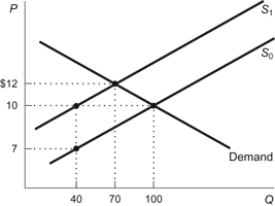 Refer to the figure. When the supply curve shifts from S0 to S1, the equilibrium price rises to:
 (Multiple Choice)
4.8/5 (83)
(83) If the market price is above the equilibrium price, which of the following will occur?
(Multiple Choice)
4.9/5 (86)
(86) When the quantity supplied of a good exceeds the quantity demanded, there is a(n):
(Multiple Choice)
4.7/5 (84)
(84) Imagine a free market in which quantity supplied is 40 units and quantity demanded is 50 units at the current price. The market is experiencing a(n):
(Multiple Choice)
4.8/5 (80)
(80) Figure: Demand-Driven Price Change 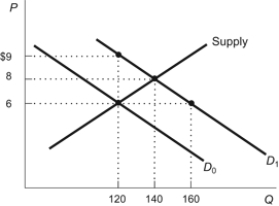 Refer to the figure. When the demand curve shifts from D0 to D1, the equilibrium price rises to:
 (Multiple Choice)
4.9/5 (88)
(88) 
Filters
- Essay(0)
- Multiple Choice(0)
- Short Answer(0)
- True False(0)
- Matching(0)