



 Chat with AI
Exam 4: Equilibrium

Exam 1: The Big Ideas253 Questions
Exam 2: The Power of Trade and Comparative239 Questions
Exam 3: Supply and Demand249 Questions
Exam 4: Equilibrium256 Questions
Exam 5: Elasticity and Its Applications271 Questions
Exam 6: Taxes and Subsidies225 Questions
Exam 7: The Price System275 Questions
Exam 8: Price Ceilings and Floors327 Questions
Exam 9: International Trade195 Questions
Exam 10: Externalities- When the Price Is Not Right273 Questions
Exam 11: Costs and Profit Maximization Under Competition217 Questions
Exam 12: Competition and the Invisible Hand144 Questions
Exam 13: Monopoly233 Questions
Exam 14: Price Discrimination262 Questions
Exam 15: Oligopoly and Game Theory218 Questions
Exam 16: Competing for Monopoly160 Questions
Exam 17: Monopolistic Competition and Advertising113 Questions
Exam 18: Labor Markets262 Questions
Exam 19: Public Goods and the Tragedy of the Commons244 Questions
Exam 20: Political Economy and Public Choice306 Questions
Exam 21: Economics, Ethics, and Public Policy241 Questions
Exam 22: Managing Incentives263 Questions
Exam 23: Stock Markets and Personal Finance271 Questions
Exam 24: Price Discrimination151 Questions
Exam 25: Consumer Choice145 Questions
Select questions type


Figure: Supply and Demand 1 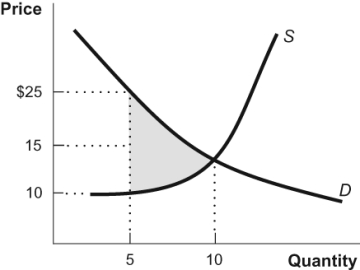 At a market quantity of 5, the shaded region in the figure represents:
 (Multiple Choice)
5.0/5  (85)
(85) An increase in demand causes an increase in quantity supplied, which causes a decrease in price.
(True/False)
4.7/5 (91)
(91) Gains from trade are maximized in a competitive market when:
(Multiple Choice)
4.9/5 (83)
(83) Suppose the price of oil is falling due to a drop-off in demand after the summer driving season. Explain what a group of oil-producing nations (like OPEC) that control a significant amount of the world's oil supplies could do in order to keep prices (and hence profits) high.
(Essay)
4.8/5 (67)
(67) The September 11 terrorist attacks turned many people away from flying. The demand and supply model would predict which of the following events in the airline travel market?
(Multiple Choice)
4.8/5 (80)
(80) Imagine a free market in equilibrium. After a sudden decrease in supply (but before the price can adjust), the market experiences a:
(Multiple Choice)
4.8/5 (77)
(77) Following the release of a new study showing even more benefits to drinking red wine, economists expect:
(Multiple Choice)
4.8/5 (77)
(77) In 1980 when Iraq attacked Iran, the price of oil _______ because of a(n) ______.
(Multiple Choice)
4.9/5 (82)
(82) If the government institutes a tax on suppliers of Cheesy-Poofs, the market for Cheesy-Poofs will see:
(Multiple Choice)
5.0/5 (72)
(72) If the equilibrium quantity in a market is 200, resources will be wasted and society made poorer if 250 units are produced.
(True/False)
4.7/5 (80)
(80) The key condition for equilibrium to occur in a market is:
(Multiple Choice)
4.7/5 (90)
(90) Economic experiments suggest that the real world closely follows theoretical supply and demand.
(True/False)
4.8/5 (79)
(79) In a free market equilibrium, the gains from trade are always greater for consumers than for producers.
(True/False)
4.9/5 (91)
(91) For suppliers to sell more than the equilibrium quantity, it would mean that:
(Multiple Choice)
4.8/5 (77)
(77) What is the difference between a change in the demand and a change in quantity demanded?
(Multiple Choice)
4.9/5 (90)
(90) Imagine a free market in equilibrium. After a sudden decrease in demand (but before the price can adjust), the market experiences a:
(Multiple Choice)
4.7/5 (88)
(88) What can cause both equilibrium price and quantity to increase?
(Multiple Choice)
4.9/5 (91)
(91) 
Filters
- Essay(0)
- Multiple Choice(0)
- Short Answer(0)
- True False(0)
- Matching(0)