



 Chat with AI
Exam 4: Equilibrium

Exam 1: The Big Ideas253 Questions
Exam 2: The Power of Trade and Comparative239 Questions
Exam 3: Supply and Demand249 Questions
Exam 4: Equilibrium256 Questions
Exam 5: Elasticity and Its Applications271 Questions
Exam 6: Taxes and Subsidies225 Questions
Exam 7: The Price System275 Questions
Exam 8: Price Ceilings and Floors327 Questions
Exam 9: International Trade195 Questions
Exam 10: Externalities- When the Price Is Not Right273 Questions
Exam 11: Costs and Profit Maximization Under Competition217 Questions
Exam 12: Competition and the Invisible Hand144 Questions
Exam 13: Monopoly233 Questions
Exam 14: Price Discrimination262 Questions
Exam 15: Oligopoly and Game Theory218 Questions
Exam 16: Competing for Monopoly160 Questions
Exam 17: Monopolistic Competition and Advertising113 Questions
Exam 18: Labor Markets262 Questions
Exam 19: Public Goods and the Tragedy of the Commons244 Questions
Exam 20: Political Economy and Public Choice306 Questions
Exam 21: Economics, Ethics, and Public Policy241 Questions
Exam 22: Managing Incentives263 Questions
Exam 23: Stock Markets and Personal Finance271 Questions
Exam 24: Price Discrimination151 Questions
Exam 25: Consumer Choice145 Questions
Select questions type


Imagine a free market in equilibrium. After a sudden increase in supply (but before the price can adjust), the market experiences a:
(Multiple Choice)
4.9/5  (80)
(80) If demand decreases, ceteris paribus, the quantity exchanged will be ______ at the new market equilibrium point.
(Multiple Choice)
4.8/5 (70)
(70) If firms produce a quantity that is greater than the equilibrium quantity, then unexploited gains from trade exist.
(True/False)
4.9/5 (82)
(82) Imagine a free market in which at a price of $10, quantity supplied is 40 units and quantity demanded is 50 units. Equilibrium price in this market:
(Multiple Choice)
4.9/5 (81)
(81) The equilibrium price and quantity are the only price and quantity that are stable in a free market.
(True/False)
4.8/5 (79)
(79) Use the following to answer questions:
Figure: Price and Quantity 3 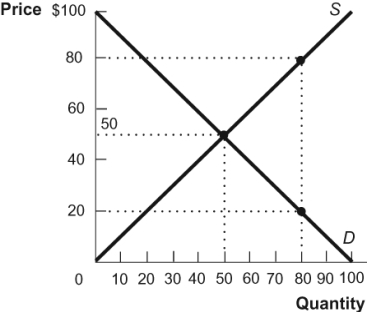 -(Figure: Price and Quantity 3) At a quantity of 80 units in the figure, it cost sellers ______ to produce the last unit, but buyers value this last unit at ______.
 (Multiple Choice)
4.9/5 (74)
(74) Five new sellers enter a market (that previously had seven) and begin producing a good. Which of the following choices explains what happens to the equilibrium Q and P?
(Multiple Choice)
4.9/5 (74)
(74) After adjusting for inflation, a comparison of the price of leg warmers reveals that the price of leg warmers was significantly higher in the 1980s than it is today. Which of the following can explain this?
(Multiple Choice)
4.8/5 (67)
(67) Draw a market demand curve and market supply curve for automobiles and label these curves D1 and S1, respectively. (Be sure to label all axes!) On the same graph, show what would happen if the auto workers union required all manufacturers of automobiles to now provide health insurance for ALL workers and their dependents. (Note: Assume that prior to this change, manufacturers of automobiles do NOT provide health insurance coverage to 100 percent of their employees and/or their dependents.) What do you expect to happen to the price of automobiles as a result of this change in union policy?
(Essay)
4.9/5 (70)
(70) Use the following to answer questions:
Figure: Price and Quantity 1  -(Figure: Price and Quantity 1) In the diagram, at which price is there a surplus?
 (Multiple Choice)
5.0/5 (81)
(81) Figure: Supply Shift 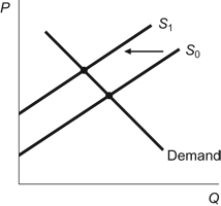 In the figure, the supply curve shifted from S0 to S1. To describe this movement, we would say that:
 (Multiple Choice)
4.9/5 (86)
(86) In the market for a normal good, an increase in income will cause an increase in ______, an increase in quantity ______, and a(n) ______ in price.
(Multiple Choice)
4.8/5 (81)
(81) For each good produced in a free market economy, demand and supply determine:
(Multiple Choice)
4.8/5 (87)
(87) Use the following to answer questions:
Figure: Basic Supply and Demand  -(Figure: Basic Supply and Demand) In the diagram, which of the following statements is TRUE?
 (Multiple Choice)
4.9/5 (80)
(80) Gains from trade will be maximized at the free market equilibrium price and quantity because the supply of goods is:
(Multiple Choice)
4.8/5 (83)
(83) If market transactions equal the equilibrium quantity, there may still be unexploited gains from trade.
(True/False)
4.9/5 (90)
(90) 
Filters
- Essay(0)
- Multiple Choice(0)
- Short Answer(0)
- True False(0)
- Matching(0)