



 Chat with AI
Exam 4: Equilibrium

Exam 1: The Big Ideas253 Questions
Exam 2: The Power of Trade and Comparative239 Questions
Exam 3: Supply and Demand249 Questions
Exam 4: Equilibrium256 Questions
Exam 5: Elasticity and Its Applications271 Questions
Exam 6: Taxes and Subsidies225 Questions
Exam 7: The Price System275 Questions
Exam 8: Price Ceilings and Floors327 Questions
Exam 9: International Trade195 Questions
Exam 10: Externalities- When the Price Is Not Right273 Questions
Exam 11: Costs and Profit Maximization Under Competition217 Questions
Exam 12: Competition and the Invisible Hand144 Questions
Exam 13: Monopoly233 Questions
Exam 14: Price Discrimination262 Questions
Exam 15: Oligopoly and Game Theory218 Questions
Exam 16: Competing for Monopoly160 Questions
Exam 17: Monopolistic Competition and Advertising113 Questions
Exam 18: Labor Markets262 Questions
Exam 19: Public Goods and the Tragedy of the Commons244 Questions
Exam 20: Political Economy and Public Choice306 Questions
Exam 21: Economics, Ethics, and Public Policy241 Questions
Exam 22: Managing Incentives263 Questions
Exam 23: Stock Markets and Personal Finance271 Questions
Exam 24: Price Discrimination151 Questions
Exam 25: Consumer Choice145 Questions
Select questions type


Use the following to answer questions:
Figure: Basic Supply and Demand 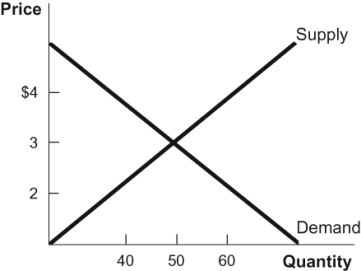 -(Figure: Basic Supply and Demand) In the diagram, the market price is stable only at a price of:
 (Multiple Choice)
4.7/5  (63)
(63) A shortage occurs when consumers want to buy more goods than sellers are making available.
(True/False)
4.9/5 (95)
(95) With an equilibrium price of $10, a price of $10.99 would create an excess supply.
(True/False)
4.9/5 (76)
(76) If the market price is below the equilibrium price, which of the following will occur?
(Multiple Choice)
5.0/5 (77)
(77) When there is a surplus, sellers have an incentive to ______ their price and buyers have an incentive to offer a ______ price.
(Multiple Choice)
4.9/5 (77)
(77) Imagine a free market in which at a price of $10, quantity supplied is 50 units and quantity demanded is 50 units. Equilibrium price in this market:
(Multiple Choice)
4.8/5 (81)
(81) When a surplus exists in a market, we know that the actual price is:
(Multiple Choice)
4.8/5 (68)
(68) Use the following to answer questions:
Figure: Basic Supply and Demand
-(Figure: Basic Supply and Demand) In the diagram, which of the following statements is TRUE?
-(Figure: Basic Supply and Demand) In the diagram, which of the following statements is TRUE? (Multiple Choice)
4.8/5 (69)
(69) If scientists discover a new form of energy that cuts the cost of producing electricity to the equivalent of $10 a barrel, what will happen to the market for oil?
(Multiple Choice)
4.9/5 (71)
(71) A technological innovation in the production of golf balls increases ______, causing the price to ______ and the ______.
(Multiple Choice)
4.9/5 (80)
(80) In a free market, the market moves to an equilibrium because buyers compete against sellers to get the lowest possible prices.
(True/False)
4.9/5 (81)
(81) Use the following to answer questions:
Figure: Market Changes  -(Figure: Market Changes) Refer to the figures. If these figures represent the market for new cars, which figure shows the effect of an economic recession?
 (Multiple Choice)
4.8/5 (69)
(69) The price of professional sports tickets is high; therefore, you should blame the owners for taking advantage of the fans, not the other buyers for outbidding you.
(True/False)
4.9/5 (84)
(84) In a market diagram, demand and supply cross each other at the equilibrium point.
(True/False)
4.8/5 (84)
(84) 
Filters
- Essay(0)
- Multiple Choice(0)
- Short Answer(0)
- True False(0)
- Matching(0)