



 Chat with AI
Exam 16: Lipid Metabolism

Exam 1: Principles of Biochemistry98 Questions
Exam 2: Physical Biochemistry: Energy Conversion,water,and Membranes99 Questions
Exam 3: Nucleic Acid Structure and Function100 Questions
Exam 4: Protein Structure100 Questions
Exam 5: Methods in Protein Biochemistry98 Questions
Exam 6: Protein Function113 Questions
Exam 7: Enzyme Mechanisms105 Questions
Exam 8: Cell Signaling Systems102 Questions
Exam 9: Glycolysis: a Paradigm of Metabolic Regulation100 Questions
Exam 10: The Citrate Cycle100 Questions
Exam 11: Oxidative Phosphorylation98 Questions
Exam 12: Photosynthesis100 Questions
Exam 13: Carbohydrate Structure and Function100 Questions
Exam 14: Carbohydrate Metabolism100 Questions
Exam 15: Lipid Structure and Function98 Questions
Exam 16: Lipid Metabolism100 Questions
Exam 17: Amino Acid Metabolism100 Questions
Exam 18: Nucleotide Metabolism98 Questions
Exam 19: Metabolic Integration101 Questions
Exam 20: Dna Replication, repair, and Recombination99 Questions
Exam 21: Rna Synthesis, processing, and Gene Silencing100 Questions
Exam 22: Protein Synthesis, posttranslational Modification, and Transport100 Questions
Exam 23: Gene Regulation99 Questions
Select questions type


In the fatty acid synthesis pathway,how many ATPs and NADPHs are needed to add two carbons to the growing fatty acid chain starting with an acetyl-CoA?
(Essay)
4.8/5  (75)
(75) In triacylglycerol synthesis,from where is the glycerol backbone derived?
(Multiple Choice)
4.9/5 (96)
(96) Which fatty acid can be synthesized from scratch in humans by desaturase enzymes?
(Multiple Choice)
4.9/5 (69)
(69) How many more enzymes does the oxidation of a polyunsaturated fat such as linoleoyl-CoA (18:2)require than the oxidation of stearoyl-CoA (18:0)?
(Multiple Choice)
4.8/5 (79)
(79) Describe the role that AMP-activated protein kinase (AMPK)plays in the regulation of fatty acid synthesis.
(Essay)
4.8/5 (80)
(80) List the five classes of lipoproteins and briefly state the body origin of each.
(Essay)
4.9/5 (87)
(87) Draw the structure of malonyl-CoA,the activated form of acetyl-CoA for fatty acid synthesis.
(Essay)
4.9/5 (77)
(77) About __________ more ATPs can be obtained from one 16:0 fatty acid than from one glucose molecule.
(Multiple Choice)
4.9/5 (90)
(90) How many passes through the fatty acid oxidation pathway are required to degrade palmitic acid?
(Multiple Choice)
4.8/5 (86)
(86) Diagram the process by which the palmitoyl-CoA molecule moves from the cytosol into the mitochondria for degradation.
(Essay)
4.9/5 (69)
(69) Which of the following do  -oxidation and fatty acid synthesis have in common?
 (Multiple Choice)
4.9/5 (80)
(80) Cholesterol biosynthesis and cholesterol uptake is stimulated by
(Multiple Choice)
4.8/5 (87)
(87) By what process are LDL particles removed selectively from the blood serum?
(Multiple Choice)
4.7/5 (90)
(90) Identify the name of the group shown below that is common to CoA and the acyl carrier protein. 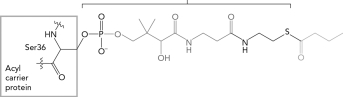
(Short Answer)
4.9/5 (81)
(81) How many acetyl-CoAs per ketone body are delivered to cells in need of energy?
(Multiple Choice)
4.9/5 (81)
(81) The same four reactions that are central to the  -oxidation pathway are also present in the fatty acid synthesis pathway,except they are reversed.What is a key difference between the four reactions in these two pathways?
 (Multiple Choice)
4.7/5 (95)
(95) Which cofactor is utilized in the following fatty acid oxidation reaction? 
(Multiple Choice)
4.7/5 (68)
(68) How many more enzymes does the oxidation of oleoyl-CoA (18:1)require than the oxidation of stearoyl-CoA (18:0)?
(Multiple Choice)
4.9/5 (79)
(79) The complete  -oxidation of 1 mole of palmitic acid (16:0)yields __________ moles of ATP after TCA cycle and oxidative phosphorylation processes.
 (Multiple Choice)
4.9/5 (78)
(78) 
Filters
- Essay(0)
- Multiple Choice(0)
- Short Answer(0)
- True False(0)
- Matching(0)