



 Chat with AI
Exam 4: Economic Efficiency, government Price Setting, and Taxes

Exam 1: Economics: Foundations and Models142 Questions
Exam 2: Trade-Offs, comparative Advantage, and the Market System152 Questions
Exam 3: Where Prices Come From: the Interaction of Demand and Supply149 Questions
Exam 4: Economic Efficiency, government Price Setting, and Taxes137 Questions
Exam 5: Externalities, environmental Policy, and Public Goods139 Questions
Exam 6: Elasticity: The Responsiveness of Demand and Supply149 Questions
Exam 7: The Economics of Health Care117 Questions
Exam 8: Firms, the Stock Market, and Corporate Governance140 Questions
Exam 9: Comparative Advantage and the Gains From International Trade124 Questions
Exam 10: Consumer Choice and Behavioral Economics154 Questions
Exam 11: Technology, production, and Costs174 Questions
Exam 12: Firms in Perfectly Competitive Markets153 Questions
Exam 13: Monopolistic Competition: The Competitive Model in a More Realistic Setting137 Questions
Exam 14: Oligopoly: Firms in Less Competitive Markets129 Questions
Exam 15: Monopoly and Antitrust Policy148 Questions
Exam 16: Pricing Strategy134 Questions
Exam 17: The Markets for Labor and Other Factors of Production149 Questions
Exam 18: Public Choice, taxes, and the Distribution of Income134 Questions
Exam 19: GDP: Measuring Total Production and Income135 Questions
Exam 20: Unemployment and Inflation148 Questions
Exam 21: Economic Growth, the Financial System, and Business Cycles130 Questions
Exam 22: Long-Run Economic Growth: Sources and Policies134 Questions
Exam 23: Aggregate Expenditure and Output in the Short Run157 Questions
Exam 24: Aggregate Demand and Aggregate Supply Analysis145 Questions
Exam 25: Money, banks, and the Federal Reserve System144 Questions
Exam 26: Monetary Policy145 Questions
Exam 27: Fiscal Policy155 Questions
Exam 28: Inflation, unemployment, and Federal Reserve Policy135 Questions
Exam 29: Macroeconomics in an Open Economy145 Questions
Exam 30: The International Financial System139 Questions
Select questions type


Congress passed the ________ in 1996,the purpose of which was to phase out price floors and return to a free market in agriculture
(Multiple Choice)
4.8/5  (76)
(76) Figure 4-10 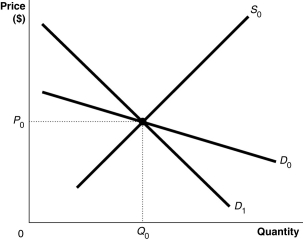 -Refer to Figure 4-10.Suppose the market is initially in equilibrium at price P0 and then the government imposes a tax on every unit sold.Which of the following statements best describes the impact of the tax?
 (Multiple Choice)
4.7/5 (86)
(86) Figure 4-12 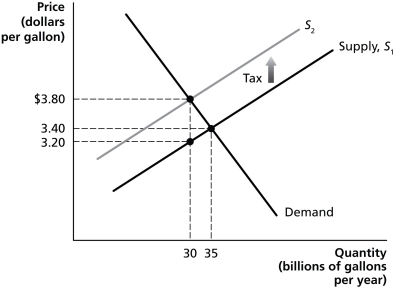 -Refer to Figure 4-12.The figure above represents demand and supply in the market for gasoline.Use the diagram to answer the following questions.
a.How much is the government tax on each gallon of gasoline?
b.What portion of the unit tax is paid by consumers?
c.What portion of the unit tax is paid by producers?
d.What is the quantity sold after the imposition of the tax?
e.What is the after-tax revenue per gallon received by producers?
f.What is the total tax revenue collected by the government?
g.What is the value of the excess burden of the tax?
h.Is this gasoline tax efficient?
-Refer to Figure 4-12.The figure above represents demand and supply in the market for gasoline.Use the diagram to answer the following questions.
a.How much is the government tax on each gallon of gasoline?
b.What portion of the unit tax is paid by consumers?
c.What portion of the unit tax is paid by producers?
d.What is the quantity sold after the imposition of the tax?
e.What is the after-tax revenue per gallon received by producers?
f.What is the total tax revenue collected by the government?
g.What is the value of the excess burden of the tax?
h.Is this gasoline tax efficient? (Essay)
4.7/5 (68)
(68) Figure 4-5  Figure 4-5 shows the market for apartments in Springfield. Recently, the government imposed a rent ceiling of $1,000 per month.
-Refer to Figure 4-5.With rent control,the quantity supplied is 200 apartments.Suppose apartment owners ignore the law and rent this quantity for the highest rent they can get.What is the highest rent they can get per month?
Figure 4-5 shows the market for apartments in Springfield. Recently, the government imposed a rent ceiling of $1,000 per month.
-Refer to Figure 4-5.With rent control,the quantity supplied is 200 apartments.Suppose apartment owners ignore the law and rent this quantity for the highest rent they can get.What is the highest rent they can get per month? (Multiple Choice)
4.9/5 (85)
(85) The government proposes a tax on imported champagne.Buyers will bear the entire burden of the tax if the
(Multiple Choice)
4.9/5 (87)
(87) Suppose the demand curve for a product is horizontal and the supply curve is upward sloping.If a unit tax is imposed in the market for this product,
(Multiple Choice)
4.8/5 (81)
(81) Figure 4-8  Figure 4-8 shows the market for beer. The government plans to impose a unit tax in this market.
-Refer to Figure 4-8.What is the size of the unit tax?
Figure 4-8 shows the market for beer. The government plans to impose a unit tax in this market.
-Refer to Figure 4-8.What is the size of the unit tax? (Multiple Choice)
4.9/5 (75)
(75) Table 4-5
 -Refer to Table 4-5.The equations above describe the demand and supply for Chef Ernie's Sushi-on-a-Stick.The equilibrium price and quantity for Chef Ernie's sushi are $60 and 20 thousand units.What is the value of producer surplus?
 (Multiple Choice)
4.7/5 (86)
(86) Economists refer a to a market where buying and selling take place at prices that violate government price regulations as
(Multiple Choice)
4.7/5 (78)
(78) If the quantity of donuts supplied is represented by the equation QS = -15 + 5P then the corresponding price of donuts is represented by the equation
(Multiple Choice)
4.8/5 (88)
(88) The total amount of consumer surplus in a market is equal to the area below the demand curve.
(True/False)
5.0/5 (87)
(87) ________ refers to the reduction in economic surplus resulting from not being in competitive equilibrium.
(Multiple Choice)
5.0/5 (79)
(79) Figure 4-3  Figure 4-3 shows the market for tiger shrimp. The market is initially in equilibrium at a price of $15 and a quantity of 80. Now suppose producers decide to cut output to 40 in order to raise the price to $18.
-Refer to Figure 4-3.What is the value of producer surplus at a price of $18??
Figure 4-3 shows the market for tiger shrimp. The market is initially in equilibrium at a price of $15 and a quantity of 80. Now suppose producers decide to cut output to 40 in order to raise the price to $18.
-Refer to Figure 4-3.What is the value of producer surplus at a price of $18?? (Multiple Choice)
4.8/5 (84)
(84) A tax that imposes a small excess burden relative to the tax revenue that it raises is
(Multiple Choice)
5.0/5 (76)
(76) 
Filters
- Essay(0)
- Multiple Choice(0)
- Short Answer(0)
- True False(0)
- Matching(0)