



 Chat with AI
Exam 4: Economic Efficiency, government Price Setting, and Taxes

Exam 1: Economics: Foundations and Models142 Questions
Exam 2: Trade-Offs, comparative Advantage, and the Market System152 Questions
Exam 3: Where Prices Come From: the Interaction of Demand and Supply149 Questions
Exam 4: Economic Efficiency, government Price Setting, and Taxes137 Questions
Exam 5: Externalities, environmental Policy, and Public Goods139 Questions
Exam 6: Elasticity: The Responsiveness of Demand and Supply149 Questions
Exam 7: The Economics of Health Care117 Questions
Exam 8: Firms, the Stock Market, and Corporate Governance140 Questions
Exam 9: Comparative Advantage and the Gains From International Trade124 Questions
Exam 10: Consumer Choice and Behavioral Economics154 Questions
Exam 11: Technology, production, and Costs174 Questions
Exam 12: Firms in Perfectly Competitive Markets153 Questions
Exam 13: Monopolistic Competition: The Competitive Model in a More Realistic Setting137 Questions
Exam 14: Oligopoly: Firms in Less Competitive Markets129 Questions
Exam 15: Monopoly and Antitrust Policy148 Questions
Exam 16: Pricing Strategy134 Questions
Exam 17: The Markets for Labor and Other Factors of Production149 Questions
Exam 18: Public Choice, taxes, and the Distribution of Income134 Questions
Exam 19: GDP: Measuring Total Production and Income135 Questions
Exam 20: Unemployment and Inflation148 Questions
Exam 21: Economic Growth, the Financial System, and Business Cycles130 Questions
Exam 22: Long-Run Economic Growth: Sources and Policies134 Questions
Exam 23: Aggregate Expenditure and Output in the Short Run157 Questions
Exam 24: Aggregate Demand and Aggregate Supply Analysis145 Questions
Exam 25: Money, banks, and the Federal Reserve System144 Questions
Exam 26: Monetary Policy145 Questions
Exam 27: Fiscal Policy155 Questions
Exam 28: Inflation, unemployment, and Federal Reserve Policy135 Questions
Exam 29: Macroeconomics in an Open Economy145 Questions
Exam 30: The International Financial System139 Questions
Select questions type


The cities of Francistown and Nalady are five miles apart.Francistown enacts a rent control
law that puts a ceiling on rents well below their equilibrium market value.Predict the impact of this law on the competitive equilibrium rent in Nalady,which does not have a rent control law.
a.Illustrate your answer with one demand and supply graph for the apartment market in Francistown and another demand and supply graph for the apartment marketing Nalady.
b.Make sure that your graphs clearly show (1)the initial equilibrium before the rent control in both markets and (2)what happens after the imposition of rent control.
c.Clearly show any shifts in the demand or supply curves,and the movement along the curves for each market.
d.Label your graphs fully and provide written explanation for your graphs.
(Essay)
4.9/5  (76)
(76) Each point on a ________ curve shows the willingness of consumers to purchase a product at different prices.
(Multiple Choice)
4.9/5 (82)
(82) Suppose the demand curve for a product is vertical and the supply curve is upward sloping.If a unit tax is imposed in the market for this product,
(Multiple Choice)
4.9/5 (77)
(77) Which of the following statements best describes the concept of consumer surplus?
(Multiple Choice)
4.7/5 (85)
(85) The demand and supply equations for the apple market are:
Demand: P = 12 - 0.01Q
Supply: P = 0.02Q
where P= price per bushel,and Q=quantity.
a.Calculate the equilibrium price and quantity.
b.Suppose the government guaranteed producers a price of $10 per bushel.What would be the effect on quantity supplied? Provide a numerical value.
c.By how much would the $10 price change the quantity of apples demanded? Provide a numerical value.
d.Would there be a shortage or surplus of apples?
e.What is the size of this shortage or surplus? Provide a numerical value.
(Essay)
4.8/5 (94)
(94) Economic efficiency in a competitive market is achieved when
(Multiple Choice)
4.9/5 (78)
(78) Figure 4-5  Figure 4-5 shows the market for apartments in Springfield. Recently, the government imposed a rent ceiling of $1,000 per month.
-Refer to Figure 4-5.What is the value of the deadweight loss after the imposition of the ceiling?
Figure 4-5 shows the market for apartments in Springfield. Recently, the government imposed a rent ceiling of $1,000 per month.
-Refer to Figure 4-5.What is the value of the deadweight loss after the imposition of the ceiling? (Multiple Choice)
4.9/5 (80)
(80) In a city with rent-controlled apartments,all of the following are true except
(Multiple Choice)
4.9/5 (77)
(77) Figure 4-11 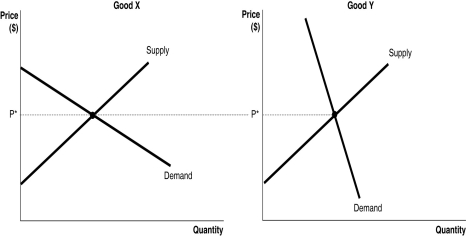 -Refer to Figure 4-11.The figure above illustrates the markets for two goods,Good X and Good Y.Suppose an identical dollar tax is imposed in each market.
a.Compare the consumer burden and producer burden in each market.Illustrate your answer graphically.
b.If the goal of the government is to raise revenue with minimum impact to quantity consumed,in which market should the tax be imposed?
c.If the goal of the government is to discourage consumption,in which market should the tax be imposed?
-Refer to Figure 4-11.The figure above illustrates the markets for two goods,Good X and Good Y.Suppose an identical dollar tax is imposed in each market.
a.Compare the consumer burden and producer burden in each market.Illustrate your answer graphically.
b.If the goal of the government is to raise revenue with minimum impact to quantity consumed,in which market should the tax be imposed?
c.If the goal of the government is to discourage consumption,in which market should the tax be imposed? (Essay)
4.7/5 (87)
(87) Figure 4-1  Figure 4-1 shows Arnold's demand curve for burritos.
-Refer to Figure 4-1.Arnold's marginal benefit from consuming the third burrito is
Figure 4-1 shows Arnold's demand curve for burritos.
-Refer to Figure 4-1.Arnold's marginal benefit from consuming the third burrito is (Multiple Choice)
4.8/5 (75)
(75) Figure 4-6  Figure 4-6 shows the demand and supply curves for the almond market. The government believes that the equilibrium price is too low and tries to help almond growers by setting a price floor at Pf.
-Refer to Figure 4-6.What area represents the portion of consumer surplus that has been transferred to producer surplus as a result of the price floor?
Figure 4-6 shows the demand and supply curves for the almond market. The government believes that the equilibrium price is too low and tries to help almond growers by setting a price floor at Pf.
-Refer to Figure 4-6.What area represents the portion of consumer surplus that has been transferred to producer surplus as a result of the price floor? (Multiple Choice)
4.8/5 (88)
(88) The payroll tax is a tax imposed on ________ that is used to fund Social Security and Medicare.
(Multiple Choice)
4.9/5 (89)
(89) Figure 4-6
Figure 4-6 shows the demand and supply curves for the almond market. The government believes that the equilibrium price is too low and tries to help almond growers by setting a price floor at Pf.
-Refer to Figure 4-6.What area represents consumer surplus after the imposition of the price floor?
Figure 4-6 shows the demand and supply curves for the almond market. The government believes that the equilibrium price is too low and tries to help almond growers by setting a price floor at Pf.
-Refer to Figure 4-6.What area represents consumer surplus after the imposition of the price floor? (Multiple Choice)
4.8/5 (85)
(85) What is "tax incidence"? What determines tax incidence in a competitive market?
(Essay)
4.8/5 (76)
(76) Figure 4-9 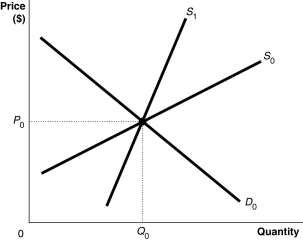 -Refer to Figure 4-9.Suppose the market is initially in equilibrium at price P0 and now the government imposes a tax on every unit sold.Which of the following statements best describes the impact of the tax? For demand curve D0
 (Multiple Choice)
4.8/5 (88)
(88) The sum of consumer surplus and producer surplus is called economic surplus.
(True/False)
4.8/5 (79)
(79) Table 4-4
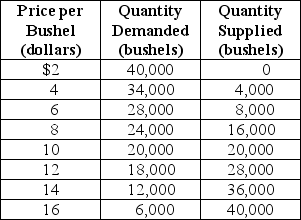 Table 4-4 above contains information about the corn market. Answer the following questions based on this table.
-Refer to Table 4-4.An agricultural price floor is a price that the government guarantees farmers will receive for a particular crop.Suppose the federal government sets a price floor for corn at $12 per bushel.
a.What is the amount of shortage or surplus in the corn market as result of the price floor?
b.If the government agrees to purchase any surplus output at $12,how much will it cost the government?
c.If the government buys all of the farmers' output at the floor price,how many bushels of corn will it have to purchase and how much will it cost the government?
d.Suppose the government buys up all of the farmers' output at the floor price and then sells the output to consumers at whatever price it can get.Under this scheme,what is the price at which the government will be able to sell off all of the output it had purchased from farmers? What is the revenue received from the government's sale?
e.In this problem we have considered two government schemes: (1)a price floor is established and the government purchases any excess output and (2)the government buys all the farmers' output at the floor price and resells at whatever price it can get.Which scheme will taxpayers prefer?
f.Consider again the two schemes.Which scheme will the farmers prefer?
g.Consider again the two schemes.Which scheme will corn buyers prefer?
Table 4-4 above contains information about the corn market. Answer the following questions based on this table.
-Refer to Table 4-4.An agricultural price floor is a price that the government guarantees farmers will receive for a particular crop.Suppose the federal government sets a price floor for corn at $12 per bushel.
a.What is the amount of shortage or surplus in the corn market as result of the price floor?
b.If the government agrees to purchase any surplus output at $12,how much will it cost the government?
c.If the government buys all of the farmers' output at the floor price,how many bushels of corn will it have to purchase and how much will it cost the government?
d.Suppose the government buys up all of the farmers' output at the floor price and then sells the output to consumers at whatever price it can get.Under this scheme,what is the price at which the government will be able to sell off all of the output it had purchased from farmers? What is the revenue received from the government's sale?
e.In this problem we have considered two government schemes: (1)a price floor is established and the government purchases any excess output and (2)the government buys all the farmers' output at the floor price and resells at whatever price it can get.Which scheme will taxpayers prefer?
f.Consider again the two schemes.Which scheme will the farmers prefer?
g.Consider again the two schemes.Which scheme will corn buyers prefer? (Essay)
4.8/5 (92)
(92) Using a supply and demand graph,illustrate the effect of the addition of a $10.00 unit tax on digital cameras,where the entire tax burden falls on the seller.Assume the equilibrium price before the tax is $125 and the equilibrium quantity is 50,000.What happens to the price and quantity after the tax is implemented?
(Essay)
4.7/5 (66)
(66) 
Filters
- Essay(0)
- Multiple Choice(0)
- Short Answer(0)
- True False(0)
- Matching(0)