



 Chat with AI
Exam 4: Economic Efficiency, government Price Setting, and Taxes

Exam 1: Economics: Foundations and Models142 Questions
Exam 2: Trade-Offs, comparative Advantage, and the Market System152 Questions
Exam 3: Where Prices Come From: the Interaction of Demand and Supply149 Questions
Exam 4: Economic Efficiency, government Price Setting, and Taxes137 Questions
Exam 5: Externalities, environmental Policy, and Public Goods139 Questions
Exam 6: Elasticity: The Responsiveness of Demand and Supply149 Questions
Exam 7: The Economics of Health Care117 Questions
Exam 8: Firms, the Stock Market, and Corporate Governance140 Questions
Exam 9: Comparative Advantage and the Gains From International Trade124 Questions
Exam 10: Consumer Choice and Behavioral Economics154 Questions
Exam 11: Technology, production, and Costs174 Questions
Exam 12: Firms in Perfectly Competitive Markets153 Questions
Exam 13: Monopolistic Competition: The Competitive Model in a More Realistic Setting137 Questions
Exam 14: Oligopoly: Firms in Less Competitive Markets129 Questions
Exam 15: Monopoly and Antitrust Policy148 Questions
Exam 16: Pricing Strategy134 Questions
Exam 17: The Markets for Labor and Other Factors of Production149 Questions
Exam 18: Public Choice, taxes, and the Distribution of Income134 Questions
Exam 19: GDP: Measuring Total Production and Income135 Questions
Exam 20: Unemployment and Inflation148 Questions
Exam 21: Economic Growth, the Financial System, and Business Cycles130 Questions
Exam 22: Long-Run Economic Growth: Sources and Policies134 Questions
Exam 23: Aggregate Expenditure and Output in the Short Run157 Questions
Exam 24: Aggregate Demand and Aggregate Supply Analysis145 Questions
Exam 25: Money, banks, and the Federal Reserve System144 Questions
Exam 26: Monetary Policy145 Questions
Exam 27: Fiscal Policy155 Questions
Exam 28: Inflation, unemployment, and Federal Reserve Policy135 Questions
Exam 29: Macroeconomics in an Open Economy145 Questions
Exam 30: The International Financial System139 Questions
Select questions type


The following equations represent the demand and supply for silver pendants. QD = 50 - 2P
QS = -10 + 2P
What is the equilibrium price (P)and quantity (Q - in thousands)of pendants?
(Multiple Choice)
4.8/5  (72)
(72) Table 4-5
 -Refer to Table 4-5.The equations above describe the demand and supply for Chef Ernie's Sushi-on-a-Stick.The equilibrium price and quantity for Chef Ernie's sushi are $60 and 20 thousand units.What is the value of consumer surplus?
 (Multiple Choice)
4.9/5 (68)
(68) Figure 4-3 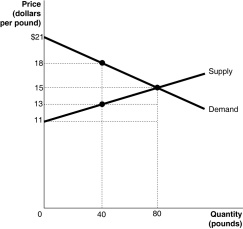 Figure 4-3 shows the market for tiger shrimp. The market is initially in equilibrium at a price of $15 and a quantity of 80. Now suppose producers decide to cut output to 40 in order to raise the price to $18.
-Refer to Figure 4-3.At a price of $18 consumers are willing to buy 40 pounds of tiger shrimp.Is this an economically efficient quantity?
Figure 4-3 shows the market for tiger shrimp. The market is initially in equilibrium at a price of $15 and a quantity of 80. Now suppose producers decide to cut output to 40 in order to raise the price to $18.
-Refer to Figure 4-3.At a price of $18 consumers are willing to buy 40 pounds of tiger shrimp.Is this an economically efficient quantity? (Multiple Choice)
4.9/5 (76)
(76) Economists are reluctant to state that price controls are desirable or undesirable because
(Multiple Choice)
4.9/5 (80)
(80) Government intervention in agricultural markets in the U.S.began in the
(Multiple Choice)
4.8/5 (84)
(84) In the economic sense,almost everything is scarce.________ of a good or service occurs when the quantity demanded is greater than the quantity supplied at the current market price.
(Multiple Choice)
4.9/5 (68)
(68) Which term refers to a legally established minimum price that firms may charge?
(Multiple Choice)
4.9/5 (73)
(73) Figure 4-3
Figure 4-3 shows the market for tiger shrimp. The market is initially in equilibrium at a price of $15 and a quantity of 80. Now suppose producers decide to cut output to 40 in order to raise the price to $18.
-Refer to Figure 4-3.What is the value of consumer surplus at a price of $18??
Figure 4-3 shows the market for tiger shrimp. The market is initially in equilibrium at a price of $15 and a quantity of 80. Now suppose producers decide to cut output to 40 in order to raise the price to $18.
-Refer to Figure 4-3.What is the value of consumer surplus at a price of $18?? (Multiple Choice)
4.9/5 (85)
(85) The division of the burden of a tax between buyers and sellers in a market is called tax allocation.
(True/False)
4.9/5 (80)
(80) Figure 4-4 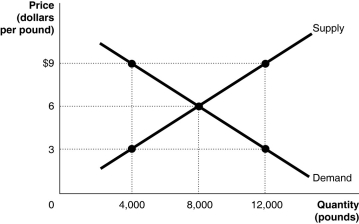 -Refer to Figure 4-4.The figure above represents the market for pecans.Assume that this is a competitive market.If the price of pecans is $3,what changes in the market would result in an economically efficient output?
 (Multiple Choice)
4.9/5 (73)
(73) ________ is maximized in a competitive market when marginal benefit equals marginal cost.
(Multiple Choice)
4.8/5 (77)
(77) Figure 4-8  Figure 4-8 shows the market for beer. The government plans to impose a unit tax in this market.
-Refer to Figure 4-8.As a result of the tax,is there a loss in consumer surplus?
Figure 4-8 shows the market for beer. The government plans to impose a unit tax in this market.
-Refer to Figure 4-8.As a result of the tax,is there a loss in consumer surplus? (Multiple Choice)
4.9/5 (71)
(71) If the demand curve for a product is vertical,any tax increase on the product is paid for entirely by the consumer.
(True/False)
4.8/5 (90)
(90) Which of the following is not a consequence of minimum wage laws?
(Multiple Choice)
4.9/5 (88)
(88) Figure 4-8
Figure 4-8 shows the market for beer. The government plans to impose a unit tax in this market.
-Refer to Figure 4-8.How much of the tax is paid by buyers?
Figure 4-8 shows the market for beer. The government plans to impose a unit tax in this market.
-Refer to Figure 4-8.How much of the tax is paid by buyers? (Multiple Choice)
4.7/5 (79)
(79) Table 4-2
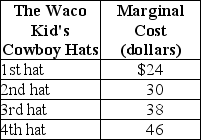 -Refer to Table 4-2.The table above lists the marginal cost of cowboy hats by The Waco Kid,a firm that specializes in producing western wear.If the market price of The Waco Kid's cowboy hats is $40
 (Multiple Choice)
4.9/5 (74)
(74) Will equilibrium in a market always result in an outcome that is economically efficient? Explain.
(Essay)
4.7/5 (83)
(83) In cities with rent controls,the actual rents paid can be higher than the legal maximum.One explanation for this is
(Multiple Choice)
4.9/5 (76)
(76) 
Filters
- Essay(0)
- Multiple Choice(0)
- Short Answer(0)
- True False(0)
- Matching(0)