



 Chat with AI
Exam 11: Technology, Production, and Costs

Exam 1: Economics: Foundations and Models444 Questions
Exam 2: Trade-Offs, Comparative Advantage, and the Market System498 Questions
Exam 3: Where Prices Come From: the Interaction of Demand and Supply475 Questions
Exam 4: Economic Efficiency, Government Price Setting, and Taxes419 Questions
Exam 5: Externalities, Environmental Policy, and Public Goods266 Questions
Exam 6: Elasticity: the Responsiveness of Demand and Supply295 Questions
Exam 7: The Economics of Health Care334 Questions
Exam 8: Firms, the Stock Market, and Corporate Governance278 Questions
Exam 9: Comparative Advantage and the Gains From International Trade379 Questions
Exam 10: Consumer Choice and Behavioral Economics302 Questions
Exam 11: Technology, Production, and Costs330 Questions
Exam 12: Firms in Perfectly Competitive Markets298 Questions
Exam 13: Monopolistic Competition: the Competitive Model in a More Realistic Setting276 Questions
Exam 14: Oligopoly: Firms in Less Competitive Markets262 Questions
Exam 15: Monopoly and Antitrust Policy271 Questions
Exam 16: Pricing Strategy263 Questions
Exam 17: The Markets for Labor and Other Factors of Production286 Questions
Exam 18: Public Choice, Taxes, and the Distribution of Income258 Questions
Exam 19: GDP: Measuring Total Production and Income266 Questions
Exam 20: Unemployment and Inflation292 Questions
Exam 21: Economic Growth, the Financial System, and Business Cycles257 Questions
Exam 22: Long-Run Economic Growth: Sources and Policies268 Questions
Exam 23: Aggregate Expenditure and Output in the Short Run306 Questions
Exam 24: Aggregate Demand and Aggregate Supply Analysis284 Questions
Exam 25: Money, Banks, and the Federal Reserve System280 Questions
Exam 26: Monetary Policy277 Questions
Exam 27: Fiscal Policy303 Questions
Exam 28: Inflation, Unemployment, and Federal Reserve Policy257 Questions
Exam 29: Macroeconomics in an Open Economy278 Questions
Exam 30: The International Financial System262 Questions
Select questions type


Figure 11-15  -Refer to Figure 11-15. What is the combination of inputs that produces 200 gooseberry pies at the lowest cost?
 (Multiple Choice)
4.9/5  (69)
(69) Figure 11-15
-Refer to Figure 11-15. Suppose Hilda hires labor at $8 per hour and capital costs $10 per unit. What is the minimum cost of producing 200 gooseberry pies?
-Refer to Figure 11-15. Suppose Hilda hires labor at $8 per hour and capital costs $10 per unit. What is the minimum cost of producing 200 gooseberry pies? (Multiple Choice)
4.9/5 (76)
(76) Suppose a chain of convenience stores reorganized its system of supplying its stores with food. This led to a sharp reduction in the number of trucks that the company had to use and increased the amount of fresh food on store shelves. Which of the following statements best describes the chain stores' actions?
(Multiple Choice)
4.9/5 (73)
(73) Sally quit her job as an auto mechanic earning $50,000 per year to start her own business. To save money she operates her business out of a small building she owns which, until she started her own business, she had rented out for $10,000 per year. She also invested her $20,000 savings (which earned a market interest rate of 5% per year) in her business. You are given the following information about the first year of her operations.
Total revenue $120,000
Cost of labor 40,000
Cost of materials 15,000
Equipment rental 5,000
a. Calculate her economic costs.
b. Calculate her accounting costs.
c. Calculate her implicit costs.
d. Sally tells you that she would really like to move to a location closer to town but she decided against it because "right now I don't pay any rent and it will cost me $10,000 a year to rent near town." Do you agree with her reasoning?
(Essay)
5.0/5 (83)
(83) Diminishing marginal product of labor occurs when adding another unit of labor
(Multiple Choice)
4.8/5 (95)
(95) Suppose Argyle Sachs has to choose between building a smaller sweater factory and a larger sweater factory. In the following graph, the relationship between costs and output for the smaller factory is represented by the curve ATC1, and the relationship between costs and output for the larger factory is represented by the curve ATC2. 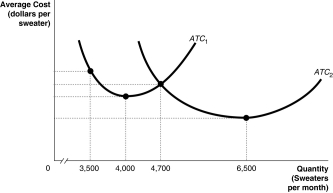 a. If Argyle expects to produce 3,600 sweaters per month, should he build a smaller factory or a larger factory? Briefly explain?
b. If Argyle expects to produce 5,000 sweaters per month, should he build a smaller factory or a larger factory? Briefly explain.
c. If the average cost of producing sweaters is lower in the larger factory when Argyle produces 6,500 sweaters per week, why isn't it also lower when Argyle produces 4,000 sweaters per week?
a. If Argyle expects to produce 3,600 sweaters per month, should he build a smaller factory or a larger factory? Briefly explain?
b. If Argyle expects to produce 5,000 sweaters per month, should he build a smaller factory or a larger factory? Briefly explain.
c. If the average cost of producing sweaters is lower in the larger factory when Argyle produces 6,500 sweaters per week, why isn't it also lower when Argyle produces 4,000 sweaters per week? (Essay)
4.7/5 (79)
(79) Golda Rush quit her job as a manager for Home Depot to start her own hair dressing salon, Goldilocks. She gave up a salary of $40,000 per year, invested her savings of $30,000 (which was earning 5 percent interest) and borrowed $10,000 from a close friend, agreeing to pay 5 percent interest per year. In her first year, Golda spent $18,000 to rent a salon, hired a part-time assistant for $12,000 and incurred another $15,000 on equipment and hairdressing material. Based on this information, what is the amount of her implicit costs?
(Multiple Choice)
4.9/5 (77)
(77) Which of the following is true at the output level where average total cost is at its minimum?
(Multiple Choice)
4.8/5 (75)
(75) Vipsana's Gyros House sells gyros. The cost of ingredients (pita, meat, spices, etc.) to make a gyro is $2.00. Vipsana pays her employees $60 per day. She also incurs a fixed cost of $120 per day. Calculate Vipsana's variable cost per day when she produces 50 gyros using two workers?
(Multiple Choice)
4.8/5 (80)
(80) Adam spent $10,000 on new equipment for his small business, "Adam's Fitness Studio." Membership at his fitness center is very low and at this rate, Adam needs an additional $12,000 per year to keep his studio open. Which of the following is true?
(Multiple Choice)
4.7/5 (81)
(81) Suppose you have just opened a store to sell espresso machines. Both you and a competing store buy this machine from a manufacturer for $130 each. Your competitor who has a store of the same size as yours is currently selling about 10 machines a month at a price of $200 per machine. You expect to sell about 6 machines a month at a price of $220 per machine. If you lower your price, you expect to make a loss. Which of the following could explain why your competitor is able to profitably sell the machine at a lower price although the cost of purchasing the machine is the same for the both of you?
(Multiple Choice)
4.9/5 (72)
(72) The absolute value of the slope of an isocost line equals the ratio of
(Multiple Choice)
4.7/5 (79)
(79) 
Filters
- Essay(0)
- Multiple Choice(0)
- Short Answer(0)
- True False(0)
- Matching(0)