



 Chat with AI
Exam 11: Technology, Production, and Costs

Exam 1: Economics: Foundations and Models444 Questions
Exam 2: Trade-Offs, Comparative Advantage, and the Market System498 Questions
Exam 3: Where Prices Come From: the Interaction of Demand and Supply475 Questions
Exam 4: Economic Efficiency, Government Price Setting, and Taxes419 Questions
Exam 5: Externalities, Environmental Policy, and Public Goods266 Questions
Exam 6: Elasticity: the Responsiveness of Demand and Supply295 Questions
Exam 7: The Economics of Health Care334 Questions
Exam 8: Firms, the Stock Market, and Corporate Governance278 Questions
Exam 9: Comparative Advantage and the Gains From International Trade379 Questions
Exam 10: Consumer Choice and Behavioral Economics302 Questions
Exam 11: Technology, Production, and Costs330 Questions
Exam 12: Firms in Perfectly Competitive Markets298 Questions
Exam 13: Monopolistic Competition: the Competitive Model in a More Realistic Setting276 Questions
Exam 14: Oligopoly: Firms in Less Competitive Markets262 Questions
Exam 15: Monopoly and Antitrust Policy271 Questions
Exam 16: Pricing Strategy263 Questions
Exam 17: The Markets for Labor and Other Factors of Production286 Questions
Exam 18: Public Choice, Taxes, and the Distribution of Income258 Questions
Exam 19: GDP: Measuring Total Production and Income266 Questions
Exam 20: Unemployment and Inflation292 Questions
Exam 21: Economic Growth, the Financial System, and Business Cycles257 Questions
Exam 22: Long-Run Economic Growth: Sources and Policies268 Questions
Exam 23: Aggregate Expenditure and Output in the Short Run306 Questions
Exam 24: Aggregate Demand and Aggregate Supply Analysis284 Questions
Exam 25: Money, Banks, and the Federal Reserve System280 Questions
Exam 26: Monetary Policy277 Questions
Exam 27: Fiscal Policy303 Questions
Exam 28: Inflation, Unemployment, and Federal Reserve Policy257 Questions
Exam 29: Macroeconomics in an Open Economy278 Questions
Exam 30: The International Financial System262 Questions
Select questions type


If average total cost is $50 and average fixed cost is $15 when output is 20 units, then the firm's total variable cost at that level of output is
(Multiple Choice)
5.0/5  (78)
(78) The short run is the time period during which a firm has at least one input constraint.
(True/False)
4.9/5 (69)
(69) When the average total cost is $16 and the total cost is $800, then the number of units the firm is producing is
(Multiple Choice)
4.9/5 (93)
(93) What is the difference between "diminishing marginal returns" and "diseconomies of scale"?
(Multiple Choice)
4.9/5 (78)
(78) Figure 11-14  Figure 11-14 shows the optimal input combinations for the production of a given quantity of cotton in the United States and in China.
-Refer to Figure 11-14. Which of the following could explain why the United States and China use different input combinations to produce a given quantity of cotton and yet, each country produces that quantity at the lowest possible cost?
Figure 11-14 shows the optimal input combinations for the production of a given quantity of cotton in the United States and in China.
-Refer to Figure 11-14. Which of the following could explain why the United States and China use different input combinations to produce a given quantity of cotton and yet, each country produces that quantity at the lowest possible cost? (Multiple Choice)
4.9/5 (86)
(86) Describe the difference between technology and positive technological change.
(Essay)
4.9/5 (85)
(85) All of the following statements are true of the minimum efficient scale except one. Which one?
(Multiple Choice)
4.8/5 (70)
(70) 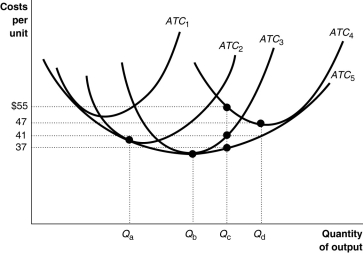 -Economies of scale occur when
If the marginal product of labor is 45 units of output and the marginal product of capital is 56 units of output while the wage rate is $20 per worker and the cost of capital is $28 per machine, are these two inputs being used in the least cost combination and what should be done if they are not?
(Essay)
4.8/5 (63)
(63) Consider a manufacturing operation that uses specialized machinery and labor to produce its output. In this case, the input that is not fixed in the short run is labor.
(True/False)
4.8/5 (91)
(91) Vipsana's Gyros House sells gyros. The cost of ingredients (pita, meat, spices, etc.) to make a gyro is $2.00. Vipsana pays her employees $60 per day. She also incurs a fixed cost of $120 per day. What is Vipsana's total cost per day when she does not produce any gyros and does not hire any workers?
(Multiple Choice)
4.9/5 (77)
(77) The marginal product of labor is calculated using the formula
(Multiple Choice)
4.7/5 (84)
(84) Minimum efficient scale is defined as the level of output at which
(Multiple Choice)
4.9/5 (84)
(84) Table 11-8
 Elegant Settings manufactures stainless steel cutlery. Table 11-8 shows the company's cost data.
-Refer to Table 11-8. What is the minimum efficient scale of production?
Elegant Settings manufactures stainless steel cutlery. Table 11-8 shows the company's cost data.
-Refer to Table 11-8. What is the minimum efficient scale of production? (Multiple Choice)
4.9/5 (92)
(92) The marginal cost curve is U-shaped because of the law of increasing opportunity costs.
(True/False)
4.8/5 (74)
(74) 
Filters
- Essay(0)
- Multiple Choice(0)
- Short Answer(0)
- True False(0)
- Matching(0)