



 Chat with AI
Exam 11: Technology, Production, and Costs

Exam 1: Economics: Foundations and Models444 Questions
Exam 2: Trade-Offs, Comparative Advantage, and the Market System498 Questions
Exam 3: Where Prices Come From: the Interaction of Demand and Supply475 Questions
Exam 4: Economic Efficiency, Government Price Setting, and Taxes419 Questions
Exam 5: Externalities, Environmental Policy, and Public Goods266 Questions
Exam 6: Elasticity: the Responsiveness of Demand and Supply295 Questions
Exam 7: The Economics of Health Care334 Questions
Exam 8: Firms, the Stock Market, and Corporate Governance278 Questions
Exam 9: Comparative Advantage and the Gains From International Trade379 Questions
Exam 10: Consumer Choice and Behavioral Economics302 Questions
Exam 11: Technology, Production, and Costs330 Questions
Exam 12: Firms in Perfectly Competitive Markets298 Questions
Exam 13: Monopolistic Competition: the Competitive Model in a More Realistic Setting276 Questions
Exam 14: Oligopoly: Firms in Less Competitive Markets262 Questions
Exam 15: Monopoly and Antitrust Policy271 Questions
Exam 16: Pricing Strategy263 Questions
Exam 17: The Markets for Labor and Other Factors of Production286 Questions
Exam 18: Public Choice, Taxes, and the Distribution of Income258 Questions
Exam 19: GDP: Measuring Total Production and Income266 Questions
Exam 20: Unemployment and Inflation292 Questions
Exam 21: Economic Growth, the Financial System, and Business Cycles257 Questions
Exam 22: Long-Run Economic Growth: Sources and Policies268 Questions
Exam 23: Aggregate Expenditure and Output in the Short Run306 Questions
Exam 24: Aggregate Demand and Aggregate Supply Analysis284 Questions
Exam 25: Money, Banks, and the Federal Reserve System280 Questions
Exam 26: Monetary Policy277 Questions
Exam 27: Fiscal Policy303 Questions
Exam 28: Inflation, Unemployment, and Federal Reserve Policy257 Questions
Exam 29: Macroeconomics in an Open Economy278 Questions
Exam 30: The International Financial System262 Questions
Select questions type


Figure 11-16  -A change in the slope of an isocost line is due to a change in
 (Multiple Choice)
4.8/5  (71)
(71) Figure 11-11  Figure 11-11 illustrates the long-run average cost curve for a firm that produces picture frames. The graph also includes short-run average cost curves for three firm sizes: ATCa, ATCb and ATCc.
-Refer to Figure 11-11. For output rates greater than 20,000 picture frames per month,
Figure 11-11 illustrates the long-run average cost curve for a firm that produces picture frames. The graph also includes short-run average cost curves for three firm sizes: ATCa, ATCb and ATCc.
-Refer to Figure 11-11. For output rates greater than 20,000 picture frames per month, (Multiple Choice)
4.8/5 (83)
(83) Figure 11-1  -Refer to Figure 11-1. Diminishing marginal productivity sets in after
 (Multiple Choice)
5.0/5 (85)
(85) Gertrude Stork's Chocolate Shoppe normally employs 4 workers. When the Chocolate Shoppe hired a 5th worker the Shoppe's total output decreased. Therefore,
(Multiple Choice)
4.8/5 (85)
(85) You own a business that answers telephone calls for physicians after their offices close. You have an incentive to substitute capital for labor if the
(Multiple Choice)
4.8/5 (74)
(74) Suppose the price of capital and labor remain constant. As a firm's expenditures for capital and labor increase, its isocost line
(Multiple Choice)
4.9/5 (85)
(85) If another worker adds 9 units of output to a group of workers who had an average product of 7 units, then the average product of labor
(Multiple Choice)
4.9/5 (83)
(83) What is minimum efficient scale? What is likely to happen in the long run to firms that do not reach minimum efficient scale?
(Essay)
4.8/5 (80)
(80) Figure 11-10 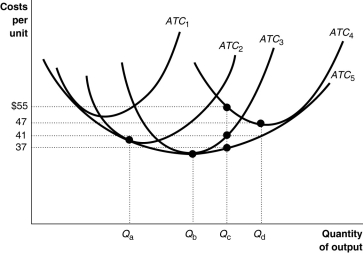 -Which of the following statements regarding a firm's long-run average total cost (LRATC) curve and its short-run average total cost (SRATC) curve is true?
 (Multiple Choice)
4.8/5 (89)
(89) The Santa Fe Spark Plug Company supplies spark plugs to automotive parts dealers. An increase in the demand for its product led Santa Fe to hire 150 new workers. Santa Fe also plans to expand the capacity of its plant but this project will take 2 years to complete. Which of the following statements is true?
(Multiple Choice)
4.8/5 (73)
(73) Table 11-7
 Table 11-7 shows cost data for Lotus Lanterns, a producer of whimsical night lights.
-Refer to Table 11-7. What is the variable cost of production when the firm produces 115 lanterns?
Table 11-7 shows cost data for Lotus Lanterns, a producer of whimsical night lights.
-Refer to Table 11-7. What is the variable cost of production when the firm produces 115 lanterns? (Multiple Choice)
4.9/5 (81)
(81) Table 11-5
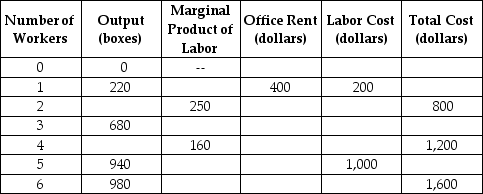 -Refer to Table 11-5. Suzette's Fancy Packaging subcontracts with Sunshineland Pecans to box dried fruit and nuts for Suzette's mail order business. Suzette rents space for her factory for $400 a week in a nearby strip mall. She can hire temporary workers for $200 a week. Table 11-5 above shows her output and cost data. Use the table to answer questions a-e.
a. Complete the table.
b. In the last week of summer Suzette closes her business to go on a family vacation. What are her costs during that week?
c. In one week Suzette exactly breaks even. If her revenue for the week is $1,200, how many boxes of fruit and nuts did she produce?
d. Judging from the marginal product of labor data, would you say that Suzette had to settle for increasingly unproductive workers? Explain your answer.
e. Suzette has received an order for 1,500 boxes of nuts per week for the next 3 months. If she expects the trend in the marginal product of labor will continue in the same direction, what do you think she should do? Should she not commit until she can move to a larger space or should she just hire more workers? Explain your answer.
-Refer to Table 11-5. Suzette's Fancy Packaging subcontracts with Sunshineland Pecans to box dried fruit and nuts for Suzette's mail order business. Suzette rents space for her factory for $400 a week in a nearby strip mall. She can hire temporary workers for $200 a week. Table 11-5 above shows her output and cost data. Use the table to answer questions a-e.
a. Complete the table.
b. In the last week of summer Suzette closes her business to go on a family vacation. What are her costs during that week?
c. In one week Suzette exactly breaks even. If her revenue for the week is $1,200, how many boxes of fruit and nuts did she produce?
d. Judging from the marginal product of labor data, would you say that Suzette had to settle for increasingly unproductive workers? Explain your answer.
e. Suzette has received an order for 1,500 boxes of nuts per week for the next 3 months. If she expects the trend in the marginal product of labor will continue in the same direction, what do you think she should do? Should she not commit until she can move to a larger space or should she just hire more workers? Explain your answer. (Essay)
4.8/5 (73)
(73) Academic book publishers hire editors, designers, and production and marketing managers who help prepare books for publication. Because these employees work on several books simultaneously, the number of people the company hires will not go up and down with the quantity of books the company publishes during any particular year. The salaries and benefits of people in these job categories will be included in
(Multiple Choice)
4.8/5 (73)
(73) Which of the following is an example of positive technological change?
(Multiple Choice)
4.8/5 (78)
(78) Average fixed cost can be calculated using any of the formulas below except
(Multiple Choice)
4.8/5 (83)
(83) Which of the following is typically considered a fixed cost by academic book publishers but a variable cost by companies that print books?
(Multiple Choice)
4.8/5 (80)
(80) Figure 11-11 Figure 11-11 illustrates the long-run average cost curve for a firm that produces picture frames. The graph also includes short-run average cost curves for three firm sizes: ATCa, ATCb and ATCc.
-Refer to Figure 11-11. If the firm chooses to produce and sell 25,000 frames per month by operating in the short run with a scale operation represented by ATCc,
Figure 11-11 illustrates the long-run average cost curve for a firm that produces picture frames. The graph also includes short-run average cost curves for three firm sizes: ATCa, ATCb and ATCc.
-Refer to Figure 11-11. If the firm chooses to produce and sell 25,000 frames per month by operating in the short run with a scale operation represented by ATCc, (Multiple Choice)
4.9/5 (97)
(97) Figure 11-2  -Refer to Figure 11-2. The curve labeled "F" is
 (Multiple Choice)
4.9/5 (81)
(81) The slope of an isoquant is equal to the ratio of the price of the input on the horizontal axis divided by the price of the input on the vertical axis, multiplied by -1.
(True/False)
4.8/5 (80)
(80) 
Filters
- Essay(0)
- Multiple Choice(0)
- Short Answer(0)
- True False(0)
- Matching(0)