



 Chat with AI
Exam 11: Technology, Production, and Costs

Exam 1: Economics: Foundations and Models444 Questions
Exam 2: Trade-Offs, Comparative Advantage, and the Market System498 Questions
Exam 3: Where Prices Come From: the Interaction of Demand and Supply475 Questions
Exam 4: Economic Efficiency, Government Price Setting, and Taxes419 Questions
Exam 5: Externalities, Environmental Policy, and Public Goods266 Questions
Exam 6: Elasticity: the Responsiveness of Demand and Supply295 Questions
Exam 7: The Economics of Health Care334 Questions
Exam 8: Firms, the Stock Market, and Corporate Governance278 Questions
Exam 9: Comparative Advantage and the Gains From International Trade379 Questions
Exam 10: Consumer Choice and Behavioral Economics302 Questions
Exam 11: Technology, Production, and Costs330 Questions
Exam 12: Firms in Perfectly Competitive Markets298 Questions
Exam 13: Monopolistic Competition: the Competitive Model in a More Realistic Setting276 Questions
Exam 14: Oligopoly: Firms in Less Competitive Markets262 Questions
Exam 15: Monopoly and Antitrust Policy271 Questions
Exam 16: Pricing Strategy263 Questions
Exam 17: The Markets for Labor and Other Factors of Production286 Questions
Exam 18: Public Choice, Taxes, and the Distribution of Income258 Questions
Exam 19: GDP: Measuring Total Production and Income266 Questions
Exam 20: Unemployment and Inflation292 Questions
Exam 21: Economic Growth, the Financial System, and Business Cycles257 Questions
Exam 22: Long-Run Economic Growth: Sources and Policies268 Questions
Exam 23: Aggregate Expenditure and Output in the Short Run306 Questions
Exam 24: Aggregate Demand and Aggregate Supply Analysis284 Questions
Exam 25: Money, Banks, and the Federal Reserve System280 Questions
Exam 26: Monetary Policy277 Questions
Exam 27: Fiscal Policy303 Questions
Exam 28: Inflation, Unemployment, and Federal Reserve Policy257 Questions
Exam 29: Macroeconomics in an Open Economy278 Questions
Exam 30: The International Financial System262 Questions
Select questions type


Which of the following statements correctly describes the distinction between technology and technological change?
(Multiple Choice)
4.9/5  (90)
(90) When a firm produces 50,000 units of output, its total cost equals $6.5 million. When it increases its production to 70,000 units of output, its total cost increases to $9.4 million. Within this range, the marginal cost of an additional unit of output is
(Multiple Choice)
5.0/5 (74)
(74) Damian owns a tattoo parlor and has hired three tattoo artists to work for him. The marginal product of labor is 8 for the first artist, 12 for the second artist, and 7 for the third artist. What is Damian's average product of labor for these three tattoo artists?
(Essay)
4.9/5 (77)
(77) Table 11-1
 Table 11-1 shows the technology of production at the Matsuko's Mushroom Farm for the month of May.
-Refer to Table 11-1. What is the average product of labor when the farm hires 5 workers?
Table 11-1 shows the technology of production at the Matsuko's Mushroom Farm for the month of May.
-Refer to Table 11-1. What is the average product of labor when the farm hires 5 workers? (Multiple Choice)
5.0/5 (74)
(74) The slope of a typical isoquant is negative because to produce a given output, a producer
(Multiple Choice)
4.9/5 (98)
(98) Figure 11-15  -Refer to Figure 11-15. Suppose Hilda produces 100 gooseberry pies. What is the marginal rate of technical substitution of labor for capital when labor is increased from 10 to 20 hours?
 (Multiple Choice)
4.9/5 (77)
(77) If diminishing marginal returns have already set in for Golden Lark Woodworks, and the marginal product of the 6th carpenter is 8 chairs, then the marginal product of the 7th carpenter is
(Multiple Choice)
4.8/5 (88)
(88) Explain whether each of the following is a fixed cost or a variable cost for Damian Dandridge's tattoo parlor.
a. The payment he makes to buy tattoo ink.
b. The wages he pays his employees.
c. The $500-per-month payment he makes to advertise his shop on highway billboards.
d. The lease payment he makes to the landlord who owns the building where his shop is located.
e. The payment he makes on his liability insurance policy.
(Essay)
4.9/5 (88)
(88) Average variable cost can be calculated using any of the formulas below except
(Multiple Choice)
4.9/5 (79)
(79) The total output produced by a firm divided by the quantity of workers employed by the firm is the definition of
(Multiple Choice)
4.8/5 (86)
(86) Sam Lewis owns a firm in New York City's garment district. If Sam keeps adding workers to use the same number of sewing machines, eventually the workplace will become so crowded that workers will get in each other's way. At this point
(Multiple Choice)
5.0/5 (76)
(76) A firm's short-run average total cost curve is parallel to its short-run average variable cost curve.
(True/False)
4.8/5 (89)
(89) Figure 11-4 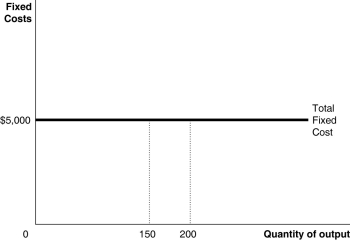 -Refer to Figure 11-4. What happens to the average fixed cost of production when the firm increases output from 150 to 200?
 (Multiple Choice)
4.8/5 (91)
(91) Which of the following explains why the marginal cost curve has a U shape?
(Multiple Choice)
4.9/5 (85)
(85) Figure 11-2  -Refer to Figure 11-2. The curve labeled "E" is
 (Multiple Choice)
4.9/5 (92)
(92) If 11 workers can produce a total of 54 units of a product and a 12th worker has a marginal product of 6 units, then the average product of 12 workers is
(Multiple Choice)
4.8/5 (88)
(88) 
Filters
- Essay(0)
- Multiple Choice(0)
- Short Answer(0)
- True False(0)
- Matching(0)