



 Chat with AI
Exam 5: Externalities, Environmental Policy, and Public Goods

Exam 1: Economics: Foundations and Models444 Questions
Exam 2: Trade-Offs, Comparative Advantage, and the Market System498 Questions
Exam 3: Where Prices Come From: the Interaction of Demand and Supply475 Questions
Exam 4: Economic Efficiency, Government Price Setting, and Taxes419 Questions
Exam 5: Externalities, Environmental Policy, and Public Goods266 Questions
Exam 6: Elasticity: the Responsiveness of Demand and Supply295 Questions
Exam 7: The Economics of Health Care334 Questions
Exam 8: Firms, the Stock Market, and Corporate Governance278 Questions
Exam 9: Comparative Advantage and the Gains From International Trade379 Questions
Exam 10: Consumer Choice and Behavioral Economics302 Questions
Exam 11: Technology, Production, and Costs330 Questions
Exam 12: Firms in Perfectly Competitive Markets298 Questions
Exam 13: Monopolistic Competition: the Competitive Model in a More Realistic Setting276 Questions
Exam 14: Oligopoly: Firms in Less Competitive Markets262 Questions
Exam 15: Monopoly and Antitrust Policy271 Questions
Exam 16: Pricing Strategy263 Questions
Exam 17: The Markets for Labor and Other Factors of Production286 Questions
Exam 18: Public Choice, Taxes, and the Distribution of Income258 Questions
Exam 19: GDP: Measuring Total Production and Income266 Questions
Exam 20: Unemployment and Inflation292 Questions
Exam 21: Economic Growth, the Financial System, and Business Cycles257 Questions
Exam 22: Long-Run Economic Growth: Sources and Policies268 Questions
Exam 23: Aggregate Expenditure and Output in the Short Run306 Questions
Exam 24: Aggregate Demand and Aggregate Supply Analysis284 Questions
Exam 25: Money, Banks, and the Federal Reserve System280 Questions
Exam 26: Monetary Policy277 Questions
Exam 27: Fiscal Policy303 Questions
Exam 28: Inflation, Unemployment, and Federal Reserve Policy257 Questions
Exam 29: Macroeconomics in an Open Economy278 Questions
Exam 30: The International Financial System262 Questions
Select questions type


Figure 5-4 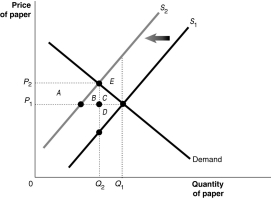 Suppose there are several paper mills producing paper for a market. These mills, located upstream from a fishing village, discharge a large amount of wastewater into the river. The waste material affects the number of fish in the river, and the use of the river for recreation and as a public water supply source. Figure 5-4 shows the paper market. Use this Figure to answer the following question(s).
-Refer to Figure 5-4. What is the deadweight loss from producing at the market equilibrium?
Suppose there are several paper mills producing paper for a market. These mills, located upstream from a fishing village, discharge a large amount of wastewater into the river. The waste material affects the number of fish in the river, and the use of the river for recreation and as a public water supply source. Figure 5-4 shows the paper market. Use this Figure to answer the following question(s).
-Refer to Figure 5-4. What is the deadweight loss from producing at the market equilibrium? (Multiple Choice)
4.7/5  (87)
(87) Which of the following displays these two characteristics: nonrivalry and nonexcludability in consumption?
(Multiple Choice)
4.8/5 (76)
(76) Who was the economist who first proposed that governments use taxes and subsidies to correct for externalities?
(Multiple Choice)
4.8/5 (90)
(90) Figure 5-3  -Refer to Figure 5-3. In the absence of any government intervention, the private market
 (Multiple Choice)
4.8/5 (67)
(67) Figure 5-2  Figure 5-2 shows a market with a negative externality.
-Refer to Figure 5-2. The true marginal cost of the last unit produced is represented by the price
Figure 5-2 shows a market with a negative externality.
-Refer to Figure 5-2. The true marginal cost of the last unit produced is represented by the price (Multiple Choice)
4.9/5 (85)
(85) If you burn your trash in the back yard in spite of regulations against it, then you are
(Multiple Choice)
4.9/5 (94)
(94) Which of the following displays rivalry and excludability in consumption?
(Multiple Choice)
4.9/5 (78)
(78) The "tragedy of the commons" refers to the phenomenon where
(Multiple Choice)
4.9/5 (87)
(87) Figure 5-5 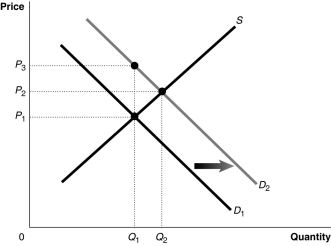 Figure 5-5 shows a market with an externality. The current market equilibrium output of Q1 is not the economically efficient output. The economically efficient output is Q2.
-Refer to Figure 5-5. If, because of an externality, the economically efficient output is Q2 and not the current equilibrium output of Q1, what does D1 represent?
Figure 5-5 shows a market with an externality. The current market equilibrium output of Q1 is not the economically efficient output. The economically efficient output is Q2.
-Refer to Figure 5-5. If, because of an externality, the economically efficient output is Q2 and not the current equilibrium output of Q1, what does D1 represent? (Multiple Choice)
4.9/5 (84)
(84) If the paint on your house was eaten away by the fumes from a factory nearby and you hired a lawyer to sue the polluting firm, your legal fees would be considered
(Multiple Choice)
4.9/5 (75)
(75) A. C. Pigou argued that the government can deal with a positive externality in consumption by giving consumers a subsidy equal to the value of the externality.
(True/False)
4.9/5 (81)
(81) Figure 5-12 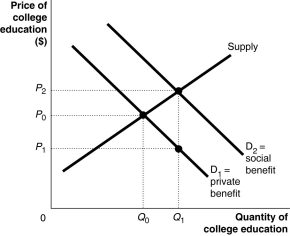 College education benefits society by producing a more employable workforce, reducing crime and creating a better informed citizenry. Thus, the social benefits of college education exceed the private benefits for any level of college education. This is illustrated in Figure 5-12.
-Refer to Figure 5-12. One way to obtain the economically efficient amount of college education is for governments to subsidize college education. What is the size of the per-student Pigovian subsidy that the government must provide to internalize the external benefits? (Note that the subsidy can be granted to the education institutions or to the students directly or indirectly; for example, through low-interest student loans.)
College education benefits society by producing a more employable workforce, reducing crime and creating a better informed citizenry. Thus, the social benefits of college education exceed the private benefits for any level of college education. This is illustrated in Figure 5-12.
-Refer to Figure 5-12. One way to obtain the economically efficient amount of college education is for governments to subsidize college education. What is the size of the per-student Pigovian subsidy that the government must provide to internalize the external benefits? (Note that the subsidy can be granted to the education institutions or to the students directly or indirectly; for example, through low-interest student loans.) (Multiple Choice)
4.7/5 (76)
(76) James Meade, who won the Nobel Prize in Economics in 1977, argued that positive externalities resulted from
(Multiple Choice)
5.0/5 (73)
(73) Figure 5-1 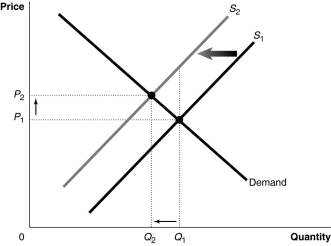 Figure 5-1 shows a market with an externality. The current market equilibrium output of Q1 is not the economically efficient output. The economically efficient output is Q2.
-Refer to Figure 5-1. If, because of an externality, the economically efficient output is Q2 and not the current equilibrium output of Q1, what does S1 represent?
Figure 5-1 shows a market with an externality. The current market equilibrium output of Q1 is not the economically efficient output. The economically efficient output is Q2.
-Refer to Figure 5-1. If, because of an externality, the economically efficient output is Q2 and not the current equilibrium output of Q1, what does S1 represent? (Multiple Choice)
4.8/5 (77)
(77) Figure 5-9  Companies producing toilet paper bleach the paper to make it white. The bleach is discharged into rivers and lakes and causes substantial environmental damage. Figure 5-9 illustrates the situation in the toilet paper market.
-Refer to Figure 5-9. The efficient output is
Companies producing toilet paper bleach the paper to make it white. The bleach is discharged into rivers and lakes and causes substantial environmental damage. Figure 5-9 illustrates the situation in the toilet paper market.
-Refer to Figure 5-9. The efficient output is (Multiple Choice)
5.0/5 (85)
(85) The social cost of cutting trees for firewood in a government forest is
(Multiple Choice)
4.8/5 (79)
(79) "A competitive market achieves economic efficiency by maximizing the sum of consumer surplus and producer surplus." This statement
(Multiple Choice)
4.8/5 (59)
(59) 
Filters
- Essay(0)
- Multiple Choice(0)
- Short Answer(0)
- True False(0)
- Matching(0)