



 Chat with AI
Exam 5: Externalities, Environmental Policy, and Public Goods

Exam 1: Economics: Foundations and Models444 Questions
Exam 2: Trade-Offs, Comparative Advantage, and the Market System498 Questions
Exam 3: Where Prices Come From: the Interaction of Demand and Supply475 Questions
Exam 4: Economic Efficiency, Government Price Setting, and Taxes419 Questions
Exam 5: Externalities, Environmental Policy, and Public Goods266 Questions
Exam 6: Elasticity: the Responsiveness of Demand and Supply295 Questions
Exam 7: The Economics of Health Care334 Questions
Exam 8: Firms, the Stock Market, and Corporate Governance278 Questions
Exam 9: Comparative Advantage and the Gains From International Trade379 Questions
Exam 10: Consumer Choice and Behavioral Economics302 Questions
Exam 11: Technology, Production, and Costs330 Questions
Exam 12: Firms in Perfectly Competitive Markets298 Questions
Exam 13: Monopolistic Competition: the Competitive Model in a More Realistic Setting276 Questions
Exam 14: Oligopoly: Firms in Less Competitive Markets262 Questions
Exam 15: Monopoly and Antitrust Policy271 Questions
Exam 16: Pricing Strategy263 Questions
Exam 17: The Markets for Labor and Other Factors of Production286 Questions
Exam 18: Public Choice, Taxes, and the Distribution of Income258 Questions
Exam 19: GDP: Measuring Total Production and Income266 Questions
Exam 20: Unemployment and Inflation292 Questions
Exam 21: Economic Growth, the Financial System, and Business Cycles257 Questions
Exam 22: Long-Run Economic Growth: Sources and Policies268 Questions
Exam 23: Aggregate Expenditure and Output in the Short Run306 Questions
Exam 24: Aggregate Demand and Aggregate Supply Analysis284 Questions
Exam 25: Money, Banks, and the Federal Reserve System280 Questions
Exam 26: Monetary Policy277 Questions
Exam 27: Fiscal Policy303 Questions
Exam 28: Inflation, Unemployment, and Federal Reserve Policy257 Questions
Exam 29: Macroeconomics in an Open Economy278 Questions
Exam 30: The International Financial System262 Questions
Select questions type


The social benefit of a given level of a public good is the vertical sum of all private benefits for that level.
(True/False)
4.9/5  (75)
(75) Figure 5-16  Amit and Bree are the only two homeowners on an isolated private road. Both agree that installing street lights along the road would be beneficial and want to do so. Figure 5-16 shows their willingness to pay for different quantities of street lights, the market demand for street lights and the marginal cost of installing the street lights.
-Refer to Figure 5-16. How much is Bree willing to pay to have 4 street lights installed?
Amit and Bree are the only two homeowners on an isolated private road. Both agree that installing street lights along the road would be beneficial and want to do so. Figure 5-16 shows their willingness to pay for different quantities of street lights, the market demand for street lights and the marginal cost of installing the street lights.
-Refer to Figure 5-16. How much is Bree willing to pay to have 4 street lights installed? (Multiple Choice)
4.9/5 (70)
(70) Steven Cheung examined the relationship between beekeepers and apple growers. Cheung noted that: "Pollination contracts usually include stipulations regarding the number and strength of ... [bee] colonies, the rental fee per hive, the time of delivery...the protection of bees from pesticides, and the strategic placing of hives." Cheung suggests that the relationship between beekeepers and apple growers is an example of
(Multiple Choice)
4.9/5 (82)
(82) Policies that mandate the installation of specific pollution control devices are called
(Multiple Choice)
4.8/5 (85)
(85) Figure 5-4 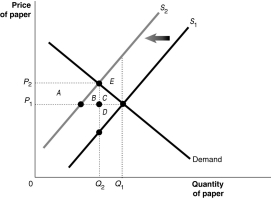 Suppose there are several paper mills producing paper for a market. These mills, located upstream from a fishing village, discharge a large amount of wastewater into the river. The waste material affects the number of fish in the river, and the use of the river for recreation and as a public water supply source. Figure 5-4 shows the paper market. Use this Figure to answer the following question(s).
-Refer to Figure 5-4. What does S1 represent?
Suppose there are several paper mills producing paper for a market. These mills, located upstream from a fishing village, discharge a large amount of wastewater into the river. The waste material affects the number of fish in the river, and the use of the river for recreation and as a public water supply source. Figure 5-4 shows the paper market. Use this Figure to answer the following question(s).
-Refer to Figure 5-4. What does S1 represent? (Multiple Choice)
4.8/5 (79)
(79) Which of the following is an example of a product that is nonexcludable and rival?
(Multiple Choice)
4.7/5 (87)
(87) It is difficult for a private market to provide the economically efficient quantity of a public good because
(Multiple Choice)
4.9/5 (64)
(64) Ronald Coase is famous for the Coase Theorem, which is based on the premise that there is an economically efficient level of pollution reduction. Many economists believe that the tradable emissions allowance program that has been used to deal with the problem of acid rain has been successful in reducing emissions of sulfur dioxide in an economically efficient manner. Why isn't this program an example of the Coase Theorem?
(Essay)
4.8/5 (94)
(94) Figure 5-15  Figure 5-15 shows the market for Atlantic salmon, a common resource. The current market equilibrium output of Q1 is not the economically efficient output. The economically efficient output is Q2.
-Refer to Figure 5-15. The current market equilibrium output is partly the result of overfishing. In that case, what does S2 represent?
Figure 5-15 shows the market for Atlantic salmon, a common resource. The current market equilibrium output of Q1 is not the economically efficient output. The economically efficient output is Q2.
-Refer to Figure 5-15. The current market equilibrium output is partly the result of overfishing. In that case, what does S2 represent? (Multiple Choice)
4.9/5 (88)
(88) Which of the following statements about the economically efficient level of air pollution is correct?
(Multiple Choice)
5.0/5 (77)
(77) Sefronia and Bella share an apartment and they are deciding whether or not to purchase a weekly housecleaning service. The value of the service to each of them is $50 and it costs $80 to hire a housecleaner. Should they hire a housecleaner?
(Multiple Choice)
4.8/5 (70)
(70) Congress passed the Clean Air Act in 1970. Since this act was passed, emissions of the six main air pollutants
(Multiple Choice)
4.9/5 (82)
(82) Which of the following is a possible solution when a scarce resource is subject to the tragedy of the commons?
(Multiple Choice)
4.9/5 (78)
(78) Figure 5-10 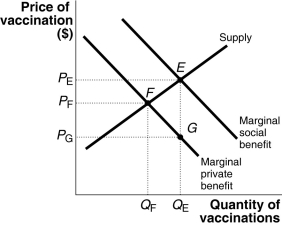 Chicken pox vaccinations for toddlers benefit society by protecting young children and by preventing an epidemic of the disease. Thus, the social benefits of chicken pox vaccinations exceed the private benefit for any quantity of vaccinations as illustrated in Figure 5-10.
-Government imposed quantitative limits on the amount of pollution firms are allowed to produce is an example of
Chicken pox vaccinations for toddlers benefit society by protecting young children and by preventing an epidemic of the disease. Thus, the social benefits of chicken pox vaccinations exceed the private benefit for any quantity of vaccinations as illustrated in Figure 5-10.
-Government imposed quantitative limits on the amount of pollution firms are allowed to produce is an example of (Multiple Choice)
5.0/5 (89)
(89) How does a positive externality in consumption reduce economic efficiency?
(Essay)
4.9/5 (78)
(78) When a tax on output is imposed to internalize the external costs of pollution, the supply curve shifts down by the amount of the tax.
(True/False)
4.9/5 (87)
(87) Article Summary
According to a study by the Center for Neighborhood Technology, homes located within one-half mile of frequently-used public transportation held their value much better during the recent housing market downturn than did those without easy access to public transportation, and the greater home values reflect greater demand for neighborhoods in close proximity to public transportation. In addition to higher home values, the study found that close proximity to public transportation offers lower transportation costs, a wider variety of travel options, and access to more employment opportunities.
Source: Meg Handley, "Study: Proximity to Public Transit Boosts Home Values," U.S. News & World Report, March 22, 2013.
-Refer to the Article Summary. Higher home values which result from close proximity to public transportation are an example of a ________ due to the public transportation.
(Multiple Choice)
4.9/5 (89)
(89) Article Summary
According to a study by the Center for Neighborhood Technology, homes located within one-half mile of frequently-used public transportation held their value much better during the recent housing market downturn than did those without easy access to public transportation, and the greater home values reflect greater demand for neighborhoods in close proximity to public transportation. In addition to higher home values, the study found that close proximity to public transportation offers lower transportation costs, a wider variety of travel options, and access to more employment opportunities.
Source: Meg Handley, "Study: Proximity to Public Transit Boosts Home Values," U.S. News & World Report, March 22, 2013.
-An externality is an example of a market failure.
(True/False)
4.8/5 (70)
(70) Which of the following must be present to reach a private solution to an externality problem?
(Multiple Choice)
4.8/5 (88)
(88) 
Filters
- Essay(0)
- Multiple Choice(0)
- Short Answer(0)
- True False(0)
- Matching(0)