



 Chat with AI
Exam 5: Externalities, Environmental Policy, and Public Goods

Exam 1: Economics: Foundations and Models444 Questions
Exam 2: Trade-Offs, Comparative Advantage, and the Market System498 Questions
Exam 3: Where Prices Come From: the Interaction of Demand and Supply475 Questions
Exam 4: Economic Efficiency, Government Price Setting, and Taxes419 Questions
Exam 5: Externalities, Environmental Policy, and Public Goods266 Questions
Exam 6: Elasticity: the Responsiveness of Demand and Supply295 Questions
Exam 7: The Economics of Health Care334 Questions
Exam 8: Firms, the Stock Market, and Corporate Governance278 Questions
Exam 9: Comparative Advantage and the Gains From International Trade379 Questions
Exam 10: Consumer Choice and Behavioral Economics302 Questions
Exam 11: Technology, Production, and Costs330 Questions
Exam 12: Firms in Perfectly Competitive Markets298 Questions
Exam 13: Monopolistic Competition: the Competitive Model in a More Realistic Setting276 Questions
Exam 14: Oligopoly: Firms in Less Competitive Markets262 Questions
Exam 15: Monopoly and Antitrust Policy271 Questions
Exam 16: Pricing Strategy263 Questions
Exam 17: The Markets for Labor and Other Factors of Production286 Questions
Exam 18: Public Choice, Taxes, and the Distribution of Income258 Questions
Exam 19: GDP: Measuring Total Production and Income266 Questions
Exam 20: Unemployment and Inflation292 Questions
Exam 21: Economic Growth, the Financial System, and Business Cycles257 Questions
Exam 22: Long-Run Economic Growth: Sources and Policies268 Questions
Exam 23: Aggregate Expenditure and Output in the Short Run306 Questions
Exam 24: Aggregate Demand and Aggregate Supply Analysis284 Questions
Exam 25: Money, Banks, and the Federal Reserve System280 Questions
Exam 26: Monetary Policy277 Questions
Exam 27: Fiscal Policy303 Questions
Exam 28: Inflation, Unemployment, and Federal Reserve Policy257 Questions
Exam 29: Macroeconomics in an Open Economy278 Questions
Exam 30: The International Financial System262 Questions
Select questions type


Public goods are distinguished by two primary characteristics. What are they?
(Multiple Choice)
5.0/5  (75)
(75) When the government imposes a tax equal to the external cost of producing a product that causes pollution, the government is said to externalize the externality.
(True/False)
4.8/5 (82)
(82) When the federal government orders firms to use particular methods to reduce pollution, it is said to be using
(Multiple Choice)
4.8/5 (87)
(87) Figure 5-16  Amit and Bree are the only two homeowners on an isolated private road. Both agree that installing street lights along the road would be beneficial and want to do so. Figure 5-16 shows their willingness to pay for different quantities of street lights, the market demand for street lights and the marginal cost of installing the street lights.
-Refer to Figure 5-16. How much is Amit willing to pay to have 4 street lights installed?
Amit and Bree are the only two homeowners on an isolated private road. Both agree that installing street lights along the road would be beneficial and want to do so. Figure 5-16 shows their willingness to pay for different quantities of street lights, the market demand for street lights and the marginal cost of installing the street lights.
-Refer to Figure 5-16. How much is Amit willing to pay to have 4 street lights installed? (Multiple Choice)
4.8/5 (79)
(79) Economists Kenneth Chay and Michael Greenstone find that in the two years following the passage of the Clean Air Act of 1970, the sharp reduction in air pollution also led to a decline in infant deaths. Although this and other studies provide compelling evidence of the link between pollution and infant health, it is not clear that reductions from the much lower levels of ambient pollution today would have the same effect. Which of the following reasons could explain this?
(Multiple Choice)
4.8/5 (86)
(86) Figure 5-3  -Refer to Figure 5-3. The size of marginal external benefits can be determined by
 (Multiple Choice)
4.8/5 (85)
(85) The basic cause of deadweight losses from the existence of common resources and externalities is
(Multiple Choice)
4.8/5 (81)
(81) Figure 5-6  Figure 5-6 shows the market for measles vaccinations, a product whose use generates positive externalities.
-Refer to Figure 5-6. What is the deadweight loss resulting from producing at the market equilibrium?
Figure 5-6 shows the market for measles vaccinations, a product whose use generates positive externalities.
-Refer to Figure 5-6. What is the deadweight loss resulting from producing at the market equilibrium? (Multiple Choice)
4.7/5 (81)
(81) In the United States, many beekeepers travel from state to state, renting out their bee colonies to farmers for pollination services. This is an example of
(Multiple Choice)
4.9/5 (94)
(94) Goods can be classified on the basis of whether their consumption is
(Multiple Choice)
5.0/5 (71)
(71) Figure 5-2  Figure 5-2 shows a market with a negative externality.
-Which of the following conditions holds in an economically efficient competitive market equilibrium?
Figure 5-2 shows a market with a negative externality.
-Which of the following conditions holds in an economically efficient competitive market equilibrium? (Multiple Choice)
4.8/5 (89)
(89) Figure 5-10 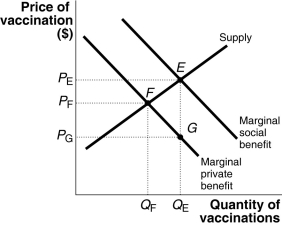 Chicken pox vaccinations for toddlers benefit society by protecting young children and by preventing an epidemic of the disease. Thus, the social benefits of chicken pox vaccinations exceed the private benefit for any quantity of vaccinations as illustrated in Figure 5-10.
-What is the rationale behind a marketable emission allowance scheme?
Chicken pox vaccinations for toddlers benefit society by protecting young children and by preventing an epidemic of the disease. Thus, the social benefits of chicken pox vaccinations exceed the private benefit for any quantity of vaccinations as illustrated in Figure 5-10.
-What is the rationale behind a marketable emission allowance scheme? (Multiple Choice)
5.0/5 (82)
(82) Private producers have no incentive to provide public goods because
(Multiple Choice)
4.9/5 (97)
(97) Article Summary
According to a study by the Center for Neighborhood Technology, homes located within one-half mile of frequently-used public transportation held their value much better during the recent housing market downturn than did those without easy access to public transportation, and the greater home values reflect greater demand for neighborhoods in close proximity to public transportation. In addition to higher home values, the study found that close proximity to public transportation offers lower transportation costs, a wider variety of travel options, and access to more employment opportunities.
Source: Meg Handley, "Study: Proximity to Public Transit Boosts Home Values," U.S. News & World Report, March 22, 2013.
-When products that create positive externalities are produced, at the market equilibrium output, the social benefit generated by consuming the product exceeds the private benefit.
(True/False)
4.8/5 (77)
(77) Figure 5-3
-Refer to Figure 5-3. The efficient output level is
-Refer to Figure 5-3. The efficient output level is (Multiple Choice)
4.9/5 (85)
(85) Figure 5-6 Figure 5-6 shows the market for measles vaccinations, a product whose use generates positive externalities.
-Refer to Figure 5-6. What does D1 represent?
Figure 5-6 shows the market for measles vaccinations, a product whose use generates positive externalities.
-Refer to Figure 5-6. What does D1 represent? (Multiple Choice)
4.8/5 (65)
(65) An external benefit is created when you pursue a college education.
(True/False)
4.8/5 (76)
(76) Figure 5-7  -Refer to Figure 5-7. The marginal cost of reducing pollution curve is the same curve as
 (Multiple Choice)
4.9/5 (90)
(90) 
Filters
- Essay(0)
- Multiple Choice(0)
- Short Answer(0)
- True False(0)
- Matching(0)