



 Chat with AI
Exam 5: Externalities, Environmental Policy, and Public Goods

Exam 1: Economics: Foundations and Models444 Questions
Exam 2: Trade-Offs, Comparative Advantage, and the Market System498 Questions
Exam 3: Where Prices Come From: the Interaction of Demand and Supply475 Questions
Exam 4: Economic Efficiency, Government Price Setting, and Taxes419 Questions
Exam 5: Externalities, Environmental Policy, and Public Goods266 Questions
Exam 6: Elasticity: the Responsiveness of Demand and Supply295 Questions
Exam 7: The Economics of Health Care334 Questions
Exam 8: Firms, the Stock Market, and Corporate Governance278 Questions
Exam 9: Comparative Advantage and the Gains From International Trade379 Questions
Exam 10: Consumer Choice and Behavioral Economics302 Questions
Exam 11: Technology, Production, and Costs330 Questions
Exam 12: Firms in Perfectly Competitive Markets298 Questions
Exam 13: Monopolistic Competition: the Competitive Model in a More Realistic Setting276 Questions
Exam 14: Oligopoly: Firms in Less Competitive Markets262 Questions
Exam 15: Monopoly and Antitrust Policy271 Questions
Exam 16: Pricing Strategy263 Questions
Exam 17: The Markets for Labor and Other Factors of Production286 Questions
Exam 18: Public Choice, Taxes, and the Distribution of Income258 Questions
Exam 19: GDP: Measuring Total Production and Income266 Questions
Exam 20: Unemployment and Inflation292 Questions
Exam 21: Economic Growth, the Financial System, and Business Cycles257 Questions
Exam 22: Long-Run Economic Growth: Sources and Policies268 Questions
Exam 23: Aggregate Expenditure and Output in the Short Run306 Questions
Exam 24: Aggregate Demand and Aggregate Supply Analysis284 Questions
Exam 25: Money, Banks, and the Federal Reserve System280 Questions
Exam 26: Monetary Policy277 Questions
Exam 27: Fiscal Policy303 Questions
Exam 28: Inflation, Unemployment, and Federal Reserve Policy257 Questions
Exam 29: Macroeconomics in an Open Economy278 Questions
Exam 30: The International Financial System262 Questions
Select questions type


What does the phrase "internalizing an external cost" mean?
(Multiple Choice)
4.8/5  (70)
(70) Figure 5-8  Consider a chemical plant that discharges toxic fumes over a nearby community. To reduce the emissions of toxic fumes the firm can install pollution abatement devices. Figure 5-8 shows the marginal benefit and the marginal cost from reducing the toxic fumes emissions.
-Refer to Figure 5-8. Suppose the emissions reduction target is currently established at 8 million tons. What is the area that represents the cost of eliminating an additional 1 million tons?
Consider a chemical plant that discharges toxic fumes over a nearby community. To reduce the emissions of toxic fumes the firm can install pollution abatement devices. Figure 5-8 shows the marginal benefit and the marginal cost from reducing the toxic fumes emissions.
-Refer to Figure 5-8. Suppose the emissions reduction target is currently established at 8 million tons. What is the area that represents the cost of eliminating an additional 1 million tons? (Multiple Choice)
4.8/5 (74)
(74) One difference between the demand for a private good and that for a public good is that
(Multiple Choice)
4.9/5 (79)
(79) When negative externalities exist, the competitive market supply curve does not include all of the costs borne by members of society.
(True/False)
4.8/5 (82)
(82) The 2005, 24 European Union nations established a cap-and-trade system which was designed to
(Multiple Choice)
5.0/5 (81)
(81) Article Summary
According to a study by the Center for Neighborhood Technology, homes located within one-half mile of frequently-used public transportation held their value much better during the recent housing market downturn than did those without easy access to public transportation, and the greater home values reflect greater demand for neighborhoods in close proximity to public transportation. In addition to higher home values, the study found that close proximity to public transportation offers lower transportation costs, a wider variety of travel options, and access to more employment opportunities.
Source: Meg Handley, "Study: Proximity to Public Transit Boosts Home Values," U.S. News & World Report, March 22, 2013.
-When there is a negative externality, the competitive output is more than the economically efficient output level.
(True/False)
4.9/5 (74)
(74) In the past the federal government often employed what is called a "command and control" approach to the reduction of pollution emissions. Many economists are critical of this approach because
(Multiple Choice)
5.0/5 (84)
(84) In England during the Middle Ages each village had an area of pasture on which any family in the village was allowed to graze its cows and sheep without charge. Eventually, the grass in the pasture would be depleted and no family's cow or sheep would get enough to eat. The reason the grass was depleted was
(Multiple Choice)
4.8/5 (76)
(76) A product is considered to be excludable if it is jointly owned by all members of a community.
(True/False)
4.7/5 (70)
(70) Briefly explain the command-and-control approach in dealing with an externality such as pollution. Give an example of the U.S. government using the command-and-control approach to deal with the pollution problem.
(Essay)
4.8/5 (78)
(78) State and local governments subsidize college students with grants and low-interest loans. The loans and subsidies are examples of
(Multiple Choice)
4.9/5 (63)
(63) What is a Pigovian tax? What happens to deadweight loss when a Pigovian tax is implemented?
(Essay)
5.0/5 (74)
(74) Figure 5-4 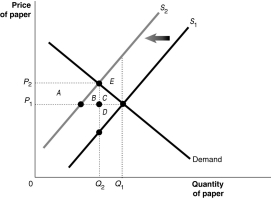 Suppose there are several paper mills producing paper for a market. These mills, located upstream from a fishing village, discharge a large amount of wastewater into the river. The waste material affects the number of fish in the river, and the use of the river for recreation and as a public water supply source. Figure 5-4 shows the paper market. Use this Figure to answer the following question(s).
-Refer to Figure 5-4. Why is there a deadweight loss?
Suppose there are several paper mills producing paper for a market. These mills, located upstream from a fishing village, discharge a large amount of wastewater into the river. The waste material affects the number of fish in the river, and the use of the river for recreation and as a public water supply source. Figure 5-4 shows the paper market. Use this Figure to answer the following question(s).
-Refer to Figure 5-4. Why is there a deadweight loss? (Multiple Choice)
4.9/5 (64)
(64) Figure 5-10 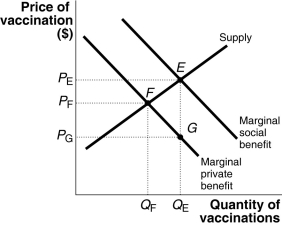 Chicken pox vaccinations for toddlers benefit society by protecting young children and by preventing an epidemic of the disease. Thus, the social benefits of chicken pox vaccinations exceed the private benefit for any quantity of vaccinations as illustrated in Figure 5-10.
-Consider the following methods of pollution reduction: a. the government sets a target for maximum emissions
B. the government mandates the installation of specific pollution abatement equipment
C. the government imposes a per unit tax on the good that creates pollution
D. the government gives firms a tax rebate for every unit of pollution abated
Which of the above is an example of a command and control approach to reducing pollution?
Chicken pox vaccinations for toddlers benefit society by protecting young children and by preventing an epidemic of the disease. Thus, the social benefits of chicken pox vaccinations exceed the private benefit for any quantity of vaccinations as illustrated in Figure 5-10.
-Consider the following methods of pollution reduction: a. the government sets a target for maximum emissions
B. the government mandates the installation of specific pollution abatement equipment
C. the government imposes a per unit tax on the good that creates pollution
D. the government gives firms a tax rebate for every unit of pollution abated
Which of the above is an example of a command and control approach to reducing pollution? (Multiple Choice)
5.0/5 (79)
(79) Figure 5-2  Figure 5-2 shows a market with a negative externality.
-A market supply curve reflects the
Figure 5-2 shows a market with a negative externality.
-A market supply curve reflects the (Multiple Choice)
4.8/5 (81)
(81) Which of the following is an example of a quasi-public good?
(Multiple Choice)
4.9/5 (89)
(89) 
Filters
- Essay(0)
- Multiple Choice(0)
- Short Answer(0)
- True False(0)
- Matching(0)