



 Chat with AI
Exam 5: Externalities, Environmental Policy, and Public Goods

Exam 1: Economics: Foundations and Models444 Questions
Exam 2: Trade-Offs, Comparative Advantage, and the Market System498 Questions
Exam 3: Where Prices Come From: the Interaction of Demand and Supply475 Questions
Exam 4: Economic Efficiency, Government Price Setting, and Taxes419 Questions
Exam 5: Externalities, Environmental Policy, and Public Goods266 Questions
Exam 6: Elasticity: the Responsiveness of Demand and Supply295 Questions
Exam 7: The Economics of Health Care334 Questions
Exam 8: Firms, the Stock Market, and Corporate Governance278 Questions
Exam 9: Comparative Advantage and the Gains From International Trade379 Questions
Exam 10: Consumer Choice and Behavioral Economics302 Questions
Exam 11: Technology, Production, and Costs330 Questions
Exam 12: Firms in Perfectly Competitive Markets298 Questions
Exam 13: Monopolistic Competition: the Competitive Model in a More Realistic Setting276 Questions
Exam 14: Oligopoly: Firms in Less Competitive Markets262 Questions
Exam 15: Monopoly and Antitrust Policy271 Questions
Exam 16: Pricing Strategy263 Questions
Exam 17: The Markets for Labor and Other Factors of Production286 Questions
Exam 18: Public Choice, Taxes, and the Distribution of Income258 Questions
Exam 19: GDP: Measuring Total Production and Income266 Questions
Exam 20: Unemployment and Inflation292 Questions
Exam 21: Economic Growth, the Financial System, and Business Cycles257 Questions
Exam 22: Long-Run Economic Growth: Sources and Policies268 Questions
Exam 23: Aggregate Expenditure and Output in the Short Run306 Questions
Exam 24: Aggregate Demand and Aggregate Supply Analysis284 Questions
Exam 25: Money, Banks, and the Federal Reserve System280 Questions
Exam 26: Monetary Policy277 Questions
Exam 27: Fiscal Policy303 Questions
Exam 28: Inflation, Unemployment, and Federal Reserve Policy257 Questions
Exam 29: Macroeconomics in an Open Economy278 Questions
Exam 30: The International Financial System262 Questions
Select questions type


The efficient level of paper production will occur where the
(Multiple Choice)
4.8/5  (98)
(98) Overuse of a common resource may be avoided by all of the following methods except
(Multiple Choice)
4.9/5 (81)
(81) Congressman Murphy made the following proposal: "We should establish policies that completely eliminate air pollution. This is the only way to ensure that none of our citizens suffers the negative effects of air pollution." If Congressman Murphy's proposal was adopted and all forms of air pollution were eliminated, which of the following would be true?
(Multiple Choice)
4.8/5 (79)
(79) Alternative approaches for reducing carbon dioxide emissions are
(Multiple Choice)
4.7/5 (73)
(73) Figure 5-2  Figure 5-2 shows a market with a negative externality.
-Refer to Figure 5-2. The private profit maximizing quantity for the firm is
Figure 5-2 shows a market with a negative externality.
-Refer to Figure 5-2. The private profit maximizing quantity for the firm is (Multiple Choice)
5.0/5 (80)
(80) Issuing marketable emission allowance permits to polluting firms will result in those firms polluting more than is socially desirable.
(True/False)
4.8/5 (88)
(88) Assume that air pollution from a copper smelter imposes external costs on people who live near the smelter. If the victims of the pollution could not legally enforce the right of their property not to be damaged, the amount of pollution reduction
(Multiple Choice)
4.9/5 (86)
(86) Which of the following displays these two characteristics: rivalry and nonexcludability?
(Multiple Choice)
4.8/5 (93)
(93) Which of the following criteria should be used to evaluate if government intervention in a market for the purpose of environmental protection is justified?
(Multiple Choice)
4.7/5 (80)
(80) Which of the following is an example of the U.S. government's use of a "command and control" approach to reducing pollution?
(Multiple Choice)
4.9/5 (91)
(91) Figure 5-1 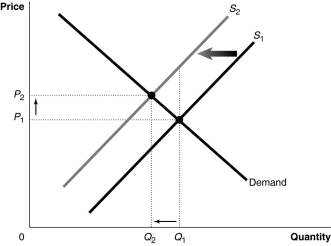 Figure 5-1 shows a market with an externality. The current market equilibrium output of Q1 is not the economically efficient output. The economically efficient output is Q2.
-Refer to Figure 5-1. If, because of an externality, the economically efficient output is Q2 and not the current equilibrium output of Q1, what does S2 represent?
Figure 5-1 shows a market with an externality. The current market equilibrium output of Q1 is not the economically efficient output. The economically efficient output is Q2.
-Refer to Figure 5-1. If, because of an externality, the economically efficient output is Q2 and not the current equilibrium output of Q1, what does S2 represent? (Multiple Choice)
4.8/5 (94)
(94) If policymakers use a pollution tax to control pollution, the tax per unit of pollution should be set
(Multiple Choice)
4.7/5 (82)
(82) If transactions costs are low, private bargaining will always result in an efficient solution to the problem of externalities.
(True/False)
4.8/5 (97)
(97) The costs in time and other resources that parties incur in the process of facilitating an exchange of goods and services are called
(Multiple Choice)
4.9/5 (81)
(81) How does a negative externality in production reduce economic efficiency?
(Essay)
4.8/5 (90)
(90) 
Filters
- Essay(0)
- Multiple Choice(0)
- Short Answer(0)
- True False(0)
- Matching(0)