



 Chat with AI
Exam 5: Externalities, Environmental Policy, and Public Goods

Exam 1: Economics: Foundations and Models444 Questions
Exam 2: Trade-Offs, Comparative Advantage, and the Market System498 Questions
Exam 3: Where Prices Come From: the Interaction of Demand and Supply475 Questions
Exam 4: Economic Efficiency, Government Price Setting, and Taxes419 Questions
Exam 5: Externalities, Environmental Policy, and Public Goods266 Questions
Exam 6: Elasticity: the Responsiveness of Demand and Supply295 Questions
Exam 7: The Economics of Health Care334 Questions
Exam 8: Firms, the Stock Market, and Corporate Governance278 Questions
Exam 9: Comparative Advantage and the Gains From International Trade379 Questions
Exam 10: Consumer Choice and Behavioral Economics302 Questions
Exam 11: Technology, Production, and Costs330 Questions
Exam 12: Firms in Perfectly Competitive Markets298 Questions
Exam 13: Monopolistic Competition: the Competitive Model in a More Realistic Setting276 Questions
Exam 14: Oligopoly: Firms in Less Competitive Markets262 Questions
Exam 15: Monopoly and Antitrust Policy271 Questions
Exam 16: Pricing Strategy263 Questions
Exam 17: The Markets for Labor and Other Factors of Production286 Questions
Exam 18: Public Choice, Taxes, and the Distribution of Income258 Questions
Exam 19: GDP: Measuring Total Production and Income266 Questions
Exam 20: Unemployment and Inflation292 Questions
Exam 21: Economic Growth, the Financial System, and Business Cycles257 Questions
Exam 22: Long-Run Economic Growth: Sources and Policies268 Questions
Exam 23: Aggregate Expenditure and Output in the Short Run306 Questions
Exam 24: Aggregate Demand and Aggregate Supply Analysis284 Questions
Exam 25: Money, Banks, and the Federal Reserve System280 Questions
Exam 26: Monetary Policy277 Questions
Exam 27: Fiscal Policy303 Questions
Exam 28: Inflation, Unemployment, and Federal Reserve Policy257 Questions
Exam 29: Macroeconomics in an Open Economy278 Questions
Exam 30: The International Financial System262 Questions
Select questions type


Figure 5-3  -Refer to Figure 5-3. The private profit maximizing output level is
 (Multiple Choice)
4.8/5  (76)
(76) Figure 5-7  -Refer to Figure 5-7. The marginal benefit of reducing pollution curve is the same curve as
 (Multiple Choice)
4.8/5 (68)
(68) Which of the following is an example of a nonexcludable product?
(Multiple Choice)
4.7/5 (74)
(74) "When it comes to public goods, individuals do not reveal their true preferences because it is not in their self-interest to do so." Evaluate this statement.
(Essay)
5.0/5 (84)
(84) Which of the following would result in a positive externality?
(Multiple Choice)
4.9/5 (82)
(82) A public good that is a good that is both rival and excludable.
(True/False)
4.8/5 (80)
(80) An advantage of imposing a tax on the producer that generates pollution is that
(Multiple Choice)
4.8/5 (72)
(72) Governments can increase the consumption of a product that creates positive externalities by
(Multiple Choice)
4.8/5 (81)
(81) Figure 5-9  Companies producing toilet paper bleach the paper to make it white. The bleach is discharged into rivers and lakes and causes substantial environmental damage. Figure 5-9 illustrates the situation in the toilet paper market.
-Refer to Figure 5-9. Suppose the government wants to use a Pigovian tax to bring about the efficient level of production. What should the value of the tax be?
Companies producing toilet paper bleach the paper to make it white. The bleach is discharged into rivers and lakes and causes substantial environmental damage. Figure 5-9 illustrates the situation in the toilet paper market.
-Refer to Figure 5-9. Suppose the government wants to use a Pigovian tax to bring about the efficient level of production. What should the value of the tax be? (Multiple Choice)
4.9/5 (87)
(87) What is meant by the term "internalizing an externality"? How does a Pigovian tax or subsidy internalize an externality?
(Essay)
4.8/5 (69)
(69) Figure 5-7
-Refer to Figure 5-7. What is the incremental benefit of increasing the quantity of pollution reduction from QB to QE units?
-Refer to Figure 5-7. What is the incremental benefit of increasing the quantity of pollution reduction from QB to QE units? (Multiple Choice)
4.9/5 (73)
(73) Figure 5-10 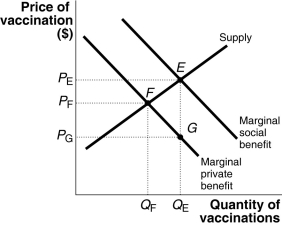 Chicken pox vaccinations for toddlers benefit society by protecting young children and by preventing an epidemic of the disease. Thus, the social benefits of chicken pox vaccinations exceed the private benefit for any quantity of vaccinations as illustrated in Figure 5-10.
-Refer to Figure 5-10. What is the value of the net gain to society as a result of subsidizing chicken pox vaccinations?
Chicken pox vaccinations for toddlers benefit society by protecting young children and by preventing an epidemic of the disease. Thus, the social benefits of chicken pox vaccinations exceed the private benefit for any quantity of vaccinations as illustrated in Figure 5-10.
-Refer to Figure 5-10. What is the value of the net gain to society as a result of subsidizing chicken pox vaccinations? (Multiple Choice)
4.8/5 (86)
(86) The tragedy of the commons was avoided in the Middle Ages by
(Multiple Choice)
4.7/5 (90)
(90) The cost borne by a producer in the production of a good or service is called
(Multiple Choice)
4.9/5 (66)
(66) Conceptually, the efficient level of carbon emissions is the level for which
(Multiple Choice)
4.7/5 (56)
(56) Because producers do not bear the external cost of pollution,
(Multiple Choice)
4.8/5 (65)
(65) Figure 5-6  Figure 5-6 shows the market for measles vaccinations, a product whose use generates positive externalities.
-Refer to Figure 5-6. What does D2 represent?
Figure 5-6 shows the market for measles vaccinations, a product whose use generates positive externalities.
-Refer to Figure 5-6. What does D2 represent? (Multiple Choice)
4.7/5 (68)
(68) Figure 5-9 Companies producing toilet paper bleach the paper to make it white. The bleach is discharged into rivers and lakes and causes substantial environmental damage. Figure 5-9 illustrates the situation in the toilet paper market.
-Refer to Figure 5-9. An efficient way to get the firm to produce the socially optimal output level is
Companies producing toilet paper bleach the paper to make it white. The bleach is discharged into rivers and lakes and causes substantial environmental damage. Figure 5-9 illustrates the situation in the toilet paper market.
-Refer to Figure 5-9. An efficient way to get the firm to produce the socially optimal output level is (Multiple Choice)
4.7/5 (93)
(93) Private solutions to the problem of externalities are most likely when
(Multiple Choice)
4.8/5 (72)
(72) 
Filters
- Essay(0)
- Multiple Choice(0)
- Short Answer(0)
- True False(0)
- Matching(0)