



 Chat with AI
Exam 5: Externalities, Environmental Policy, and Public Goods

Exam 1: Economics: Foundations and Models444 Questions
Exam 2: Trade-Offs, Comparative Advantage, and the Market System498 Questions
Exam 3: Where Prices Come From: the Interaction of Demand and Supply475 Questions
Exam 4: Economic Efficiency, Government Price Setting, and Taxes419 Questions
Exam 5: Externalities, Environmental Policy, and Public Goods266 Questions
Exam 6: Elasticity: the Responsiveness of Demand and Supply295 Questions
Exam 7: The Economics of Health Care334 Questions
Exam 8: Firms, the Stock Market, and Corporate Governance278 Questions
Exam 9: Comparative Advantage and the Gains From International Trade379 Questions
Exam 10: Consumer Choice and Behavioral Economics302 Questions
Exam 11: Technology, Production, and Costs330 Questions
Exam 12: Firms in Perfectly Competitive Markets298 Questions
Exam 13: Monopolistic Competition: the Competitive Model in a More Realistic Setting276 Questions
Exam 14: Oligopoly: Firms in Less Competitive Markets262 Questions
Exam 15: Monopoly and Antitrust Policy271 Questions
Exam 16: Pricing Strategy263 Questions
Exam 17: The Markets for Labor and Other Factors of Production286 Questions
Exam 18: Public Choice, Taxes, and the Distribution of Income258 Questions
Exam 19: GDP: Measuring Total Production and Income266 Questions
Exam 20: Unemployment and Inflation292 Questions
Exam 21: Economic Growth, the Financial System, and Business Cycles257 Questions
Exam 22: Long-Run Economic Growth: Sources and Policies268 Questions
Exam 23: Aggregate Expenditure and Output in the Short Run306 Questions
Exam 24: Aggregate Demand and Aggregate Supply Analysis284 Questions
Exam 25: Money, Banks, and the Federal Reserve System280 Questions
Exam 26: Monetary Policy277 Questions
Exam 27: Fiscal Policy303 Questions
Exam 28: Inflation, Unemployment, and Federal Reserve Policy257 Questions
Exam 29: Macroeconomics in an Open Economy278 Questions
Exam 30: The International Financial System262 Questions
Select questions type


Figure 5-2  Figure 5-2 shows a market with a negative externality.
-Refer to Figure 5-2. The deadweight loss due to the externality is represented by the area
Figure 5-2 shows a market with a negative externality.
-Refer to Figure 5-2. The deadweight loss due to the externality is represented by the area (Multiple Choice)
5.0/5  (70)
(70) How does the construction of a market demand curve for a private good differ from that for a public good?
(Multiple Choice)
4.7/5 (65)
(65) Compare two situations. (A) A firm is not legally responsible for damages that result from air pollution caused by its production of steel. (B) A firm is legally responsible for damages that result from its production of steel. Ronald Coase argued that
(Multiple Choice)
4.9/5 (94)
(94) Which of the following describes how a negative externality affects a competitive market?
(Multiple Choice)
4.9/5 (88)
(88) Figure 5-13 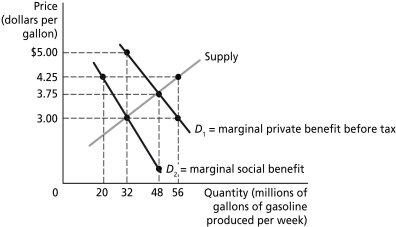 Figure 5-13 illustrates the market for gasoline before and after the government imposes a tax to bring about the efficient level of gasoline production.
-Refer to Figure 5-13. The efficient equilibrium price of gasoline is ________ per gallon.
Figure 5-13 illustrates the market for gasoline before and after the government imposes a tax to bring about the efficient level of gasoline production.
-Refer to Figure 5-13. The efficient equilibrium price of gasoline is ________ per gallon. (Multiple Choice)
4.8/5 (78)
(78) A modern example of the tragedy of the commons is the forests in many poor countries.
(True/False)
4.8/5 (87)
(87) Explain how mandatory seat belt laws may reduce the negative externalities of risky behavior.
(Essay)
4.7/5 (68)
(68) Figure 5-11 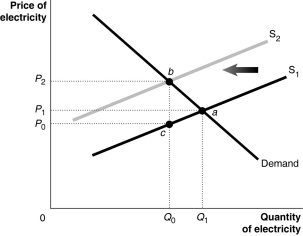 Coal burning utilities release sulfur dioxide and nitric acid which react with water to produce acid rain. Acid rain damages trees and crops and kills fish. Because the utilities do not bear the cost of the acid rain they overproduce the quantity of electricity. This is illustrated in Figure 5-11.
-Refer to Figure 5-11. S1 represents the supply curve that reflects the private cost of production and S2 represents the supply curve that reflects the social cost of production. One way to internalize the external cost generated by utilities is to impose a Pigovian tax on the production of electricity. What is the size of the Pigovian tax that will internalize the cost of the externality?
Coal burning utilities release sulfur dioxide and nitric acid which react with water to produce acid rain. Acid rain damages trees and crops and kills fish. Because the utilities do not bear the cost of the acid rain they overproduce the quantity of electricity. This is illustrated in Figure 5-11.
-Refer to Figure 5-11. S1 represents the supply curve that reflects the private cost of production and S2 represents the supply curve that reflects the social cost of production. One way to internalize the external cost generated by utilities is to impose a Pigovian tax on the production of electricity. What is the size of the Pigovian tax that will internalize the cost of the externality? (Multiple Choice)
4.8/5 (95)
(95) Figure 5-2 Figure 5-2 shows a market with a negative externality.
-Refer to Figure 5-2. The marginal benefit of the last unit produced is represented by the price
Figure 5-2 shows a market with a negative externality.
-Refer to Figure 5-2. The marginal benefit of the last unit produced is represented by the price (Multiple Choice)
4.9/5 (80)
(80) Figure 5-2 Figure 5-2 shows a market with a negative externality.
-Refer to Figure 5-2. The efficient output level is
Figure 5-2 shows a market with a negative externality.
-Refer to Figure 5-2. The efficient output level is (Multiple Choice)
4.7/5 (81)
(81) Figure 5-6  Figure 5-6 shows the market for measles vaccinations, a product whose use generates positive externalities.
-Refer to Figure 5-6. What is the economically efficient output level?
Figure 5-6 shows the market for measles vaccinations, a product whose use generates positive externalities.
-Refer to Figure 5-6. What is the economically efficient output level? (Multiple Choice)
4.8/5 (74)
(74) Which of the following is an example of a common resource?
(Multiple Choice)
4.8/5 (81)
(81) If there is pollution in producing a product, then the market equilibrium price is too high and equilibrium quantity is too low.
(True/False)
4.9/5 (76)
(76) Anyone can purchase sulfur dioxide emissions allowances on the Chicago Mercantile Exchange. Several environmental groups have raised money to buy allowances (which they subsequently destroy). As part of their fund-raising, these groups have urged contributors to buy the allowances as gifts. As one newspaper story put it, "For the environmentalist in your life, here's a gift that is sold by the ton, fits in an envelope and will last forever." Source for quote: Randall Edwards, "Dear Santa: Please Bring Me Sulfur Dioxide for Christmas," Columbus Dispatch, December 19, 1999.
What would be the impact on the price of the emission allowances in the market?
(Multiple Choice)
4.9/5 (73)
(73) If the marginal benefit of reducing emissions of some air pollutant is greater than the marginal cost,
(Multiple Choice)
5.0/5 (86)
(86) State whether each of the following goods and services is nonrival, nonexcludable or both:
a. A toll road
b. A public park
c. A lighthouse
d. An art museum
e. A radio broadcast of "A Prairie Home Companion"
(Essay)
4.9/5 (79)
(79) The efficient output level of a public good occurs where the
(Multiple Choice)
4.9/5 (79)
(79) Figure 5-9  Companies producing toilet paper bleach the paper to make it white. The bleach is discharged into rivers and lakes and causes substantial environmental damage. Figure 5-9 illustrates the situation in the toilet paper market.
-Refer to Figure 5-9. Let's suppose the government imposes a tax of $50 per ton of toilet paper to bring about the efficient level of production. What happens to the market price of toilet paper?
Companies producing toilet paper bleach the paper to make it white. The bleach is discharged into rivers and lakes and causes substantial environmental damage. Figure 5-9 illustrates the situation in the toilet paper market.
-Refer to Figure 5-9. Let's suppose the government imposes a tax of $50 per ton of toilet paper to bring about the efficient level of production. What happens to the market price of toilet paper? (Multiple Choice)
4.9/5 (80)
(80) One problem with using a command-and-control approach to pollution reduction is that the monitoring costs may be too high.
(True/False)
4.8/5 (68)
(68) 
Filters
- Essay(0)
- Multiple Choice(0)
- Short Answer(0)
- True False(0)
- Matching(0)