



 Chat with AI
Exam 5: Externalities, Environmental Policy, and Public Goods

Exam 1: Economics: Foundations and Models444 Questions
Exam 2: Trade-Offs, Comparative Advantage, and the Market System498 Questions
Exam 3: Where Prices Come From: the Interaction of Demand and Supply475 Questions
Exam 4: Economic Efficiency, Government Price Setting, and Taxes419 Questions
Exam 5: Externalities, Environmental Policy, and Public Goods266 Questions
Exam 6: Elasticity: the Responsiveness of Demand and Supply295 Questions
Exam 7: The Economics of Health Care334 Questions
Exam 8: Firms, the Stock Market, and Corporate Governance278 Questions
Exam 9: Comparative Advantage and the Gains From International Trade379 Questions
Exam 10: Consumer Choice and Behavioral Economics302 Questions
Exam 11: Technology, Production, and Costs330 Questions
Exam 12: Firms in Perfectly Competitive Markets298 Questions
Exam 13: Monopolistic Competition: the Competitive Model in a More Realistic Setting276 Questions
Exam 14: Oligopoly: Firms in Less Competitive Markets262 Questions
Exam 15: Monopoly and Antitrust Policy271 Questions
Exam 16: Pricing Strategy263 Questions
Exam 17: The Markets for Labor and Other Factors of Production286 Questions
Exam 18: Public Choice, Taxes, and the Distribution of Income258 Questions
Exam 19: GDP: Measuring Total Production and Income266 Questions
Exam 20: Unemployment and Inflation292 Questions
Exam 21: Economic Growth, the Financial System, and Business Cycles257 Questions
Exam 22: Long-Run Economic Growth: Sources and Policies268 Questions
Exam 23: Aggregate Expenditure and Output in the Short Run306 Questions
Exam 24: Aggregate Demand and Aggregate Supply Analysis284 Questions
Exam 25: Money, Banks, and the Federal Reserve System280 Questions
Exam 26: Monetary Policy277 Questions
Exam 27: Fiscal Policy303 Questions
Exam 28: Inflation, Unemployment, and Federal Reserve Policy257 Questions
Exam 29: Macroeconomics in an Open Economy278 Questions
Exam 30: The International Financial System262 Questions
Select questions type


Some policymakers have argue that products like cigarettes, alcohol, and sweetened soda generate negative externalities in consumption. If the government decided to impose a tax on soda, the government will cause
(Multiple Choice)
4.8/5  (96)
(96) Figure 5-3  -Refer to Figure 5-3. At the competitive market equilibrium, for the last unit produced,
 (Multiple Choice)
4.8/5 (70)
(70) Negative externalities and the tragedy of the commons are problems that have a common source. What is this common source?
(Multiple Choice)
4.9/5 (82)
(82) Goods differ on the basis of whether their consumption is rival and excludable. Explain the terms "rivalry" and "excludability" as they are used to define goods. List the four categories of goods, and define these categories in terms of rivalry and excludability.
(Essay)
4.7/5 (82)
(82) Medical research that ends in a cure for a serious disease produces positive externalities. What is the impact of this positive externality on economic efficiency?
(Multiple Choice)
4.7/5 (77)
(77) Economic incentives are designed to make individual self-interest coincide with social interest. According to economists, which of the following methods of pollution control best uses economic incentives to reduce pollution?
(Multiple Choice)
4.8/5 (66)
(66) Figure 5-9  Companies producing toilet paper bleach the paper to make it white. The bleach is discharged into rivers and lakes and causes substantial environmental damage. Figure 5-9 illustrates the situation in the toilet paper market.
-Refer to Figure 5-9. The private profit-maximizing output level is
Companies producing toilet paper bleach the paper to make it white. The bleach is discharged into rivers and lakes and causes substantial environmental damage. Figure 5-9 illustrates the situation in the toilet paper market.
-Refer to Figure 5-9. The private profit-maximizing output level is (Multiple Choice)
4.9/5 (73)
(73) Determine if each of the products below displays any of the following characteristics:
(i) rivalry
(ii) nonrivalry
(iii) excludability
(iv) nonexcludability.
a. a freeway during peak commute hours
b. an online college course
c. infectious disease prevention
d. open source software such as Linux
e. a movie showing at Century Theatres
(Essay)
4.8/5 (82)
(82) Figure 5-13 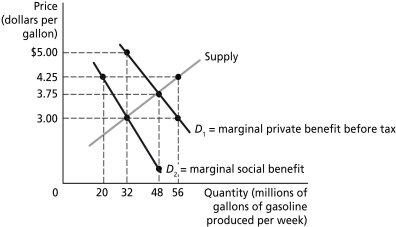 Figure 5-13 illustrates the market for gasoline before and after the government imposes a tax to bring about the efficient level of gasoline production.
-Refer to Figure 5-13. The market equilibrium quantity of gasoline is ________ million gallons per month.
Figure 5-13 illustrates the market for gasoline before and after the government imposes a tax to bring about the efficient level of gasoline production.
-Refer to Figure 5-13. The market equilibrium quantity of gasoline is ________ million gallons per month. (Multiple Choice)
4.8/5 (83)
(83) In economics, the optimal level of pollution is the level for which the net benefit from reducing the pollution is the greatest.
(True/False)
4.9/5 (77)
(77) Consider the stock of ocean tuna which is massively overfished. It is rational for an individual to exploit the resource rather than to conserve the stock because
(Multiple Choice)
4.8/5 (87)
(87) Assume that production from an electric utility caused acid rain. If the government imposed a tax on the utility equal to the cost of the acid rain, the government's action would
(Multiple Choice)
4.8/5 (83)
(83) A quasi-public good is similar to a public good in that one person's consumption of the quasi-public good does not reduce the amount available for everyone else.
(True/False)
4.8/5 (81)
(81) When there is a negative externality, the private cost of production ________ the social cost of production.
(Multiple Choice)
4.8/5 (80)
(80) Sefronia and Bella share an apartment and they are deciding whether or not to purchase a weekly housecleaning service. The value of the service to each of them is $50 and it costs $80 to hire a housecleaner. Suppose Bella is lazy and a spendthrift and Sefronia suspects that Bella will be willing to pay $80. What is Sefronia likely to do, given that she is as rational as any other person?
(Multiple Choice)
4.9/5 (85)
(85) For the Coase theorem to work, there must be clear assignment of property rights.
(True/False)
4.8/5 (90)
(90) Ronald Coase was awarded the 1991 Nobel Prize in Economics primarily for addressing problems related to externalities. Which of the following describes Coase's work?
(Multiple Choice)
4.8/5 (69)
(69) The Coase Theorem asserts that government intervention is a prerequisite for addressing externality problems.
(True/False)
4.9/5 (78)
(78) 
Filters
- Essay(0)
- Multiple Choice(0)
- Short Answer(0)
- True False(0)
- Matching(0)