



 Chat with AI
Exam 5: Externalities, Environmental Policy, and Public Goods

Exam 1: Economics: Foundations and Models444 Questions
Exam 2: Trade-Offs, Comparative Advantage, and the Market System498 Questions
Exam 3: Where Prices Come From: the Interaction of Demand and Supply475 Questions
Exam 4: Economic Efficiency, Government Price Setting, and Taxes419 Questions
Exam 5: Externalities, Environmental Policy, and Public Goods266 Questions
Exam 6: Elasticity: the Responsiveness of Demand and Supply295 Questions
Exam 7: The Economics of Health Care334 Questions
Exam 8: Firms, the Stock Market, and Corporate Governance278 Questions
Exam 9: Comparative Advantage and the Gains From International Trade379 Questions
Exam 10: Consumer Choice and Behavioral Economics302 Questions
Exam 11: Technology, Production, and Costs330 Questions
Exam 12: Firms in Perfectly Competitive Markets298 Questions
Exam 13: Monopolistic Competition: the Competitive Model in a More Realistic Setting276 Questions
Exam 14: Oligopoly: Firms in Less Competitive Markets262 Questions
Exam 15: Monopoly and Antitrust Policy271 Questions
Exam 16: Pricing Strategy263 Questions
Exam 17: The Markets for Labor and Other Factors of Production286 Questions
Exam 18: Public Choice, Taxes, and the Distribution of Income258 Questions
Exam 19: GDP: Measuring Total Production and Income266 Questions
Exam 20: Unemployment and Inflation292 Questions
Exam 21: Economic Growth, the Financial System, and Business Cycles257 Questions
Exam 22: Long-Run Economic Growth: Sources and Policies268 Questions
Exam 23: Aggregate Expenditure and Output in the Short Run306 Questions
Exam 24: Aggregate Demand and Aggregate Supply Analysis284 Questions
Exam 25: Money, Banks, and the Federal Reserve System280 Questions
Exam 26: Monetary Policy277 Questions
Exam 27: Fiscal Policy303 Questions
Exam 28: Inflation, Unemployment, and Federal Reserve Policy257 Questions
Exam 29: Macroeconomics in an Open Economy278 Questions
Exam 30: The International Financial System262 Questions
Select questions type


A negative externality is an example of market failure. The root of the problem lies in the definition and enforcement of property rights. Explain.
(Essay)
4.8/5  (69)
(69) Figure 5-13 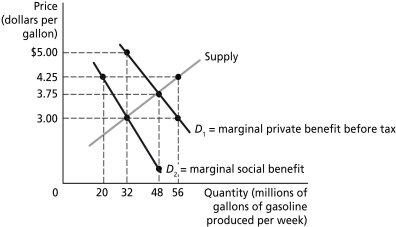 Figure 5-13 illustrates the market for gasoline before and after the government imposes a tax to bring about the efficient level of gasoline production.
-Refer to Figure 5-13. The efficient equilibrium quantity of gasoline is ________ million gallons per month.
Figure 5-13 illustrates the market for gasoline before and after the government imposes a tax to bring about the efficient level of gasoline production.
-Refer to Figure 5-13. The efficient equilibrium quantity of gasoline is ________ million gallons per month. (Multiple Choice)
5.0/5 (83)
(83) Article Summary
According to a study by the Center for Neighborhood Technology, homes located within one-half mile of frequently-used public transportation held their value much better during the recent housing market downturn than did those without easy access to public transportation, and the greater home values reflect greater demand for neighborhoods in close proximity to public transportation. In addition to higher home values, the study found that close proximity to public transportation offers lower transportation costs, a wider variety of travel options, and access to more employment opportunities.
Source: Meg Handley, "Study: Proximity to Public Transit Boosts Home Values," U.S. News & World Report, March 22, 2013.
-An externality refers to economic events outside a market.
(True/False)
4.7/5 (77)
(77) Haiti was once a heavily forested country. Today, 80 percent of Haiti's forests have been cut down, primarily to be burned to create charcoal. The reduction in the number of trees has led to devastating floods when it rains heavily. This is an example of
(Multiple Choice)
4.9/5 (77)
(77) Which of the following represents the true economic cost of production when firms produce goods that cause negative externalities?
(Multiple Choice)
5.0/5 (82)
(82) If the marginal benefit of reducing emissions of some air pollutant is less than the marginal cost,
(Multiple Choice)
5.0/5 (74)
(74) Define the tragedy of the commons. Give three examples of common resources. Briefly explain why common property resources are subject to overuse.
(Essay)
4.8/5 (69)
(69) Figure 5-14 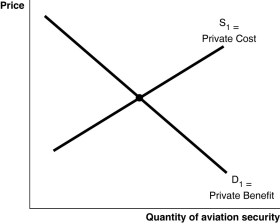 Figure 5-14 shows the market for aviation security. Aviation security generates a positive externality because people who are not airline passengers benefit from aviation security.
-Refer to Figure 5-14 to answer the following questions.
a. In the absence of any government intervention what is the equilibrium level of security that airlines will supply? Denote this level, Q*. Briefly explain why this quantity is not the economically efficient level of aviation security.
b. In the diagram, illustrate the presence of positive externalities in the aviation security market. Label any new curve that you draw.
c. On your diagram identify the economically efficient level of aviation security. Denote this level Qe.
d. Explain how a government subsidy for the airlines can bring about the economically efficient aviation security level. Be sure to identify the size of the subsidy.
Figure 5-14 shows the market for aviation security. Aviation security generates a positive externality because people who are not airline passengers benefit from aviation security.
-Refer to Figure 5-14 to answer the following questions.
a. In the absence of any government intervention what is the equilibrium level of security that airlines will supply? Denote this level, Q*. Briefly explain why this quantity is not the economically efficient level of aviation security.
b. In the diagram, illustrate the presence of positive externalities in the aviation security market. Label any new curve that you draw.
c. On your diagram identify the economically efficient level of aviation security. Denote this level Qe.
d. Explain how a government subsidy for the airlines can bring about the economically efficient aviation security level. Be sure to identify the size of the subsidy. (Essay)
4.7/5 (78)
(78) According to ________, in a market with an externality, private parties would voluntarily negotiate an efficient outcome without government intervention.
(Multiple Choice)
4.7/5 (77)
(77) Some environmentalists have criticized tradable emissions allowances on the grounds that they give permit holders a license to pollute. Furthermore, environmentalists argue that those who sell their permits receive a monetary benefit from their contribution to polluting the environment. Use economic reasoning to evaluate this criticism.
(Essay)
4.9/5 (76)
(76) Consider a situation in which a utility company emits high levels of sulfur dioxide and the company is not liable for the damages its pollution causes. According to the Coase theorem, government action is ________ to achieve an ________ amount of pollution.
(Multiple Choice)
4.9/5 (101)
(101) Figure 5-8  Consider a chemical plant that discharges toxic fumes over a nearby community. To reduce the emissions of toxic fumes the firm can install pollution abatement devices. Figure 5-8 shows the marginal benefit and the marginal cost from reducing the toxic fumes emissions.
-Refer to Figure 5-8. What is the economically efficient level of pollution reduction?
Consider a chemical plant that discharges toxic fumes over a nearby community. To reduce the emissions of toxic fumes the firm can install pollution abatement devices. Figure 5-8 shows the marginal benefit and the marginal cost from reducing the toxic fumes emissions.
-Refer to Figure 5-8. What is the economically efficient level of pollution reduction? (Multiple Choice)
4.8/5 (88)
(88) Kenneth Chay and Michael Greenstone examined the impact of reductions in air pollution since the passage of the Clean Air Act of 1970. Which of the following statements summarizes their findings?
(Multiple Choice)
4.7/5 (82)
(82) Figure 5-4 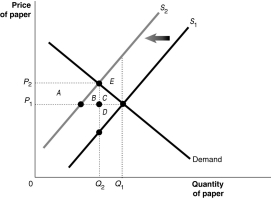 Suppose there are several paper mills producing paper for a market. These mills, located upstream from a fishing village, discharge a large amount of wastewater into the river. The waste material affects the number of fish in the river, and the use of the river for recreation and as a public water supply source. Figure 5-4 shows the paper market. Use this Figure to answer the following question(s).
-Refer to Figure 5-4. What does S2 represent?
Suppose there are several paper mills producing paper for a market. These mills, located upstream from a fishing village, discharge a large amount of wastewater into the river. The waste material affects the number of fish in the river, and the use of the river for recreation and as a public water supply source. Figure 5-4 shows the paper market. Use this Figure to answer the following question(s).
-Refer to Figure 5-4. What does S2 represent? (Multiple Choice)
4.9/5 (91)
(91) What is a private benefit from consumption? What is a social benefit from consumption? When is the private benefit from consumption equal to the social benefit from consumption?
(Essay)
5.0/5 (73)
(73) 
Filters
- Essay(0)
- Multiple Choice(0)
- Short Answer(0)
- True False(0)
- Matching(0)