



 Chat with AI
Exam 5: Thermochemistry

Exam 1: Introduction: Matter and Measurement163 Questions
Exam 2: Atoms, Molecules, and Ions250 Questions
Exam 3: Stoichiometry: Calculations With Chemical Formulas and Equations178 Questions
Exam 4: Aqueous Reactions and Solution Stoichiometry180 Questions
Exam 5: Thermochemistry154 Questions
Exam 6: Electronic Structure of Atoms186 Questions
Exam 7: Periodic Properties of the Elements176 Questions
Exam 8: Basic Concepts of Chemical Bonding147 Questions
Exam 9: Molecular Geometry and Bonding Theories183 Questions
Exam 10: Gases175 Questions
Exam 11: Liquids and Intermolecular Forces124 Questions
Exam 12: Solids and Modern Materials84 Questions
Exam 13: Properties of Solutions160 Questions
Exam 14: Chemical Kinetics134 Questions
Exam 15: Chemical Equilibrium97 Questions
Exam 16: Acid-Base Equilibria139 Questions
Exam 17: Additional Aspects of Aqueous Equilibria116 Questions
Exam 18: Chemistry of the Environment126 Questions
Exam 19: Chemical Thermodynamics125 Questions
Exam 20: Electrochemistry114 Questions
Exam 21: Nuclear Chemistry178 Questions
Exam 22: Chemistry of the Nonmetals194 Questions
Exam 23: Transition Metals and Coordination Chemistry165 Questions
Exam 24: The Chemistry of Life: Organic and Biological Chemistry131 Questions
Select questions type


Calculate the kinetic energy in joules of an 80.0 g bullet traveling at 300.0 m/s.
(Multiple Choice)
4.7/5  (79)
(79) The value of ΔH° for the following reaction is -3351 kJ: 2Al (s) + 3O2 (g) → 2Al2O3 (s)
The value of ΔH°f for Al2O3 (s)is ________ kJ.
(Multiple Choice)
4.9/5 (98)
(98) Given the following reactions N2 (g) + O2 (g) → 2NO (g)ΔH = +180.7 kJ
2NO (g) + O2 (g) → 2NO2 (g)ΔH = -113.1 kJ
The enthalpy of reaction for
4NO (g) → 2NO2 (g) + N2 (g)
Is ________ kJ.
(Multiple Choice)
4.8/5 (87)
(87) Given the equation:
CH4 (g)+ 2 O2 (g)→ CO2 (g)+ H2O (l)ΔH = -890.0 kJ
The heat liberated when 34.78 grams of methane (CH4)are burned in an excess amount of oxygen is ________ kJ.
(Short Answer)
4.9/5 (70)
(70) The value of ΔH° for the reaction below is +128.1 kJ: CH3OH (l) → CO (g) + 2H2 (g)
How many kJ of heat are consumed when 5.75 g of CO (g)is formed as shown in the equation?
(Multiple Choice)
4.7/5 (84)
(84) ________ is defined as the energy used to move an object against a force.
(Short Answer)
4.8/5 (87)
(87) The value of ΔH° for the following reaction is 177.8 kJ. The value of ΔH°f for CaO(s)is ________ kJ/mol. CaCO3 (s) → CaO (s) + CO2 (g) 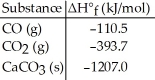
(Multiple Choice)
4.9/5 (96)
(96) The internal energy of a system is always increased by ________.
(Multiple Choice)
4.9/5 (84)
(84) Given the equation
H2O (l)→ H2O (g)ΔHrxn = 40.7 kJ at 100 °C
Calculate the heat required to convert 3.00 grams of liquid water at 100 °C to vapor.
(Short Answer)
4.7/5 (89)
(89) The specific heat capacity of methane gas is 2.20 J/g-K. How many joules of heat are needed to raise the temperature of 7.25 g of methane from 22.0 °C to 57.0 °C?
(Multiple Choice)
4.8/5 (84)
(84) Given the following reactions 2S (s) + 3O2 (g) → 2SO3 (g) ΔH = -790 kJ
S (s) + O2 (g) → SO2 (g)ΔH = -297 kJ
The enthalpy of the reaction in which sulfur dioxide is oxidized to sulfur trioxide
2SO2 (g) + O2 (g) → 2SO3 (g)
Is ________ kJ.
(Multiple Choice)
4.9/5 (80)
(80) Given the data in the table below, ΔH°rxn for the reaction 3 Cl2 (g) + PH3 (g) → PCl3 (g) + 3 HCl (g)
Is ________ kJ. 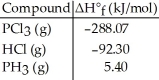
(Multiple Choice)
4.7/5 (83)
(83) A 4.50-g sample of liquid water at 25.0 °C is heated by the addition of 133 J of energy. The final temperature of the water is ________ °C. The specific heat capacity of liquid water is 4.18 J/g-K.
(Multiple Choice)
4.9/5 (76)
(76) Given the data in the table below, ΔH°rxn for the reaction PCl3 (g) + 3 HCl (g) → 3Cl2 (g) + PH3 (g)
Is ________ kJ. 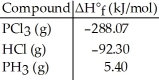
(Multiple Choice)
4.9/5 (84)
(84) 
Filters
- Essay(0)
- Multiple Choice(0)
- Short Answer(0)
- True False(0)
- Matching(0)