



 Chat with AI
Exam 8: Basic Concepts of Chemical Bonding

Exam 1: Introduction: Matter and Measurement163 Questions
Exam 2: Atoms, Molecules, and Ions250 Questions
Exam 3: Stoichiometry: Calculations With Chemical Formulas and Equations178 Questions
Exam 4: Aqueous Reactions and Solution Stoichiometry180 Questions
Exam 5: Thermochemistry154 Questions
Exam 6: Electronic Structure of Atoms186 Questions
Exam 7: Periodic Properties of the Elements176 Questions
Exam 8: Basic Concepts of Chemical Bonding147 Questions
Exam 9: Molecular Geometry and Bonding Theories183 Questions
Exam 10: Gases175 Questions
Exam 11: Liquids and Intermolecular Forces124 Questions
Exam 12: Solids and Modern Materials84 Questions
Exam 13: Properties of Solutions160 Questions
Exam 14: Chemical Kinetics134 Questions
Exam 15: Chemical Equilibrium97 Questions
Exam 16: Acid-Base Equilibria139 Questions
Exam 17: Additional Aspects of Aqueous Equilibria116 Questions
Exam 18: Chemistry of the Environment126 Questions
Exam 19: Chemical Thermodynamics125 Questions
Exam 20: Electrochemistry114 Questions
Exam 21: Nuclear Chemistry178 Questions
Exam 22: Chemistry of the Nonmetals194 Questions
Exam 23: Transition Metals and Coordination Chemistry165 Questions
Exam 24: The Chemistry of Life: Organic and Biological Chemistry131 Questions
Select questions type


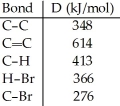
Using the table of bond dissociation energies, the ΔH for the following gas-phase reaction is ________ kJ. 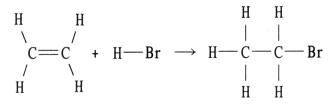

Free
(Multiple Choice)
4.9/5  (66)
(66) Correct Answer: Verified
C
Ni2+ ions are represented by the electron configuration ________.
Free
(Multiple Choice)
4.9/5 (77)
(77) Correct Answer:Verified
VerifiedA
Of the bonds C-C, C  C, and C≡C, the C-C bond is ________.
Free
(Multiple Choice)
4.8/5 (91)
(91) Correct Answer:Verified
VerifiedC
Atoms surrounded by eight valence electrons tend to lose electrons.
(True/False)
4.8/5 (78)
(78) Based on the octet rule, magnesium most likely forms a ________ ion.
(Multiple Choice)
4.9/5 (67)
(67) The Lewis structure of AsH3 shows ________ nonbonding electron pair(s)on As.
(Multiple Choice)
4.9/5 (70)
(70) In ionic bond formation, the lattice energy of ions ________ as the magnitude of the ion charges _______ and the radii ________.
(Multiple Choice)
4.9/5 (70)
(70) The Lewis structure of HCN (H bonded toC)shows that ________ has ________ nonbonding electron pair(s).
(Multiple Choice)
4.9/5 (80)
(80) Which of the following does not have eight valence electrons?
(Multiple Choice)
4.9/5 (100)
(100) There are ________ valence electrons in the Lewis structure of CH3Cl.
(Multiple Choice)
4.7/5 (76)
(76) The bond length in an HI molecule is 1.61 Å and the measured dipole moment is 0.44 D. What is the magnitude (in units of e)of the negative charge on I in HI? (1 debye = 3.34 × 10⁻³⁰ coulomb-meters; e = 1.6 × 10⁻¹⁹ coulombs)
(Multiple Choice)
4.9/5 (84)
(84) Benzene is a(n)________ compound with ________ equivalent Lewis structures.
(Short Answer)
5.0/5 (77)
(77) How many hydrogen atoms must bond to silicon to give it an octet of valence electrons?
(Multiple Choice)
4.9/5 (78)
(78) The reaction below is used to produce methanol:
CO (g) + 2H2 (g) → CH3OH (l)△Hrxn = -128 kJ
(a) Calculate the C-H bond energy given the following data: 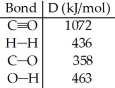 (b) The tabulated value of the (C-H)bond energy is 413 kJ/mol. Explain why there is a difference between the number you have calculated in (a)and the tabulated value.
 (Essay)
4.9/5 (87)
(87) The Lewis structure of PF3 shows that the central phosphorus atom has ________ nonbonding and ________ bonding electron pair(s).
(Multiple Choice)
4.8/5 (87)
(87) A valid Lewis structure of ________ cannot be drawn without violating the octet rule.
(Multiple Choice)
4.8/5 (71)
(71) Using the table of bond dissociation energies, the ΔH for the following reaction is ________ kJ. 2HCl (g) + F2 (g) → 2HF (g) + Cl2 (g) 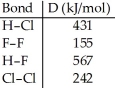
(Multiple Choice)
4.8/5 (78)
(78) What is the maximum number of double bonds that a carbon atom can form?
(Multiple Choice)
4.9/5 (72)
(72) 
Filters
- Essay(0)
- Multiple Choice(0)
- Short Answer(0)
- True False(0)
- Matching(0)