



 Chat with AI
Exam 14: Chemical Kinetics

Exam 1: Introduction: Matter and Measurement163 Questions
Exam 2: Atoms, Molecules, and Ions250 Questions
Exam 3: Stoichiometry: Calculations With Chemical Formulas and Equations178 Questions
Exam 4: Aqueous Reactions and Solution Stoichiometry180 Questions
Exam 5: Thermochemistry154 Questions
Exam 6: Electronic Structure of Atoms186 Questions
Exam 7: Periodic Properties of the Elements176 Questions
Exam 8: Basic Concepts of Chemical Bonding147 Questions
Exam 9: Molecular Geometry and Bonding Theories183 Questions
Exam 10: Gases175 Questions
Exam 11: Liquids and Intermolecular Forces124 Questions
Exam 12: Solids and Modern Materials84 Questions
Exam 13: Properties of Solutions160 Questions
Exam 14: Chemical Kinetics134 Questions
Exam 15: Chemical Equilibrium97 Questions
Exam 16: Acid-Base Equilibria139 Questions
Exam 17: Additional Aspects of Aqueous Equilibria116 Questions
Exam 18: Chemistry of the Environment126 Questions
Exam 19: Chemical Thermodynamics125 Questions
Exam 20: Electrochemistry114 Questions
Exam 21: Nuclear Chemistry178 Questions
Exam 22: Chemistry of the Nonmetals194 Questions
Exam 23: Transition Metals and Coordination Chemistry165 Questions
Exam 24: The Chemistry of Life: Organic and Biological Chemistry131 Questions
Select questions type


Rates of reaction can be positive or negative.

Free
(True/False)
4.9/5  (86)
(86) Correct Answer: Verified
False
Units of the rate constant of a reaction are independent of the overall reaction order.
Free
(True/False)
4.7/5 (80)
(80) Correct Answer:Verified
VerifiedFalse
A second-order reaction has a half-life of 18 s when the initial concentration of reactant is 0.71 M. The rate constant for this reaction is ________ M-1s-1.
Free
(Multiple Choice)
4.8/5 (95)
(95) Correct Answer:Verified
VerifiedA
The rate of disappearance of HBr in the gas phase reaction 2HBr (g) → H2 (g)+ Br2 (g)
Is 0.140 M s-1 at 150 °C. The rate of reaction is ________ M s-1.
(Multiple Choice)
4.8/5 (90)
(90) At elevated temperatures, methylisonitrile (CH3NC)isomerizes to acetonitrile (CH3CN): CH3NC (g) → CH3CN (g)
At the start of an experiment, there are 0.200 mol of reactant and 0 mol of product in the reaction vessel. After 25 min, 0.121 mol of reactant (CH3NC)remain. There are ________ mol of product (CH3CN)in the reaction vessel.
(Multiple Choice)
4.9/5 (74)
(74) In a linear graphical representation of a zero-order reaction, what value is represented by the y-intercept of the line drawn from plotting [A] vs. time?
(Multiple Choice)
4.8/5 (71)
(71) At elevated temperatures, methylisonitrile (CH3NC)isomerizes to acetonitrile (CH3CN): CH3NC (g) → CH3CN (g)
At the start of the experiment, there are 0.200 mol of reactant (CH3NC)and 0 mol of product (CH3CN)in the reaction vessel. After 25 min of reaction, 0.108 mol of reactant (CH3NC)remain. The average rate of decomposition of methyl isonitrile, CH3NC, in this 25 min period is ________ mol/min.
(Multiple Choice)
5.0/5 (80)
(80) The data in the table below were obtained for the reaction:
A + B → P 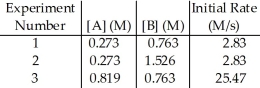 -The overall order of the reaction is ________.
 (Multiple Choice)
4.9/5 (81)
(81) The concentration of reactants or products at any time during the reaction can be calculated from the integrated rate law.
(True/False)
5.0/5 (65)
(65) The following reaction is second order in [A] and the rate constant is 0.039 M-1s-1: A → B
The concentration of A was 0.26 M at 28 s. The initial concentration of A was ________ M.
(Multiple Choice)
4.9/5 (65)
(65) The isomerization of methylisonitrile to acetonitrile CH3NC (g) → CH3CN (g)
Is first order in CH3NC. The rate constant for the reaction is 9.45 × 10⁻⁵ s-1 at 478 K. The half-life of the reaction when the initial [CH3NC] is 0.030 M is ________ s.
(Multiple Choice)
4.8/5 (80)
(80) The rate limiting step in a reaction is the slowest step in the reaction sequence.
(True/False)
4.9/5 (79)
(79) The reaction A → B is first order in [A]. Consider the following data. 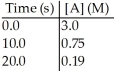 The half-life of this reaction is ________ s.
 (Multiple Choice)
4.7/5 (87)
(87) The rate of a second order reaction can depend on the concentrations of more than one reactant.
(True/False)
4.9/5 (90)
(90) The reaction shown below is ________, and it is a ________ elementary reaction. A + B + C → ABC
(Multiple Choice)
4.8/5 (89)
(89) The minimum energy to initiate a chemical reaction is the ________.
(Short Answer)
4.9/5 (67)
(67) The following reaction occurs in aqueous solution: NH4+ (aq) + NO2- → N2 (g) + 2H2O (l)
The data below is obtained at 25 °C. 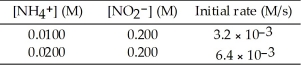 The order of the reaction in NH4+ is ________.
 (Multiple Choice)
4.7/5 (69)
(69) The primary source of the specificity of enzymes is ________.
(Multiple Choice)
4.9/5 (83)
(83) The combustion of ethylene proceeds by the reaction C2H4 (g) + 3O2 (g) → 2CO2 (g) + 2H2O (g)
When the rate of disappearance of O2 is 0.13 M s-1, the rate of disappearance of C2H4 is ________ M s-1.
(Multiple Choice)
4.8/5 (75)
(75) 
Filters
- Essay(0)
- Multiple Choice(0)
- Short Answer(0)
- True False(0)
- Matching(0)