



 Chat with AI
Exam 14: Chemical Kinetics

Exam 1: Introduction: Matter and Measurement163 Questions
Exam 2: Atoms, Molecules, and Ions250 Questions
Exam 3: Stoichiometry: Calculations With Chemical Formulas and Equations178 Questions
Exam 4: Aqueous Reactions and Solution Stoichiometry180 Questions
Exam 5: Thermochemistry154 Questions
Exam 6: Electronic Structure of Atoms186 Questions
Exam 7: Periodic Properties of the Elements176 Questions
Exam 8: Basic Concepts of Chemical Bonding147 Questions
Exam 9: Molecular Geometry and Bonding Theories183 Questions
Exam 10: Gases175 Questions
Exam 11: Liquids and Intermolecular Forces124 Questions
Exam 12: Solids and Modern Materials84 Questions
Exam 13: Properties of Solutions160 Questions
Exam 14: Chemical Kinetics134 Questions
Exam 15: Chemical Equilibrium97 Questions
Exam 16: Acid-Base Equilibria139 Questions
Exam 17: Additional Aspects of Aqueous Equilibria116 Questions
Exam 18: Chemistry of the Environment126 Questions
Exam 19: Chemical Thermodynamics125 Questions
Exam 20: Electrochemistry114 Questions
Exam 21: Nuclear Chemistry178 Questions
Exam 22: Chemistry of the Nonmetals194 Questions
Exam 23: Transition Metals and Coordination Chemistry165 Questions
Exam 24: The Chemistry of Life: Organic and Biological Chemistry131 Questions
Select questions type


The overall order of a reaction is 2. The units of the rate constant for the reaction are ________.
(Multiple Choice)
4.9/5  (94)
(94) Consider the following reaction: A → 2C
The average rate of appearance of C is given by Δ[C]/Δt. Comparing the rate of appearance of C and the rate of disappearance of A, we get Δ[C]/Δt = ________ × (-Δ[A]/Δt).
(Multiple Choice)
4.7/5 (88)
(88) A compound decomposes by a first-order process. If 17.0% of the compound decomposes in 30 minutes, the half-life of the compound is ________.
(Multiple Choice)
4.8/5 (78)
(78) At elevated temperatures, dinitrogen pentoxide decomposes to nitrogen dioxide and oxygen: 2N2O5(g) → 4NO2 (g) + O2 (g)
When the rate of formation of O2 is 2.2 × 10⁻⁴ M/s, the rate of decomposition of N2O5 is ________ M/s.
(Multiple Choice)
4.7/5 (87)
(87) The data in the table below were obtained for the reaction:
A + B → P 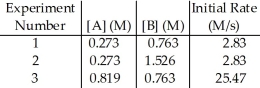 -The order of the reaction in B is ________.
 (Multiple Choice)
4.8/5 (83)
(83) The uptake of molecules into the interior of another substance is referred to as ________.
(Short Answer)
5.0/5 (71)
(71) The reaction 2NOBr (g) → 2 NO (g)+ Br2 (g)
Is a second-order reaction with a rate constant of 0.80 M-1s-1 at 11 °C. If the initial concentration of NOBr is 0.0440 M, the concentration of NOBr after 6.0 seconds is ________.
(Multiple Choice)
4.9/5 (83)
(83) A first-order reaction has a rate constant of 0.33 min-1. It takes ________ min for the reactant concentration to decrease from 0.13 M to 0.066 M.
(Multiple Choice)
4.8/5 (87)
(87) The rate constant for a particular second-order reaction is 0.47 M-1s-1. If the initial concentration of reactant is 0.25 mol/L, it takes ________ s for the concentration to decrease to 0.20 mol/L.
(Multiple Choice)
4.8/5 (75)
(75) The reaction A → B is first order in [A]. Consider the following data.  -The rate constant for this reaction is ________ s-1.
 (Multiple Choice)
4.8/5 (75)
(75) Which one of the following graphs shows the correct relationship between concentration and time for a reaction that is second order in [A]?
(Multiple Choice)
4.8/5 (80)
(80) In general, as activation energy increases, reaction rate ________.
(Multiple Choice)
4.8/5 (83)
(83) The following reaction is second order in [A] and the rate constant is 0.025 M-1s-1: A → B
The concentration of A was 0.65 M at 33 s. The initial concentration of A was ________ M.
(Multiple Choice)
4.8/5 (86)
(86) 
Filters
- Essay(0)
- Multiple Choice(0)
- Short Answer(0)
- True False(0)
- Matching(0)