



 Chat with AI
Exam 14: Chemical Kinetics

Exam 1: Introduction: Matter and Measurement163 Questions
Exam 2: Atoms, Molecules, and Ions250 Questions
Exam 3: Stoichiometry: Calculations With Chemical Formulas and Equations178 Questions
Exam 4: Aqueous Reactions and Solution Stoichiometry180 Questions
Exam 5: Thermochemistry154 Questions
Exam 6: Electronic Structure of Atoms186 Questions
Exam 7: Periodic Properties of the Elements176 Questions
Exam 8: Basic Concepts of Chemical Bonding147 Questions
Exam 9: Molecular Geometry and Bonding Theories183 Questions
Exam 10: Gases175 Questions
Exam 11: Liquids and Intermolecular Forces124 Questions
Exam 12: Solids and Modern Materials84 Questions
Exam 13: Properties of Solutions160 Questions
Exam 14: Chemical Kinetics134 Questions
Exam 15: Chemical Equilibrium97 Questions
Exam 16: Acid-Base Equilibria139 Questions
Exam 17: Additional Aspects of Aqueous Equilibria116 Questions
Exam 18: Chemistry of the Environment126 Questions
Exam 19: Chemical Thermodynamics125 Questions
Exam 20: Electrochemistry114 Questions
Exam 21: Nuclear Chemistry178 Questions
Exam 22: Chemistry of the Nonmetals194 Questions
Exam 23: Transition Metals and Coordination Chemistry165 Questions
Exam 24: The Chemistry of Life: Organic and Biological Chemistry131 Questions
Select questions type


The overall reaction order is the sum of the orders of each reactant in the rate law.
(True/False)
4.9/5  (82)
(82) For the reaction aA + Bb → cC + dD, the rate law is ________.
(Short Answer)
4.9/5 (74)
(74) In the Arrhenius equation, k = Ae-Ea/RT
________ is the frequency factor.
(Multiple Choice)
4.8/5 (79)
(79) In general, as temperature goes up, reaction rate ________.
(Multiple Choice)
4.9/5 (64)
(64) Under constant conditions, the half-life of a first-order reaction ________.
(Multiple Choice)
4.7/5 (76)
(76) The peroxydisulfate ion (S2O82-)reacts with the iodide ion in aqueous solution via the reaction:
S2O82- (aq) + 3I- → 2SO4 (aq)+ I3- (aq)
An aqueous solution containing 0.050 M of S2O82- ion and 0.072 M of I- is prepared, and the progress of the reaction followed by measuring [I-]. The data obtained is given in the table below.  -The average rate of disappearance of I- in the initial 400.0 s is ________ M/s.
 (Multiple Choice)
4.9/5 (83)
(83) The binding of molecules to the surface of a catalyst is referred to as ________.
(Short Answer)
4.9/5 (74)
(74) The graph shown below depicts the relationship between concentration and time for the following chemical reaction. 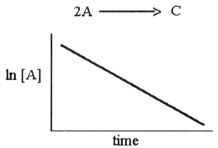 The slope of this line is equal to ________.
 (Multiple Choice)
4.8/5 (79)
(79) The peroxydisulfate ion (S2O82-)reacts with the iodide ion in aqueous solution via the reaction:
S2O82- (aq) + 3I- → 2SO4 (aq)+ I3- (aq)
An aqueous solution containing 0.050 M of S2O82- ion and 0.072 M of I- is prepared, and the progress of the reaction followed by measuring [I-]. The data obtained is given in the table below.
-The average rate of disappearance of I- between 400.0 s and 800.0 s is ________ M/s.
-The average rate of disappearance of I- between 400.0 s and 800.0 s is ________ M/s. (Multiple Choice)
4.9/5 (80)
(80) The data in the table below were obtained for the reaction:
2 ClO2 (aq) + 2 OH- (aq) → ClO3- (aq) + ClO2- (aq) + H2O (1)  -What is the order of the reaction with respect to OH-?
 (Multiple Choice)
4.9/5 (76)
(76) The reaction below is first order in [H2O2]: 2H2O2 (l) → 2H2O (l) + O2 (g)
A solution originally at 0.600 M H2O2 is found to be 0.075 M after 54 min. The half-life for this reaction is ________ min.
(Multiple Choice)
4.8/5 (82)
(82) The reaction CH3-N≡C → CH3-C≡N
Is a first-order reaction. At 230.3 °C, k = 6.29 × 10⁻⁴s-1. If  is 1.00 × 10⁻³ initially,
 is ________ after 1.000 × 10³ s.
is 1.00 × 10⁻³ initially, is ________ after 1.000 × 10³ s. (Multiple Choice)
4.8/5 (73)
(73) At elevated temperatures, methylisonitrile (CH3NC)isomerizes to acetonitrile (CH3CN): CH3NC (g) → CH3CN (g)
The reaction is first order in methylisonitrile. The attached graph shows data for the reaction obtained at 198.9 °C. 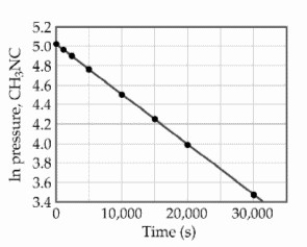 The rate constant for the reaction is ________ s-1.
 (Multiple Choice)
4.9/5 (90)
(90) The data in the table below were obtained for the reaction:
2 ClO2 (aq) + 2 OH- (aq) → ClO3- (aq) + ClO2- (aq) + H2O (1)
-What is the order of the reaction with respect to ClO2?
-What is the order of the reaction with respect to ClO2? (Multiple Choice)
4.9/5 (84)
(84) If the rate law for the reaction 2A + 3B → products
Is first order in A and second order in B, then the rate law is rate = ________.
(Multiple Choice)
4.8/5 (79)
(79) Reaction rate data showing temperature dependence obey an equation devised by ________.
(Short Answer)
4.9/5 (86)
(86) A flask is charged with 0.124 mol of A and allowed to react to form B according to the reaction A(g)→B(g). The following data are obtained for [A] as the reaction proceeds:  -The average rate of disappearance of A between 10 s and 20 s is ________ mol/s.
 (Multiple Choice)
4.8/5 (91)
(91) A possible mechanism for the overall reaction Br2 (g) + 2NO (g) → 2NOBr (g)
Is
NO (g) + Br2 (g)  NOBr2 (g)(fast)
NOBr2 (g) + NO (g)
 2NOBr (slow)
The rate law for formation of NOBr based on this mechanism is rate = ________.
NOBr2 (g)(fast)
NOBr2 (g) + NO (g) 2NOBr (slow)
The rate law for formation of NOBr based on this mechanism is rate = ________. (Multiple Choice)
4.9/5 (67)
(67) SO2Cl2 decomposes in the gas phase by the reaction SO2Cl2 (g) → SO2 (g) + Cl2 (g)
The reaction is first order in SO2Cl2 and the rate constant is 3.0 × 10⁻⁶ s-1at 600 K. A vessel is charged with 3.6 atm of SO2Cl2 at 600 K. The partial pressure of SO2Cl2 at 3.0 × 10⁵ s is ________ atm.
(Multiple Choice)
4.8/5 (79)
(79) Nitrogen fixation is a difficult process because ________.
(Multiple Choice)
4.8/5 (70)
(70) 
Filters
- Essay(0)
- Multiple Choice(0)
- Short Answer(0)
- True False(0)
- Matching(0)