



 Chat with AI
Exam 14: Chemical Kinetics

Exam 1: Introduction: Matter and Measurement163 Questions
Exam 2: Atoms, Molecules, and Ions250 Questions
Exam 3: Stoichiometry: Calculations With Chemical Formulas and Equations178 Questions
Exam 4: Aqueous Reactions and Solution Stoichiometry180 Questions
Exam 5: Thermochemistry154 Questions
Exam 6: Electronic Structure of Atoms186 Questions
Exam 7: Periodic Properties of the Elements176 Questions
Exam 8: Basic Concepts of Chemical Bonding147 Questions
Exam 9: Molecular Geometry and Bonding Theories183 Questions
Exam 10: Gases175 Questions
Exam 11: Liquids and Intermolecular Forces124 Questions
Exam 12: Solids and Modern Materials84 Questions
Exam 13: Properties of Solutions160 Questions
Exam 14: Chemical Kinetics134 Questions
Exam 15: Chemical Equilibrium97 Questions
Exam 16: Acid-Base Equilibria139 Questions
Exam 17: Additional Aspects of Aqueous Equilibria116 Questions
Exam 18: Chemistry of the Environment126 Questions
Exam 19: Chemical Thermodynamics125 Questions
Exam 20: Electrochemistry114 Questions
Exam 21: Nuclear Chemistry178 Questions
Exam 22: Chemistry of the Nonmetals194 Questions
Exam 23: Transition Metals and Coordination Chemistry165 Questions
Exam 24: The Chemistry of Life: Organic and Biological Chemistry131 Questions
Select questions type


A particular first-order reaction has a rate constant of 1.35 × 10² s-1 at 25.0 °C. What is the magnitude of k at 75.0 °C if Ea = 55.3 kJ/mol?
(Multiple Choice)
4.9/5  (79)
(79) The data in the table below were obtained for the reaction:
A + B → P 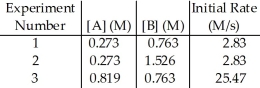 -The rate law for this reaction is rate = ________.
 (Multiple Choice)
5.0/5 (79)
(79) The rate law of a reaction is rate = k[D][X]. The units of the rate constant are ________.
(Multiple Choice)
4.8/5 (88)
(88) A burning splint will burn more vigorously in pure oxygen than in air because ________.
(Multiple Choice)
4.8/5 (78)
(78) One difference between first- and second-order reactions is that ________.
(Multiple Choice)
4.9/5 (91)
(91) As the temperature of a reaction is increased, the rate of the reaction increases because the ________.
(Multiple Choice)
4.8/5 (68)
(68) The reaction A → B is first order in [A]. Consider the following data.  -The rate constant of a first-order process that has a half-life of 3.50 min is ________ s-1.
 (Multiple Choice)
4.7/5 (77)
(77) In the energy profile of a reaction, the species that exists at the maximum on the curve is called the ________.
(Multiple Choice)
4.9/5 (81)
(81) The active site of nitrogenase is a cofactor that contains two transition metals. These transition metals are ________.
(Multiple Choice)
4.8/5 (79)
(79) The data in the table below were obtained for the reaction:
A + B → P
-The magnitude of the rate constant is ________.
-The magnitude of the rate constant is ________. (Multiple Choice)
5.0/5 (88)
(88) The relationship of absorbed light to the concentration of the substance absorbing the light is governed by ________.
(Short Answer)
5.0/5 (89)
(89) A compound decomposes by a first-order process. If 13% of the compound decomposes in 60 minutes, the half-life of the compound is ________.
(Multiple Choice)
4.7/5 (68)
(68) The mechanism for formation of the product X is: A + B → C + D (slow)
B + D → X (fast)
The intermediate reactant in the reaction is ________.
(Multiple Choice)
4.7/5 (77)
(77) The rate constant of a first-order process that has a half-life of 462 s is ________ s-1.
(Multiple Choice)
4.8/5 (79)
(79) Elementary reactions involving the simultaneous collision of three molecules are ________.
(Short Answer)
4.8/5 (75)
(75) The reaction A → B is first order in [A]. Consider the following data.
-The concentration of A is ________ M after 40.0 s.
-The concentration of A is ________ M after 40.0 s. (Multiple Choice)
4.7/5 (87)
(87) If a rate law is second order (reactant), doubling the reactant ________ the reaction rate.
(Short Answer)
4.8/5 (87)
(87) A reaction was found to be zero order in A. Increasing the concentration of A by a factor of 3 will cause the reaction rate to ________.
(Multiple Choice)
4.8/5 (89)
(89) 
Filters
- Essay(0)
- Multiple Choice(0)
- Short Answer(0)
- True False(0)
- Matching(0)