



 Chat with AI
Exam 20: Electrochemistry

Exam 1: Introduction: Matter and Measurement163 Questions
Exam 2: Atoms, Molecules, and Ions250 Questions
Exam 3: Stoichiometry: Calculations With Chemical Formulas and Equations178 Questions
Exam 4: Aqueous Reactions and Solution Stoichiometry180 Questions
Exam 5: Thermochemistry154 Questions
Exam 6: Electronic Structure of Atoms186 Questions
Exam 7: Periodic Properties of the Elements176 Questions
Exam 8: Basic Concepts of Chemical Bonding147 Questions
Exam 9: Molecular Geometry and Bonding Theories183 Questions
Exam 10: Gases175 Questions
Exam 11: Liquids and Intermolecular Forces124 Questions
Exam 12: Solids and Modern Materials84 Questions
Exam 13: Properties of Solutions160 Questions
Exam 14: Chemical Kinetics134 Questions
Exam 15: Chemical Equilibrium97 Questions
Exam 16: Acid-Base Equilibria139 Questions
Exam 17: Additional Aspects of Aqueous Equilibria116 Questions
Exam 18: Chemistry of the Environment126 Questions
Exam 19: Chemical Thermodynamics125 Questions
Exam 20: Electrochemistry114 Questions
Exam 21: Nuclear Chemistry178 Questions
Exam 22: Chemistry of the Nonmetals194 Questions
Exam 23: Transition Metals and Coordination Chemistry165 Questions
Exam 24: The Chemistry of Life: Organic and Biological Chemistry131 Questions
Select questions type


Which substance is the reducing agent in the reaction below? Pb + PbO2 + 2H2SO4 → 2PbSO4 + 2H2O

Free
(Multiple Choice)
4.8/5  (83)
(83) Correct Answer: Verified
A
What is the coefficient of the permanganate ion when the following equation is balanced? MnO4- + Br- → Mn2+ + Br2 (acidic solution)
Free
(Multiple Choice)
4.8/5 (72)
(72) Correct Answer:Verified
VerifiedB
The standard cell potential (E° cell)for the reaction below is +1.10 V. The cell potential for this reaction is ________ V when the concentration of [Cu2+] = 1.0 × 10⁻⁵ M and [Zn2+] = 3.0 M. Zn (s) + Cu2+ (aq) → Cu (s) + Zn2+ (aq)
Free
(Multiple Choice)
4.9/5 (86)
(86) Correct Answer:Verified
VerifiedC
How many seconds are required to produce 1.0 g of silver metal by the electrolysis of a AgNO3 solution using a current of 60 amps?
(Multiple Choice)
4.7/5 (89)
(89) How many minutes will it take to plate out 4.56 g of Ni metal from a solution of Ni2+ using a current of 50.5 amps in an electrolytic cell?
(Multiple Choice)
4.9/5 (87)
(87) Consider an electrochemical cell based on the reaction: 2H+ (aq) + Sn (s) → Sn2+ (aq) + H2 (g)
Which of the following actions would not change the measured cell potential?
(Multiple Choice)
5.0/5 (95)
(95) Table 20.2 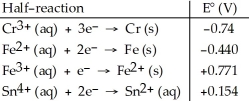 -The standard cell potential (E°cell)for the voltaic cell based on the reaction below is ________ V. 2Cr (s) + 3Fe2+ (aq) → 3Fe (s) + 2Cr3+ (aq)
 (Multiple Choice)
4.8/5 (84)
(84) The purpose of the salt bridge in an electrochemical cell is to ________.
(Multiple Choice)
4.8/5 (78)
(78) Which transformation could take place at the cathode of an electrochemical cell?
(Multiple Choice)
4.9/5 (84)
(84) Table 20.2 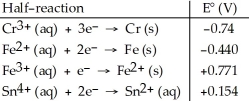 -Which of the following reactions will occur spontaneously as written?
 (Multiple Choice)
4.7/5 (85)
(85) The standard emf for the cell using the overall cell reaction below is +2.20 V: 2Al (s) + 3I2 (s) → 2Al3+ (aq)+ 6I- (aq)
The emf generated by the cell when [Al3+] = 3.5 × 10⁻³ M and [I-] = 0.30 M is ________ V.
(Multiple Choice)
4.8/5 (86)
(86) In a voltaic cell, electrons flow from the ________ to the ________.
(Multiple Choice)
4.8/5 (80)
(80) At constant temperature and pressure the Gibbs free energy value is a measure of the ________ of a process.
(Short Answer)
4.9/5 (73)
(73) Which transformation could take place at the anode of an electrochemical cell?
(Multiple Choice)
5.0/5 (80)
(80) Which element is reduced in the reaction below? I- + MnO4- + H+ → I2 + MnO2 + H2O
(Multiple Choice)
4.8/5 (76)
(76) Which substance is the oxidizing agent in the reaction below? Pb + PbO2 + 2H2SO4 → 2PbSO4 + 2H2O
(Multiple Choice)
4.8/5 (80)
(80) Which substance is the oxidizing agent in the following reaction? Fe2S3 + 12HNO3 → 2Fe(NO3)3 + 3S + 6NO2 + 6H2O
(Multiple Choice)
4.9/5 (85)
(85) The standard cell potential (E°cell)of the reaction below is +1.34 V. The value of ΔG° for the reaction is ________ kJ/mol. 3 Cu (s) + 2 MnO4- (aq)+ 8H+ (aq) → 3 Cu2+ (aq)+ 2 MnO2 (s) + 4 H2O (l)
(Multiple Choice)
4.8/5 (80)
(80) 
Filters
- Essay(0)
- Multiple Choice(0)
- Short Answer(0)
- True False(0)
- Matching(0)