



 Chat with AI
Exam 8: Basic Concepts of Chemical Bonding

Exam 1: Introduction: Matter and Measurement163 Questions
Exam 2: Atoms, Molecules, and Ions250 Questions
Exam 3: Stoichiometry: Calculations With Chemical Formulas and Equations178 Questions
Exam 4: Aqueous Reactions and Solution Stoichiometry180 Questions
Exam 5: Thermochemistry154 Questions
Exam 6: Electronic Structure of Atoms186 Questions
Exam 7: Periodic Properties of the Elements176 Questions
Exam 8: Basic Concepts of Chemical Bonding147 Questions
Exam 9: Molecular Geometry and Bonding Theories183 Questions
Exam 10: Gases175 Questions
Exam 11: Liquids and Intermolecular Forces124 Questions
Exam 12: Solids and Modern Materials84 Questions
Exam 13: Properties of Solutions160 Questions
Exam 14: Chemical Kinetics134 Questions
Exam 15: Chemical Equilibrium97 Questions
Exam 16: Acid-Base Equilibria139 Questions
Exam 17: Additional Aspects of Aqueous Equilibria116 Questions
Exam 18: Chemistry of the Environment126 Questions
Exam 19: Chemical Thermodynamics125 Questions
Exam 20: Electrochemistry114 Questions
Exam 21: Nuclear Chemistry178 Questions
Exam 22: Chemistry of the Nonmetals194 Questions
Exam 23: Transition Metals and Coordination Chemistry165 Questions
Exam 24: The Chemistry of Life: Organic and Biological Chemistry131 Questions
Select questions type


The halogens, alkali metals, and alkaline earth metals have ________ valence electrons, respectively.
(Multiple Choice)
4.8/5  (68)
(68) Based on the octet rule, aluminum most likely forms an ________ ion.
(Multiple Choice)
4.7/5 (62)
(62) In some molecules and polyatomic ions, the sum of the valence electrons is odd and as a result the octet rule fails.
(True/False)
4.8/5 (70)
(70) Calculate the bond energy of C-F given that the heat of atomization of CHFClBr is 1502 kJ/mol, and that the bond energies of C-H, C-Br, and C-Cl are 413, 276, and 328 kJ/mol, respectively.
(Essay)
5.0/5 (85)
(85) For a given arrangement of ions, the lattice energy decreases as ionic radius ________ and as ionic charge ________.
(Multiple Choice)
4.9/5 (79)
(79) The oxide of which of the following metals should have the greatest lattice energy?
(Multiple Choice)
4.9/5 (78)
(78) Using the table of average bond energies below, the ΔH for the reaction is ________ kJ. 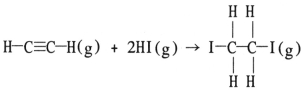 Bond: C≡C C-C H-I C-I C-H D (kJ/mol): 839 348 299 240 413
 (Multiple Choice)
4.9/5 (75)
(75) What is the maximum number of triple bonds that a carbon atom can form?
(Multiple Choice)
4.8/5 (75)
(75) A double bond consists of ________ pairs of electrons shared between two atoms.
(Multiple Choice)
4.9/5 (85)
(85) As the number of covalent bonds between two atoms increases, the distance between the atoms ________ and the strength of the bond between them ________.
(Multiple Choice)
4.8/5 (82)
(82) There are ________ unpaired electrons in the Lewis symbol for an oxygen atom.
(Multiple Choice)
4.9/5 (95)
(95) The type of compound that is most likely to contain a covalent bond is ________.
(Multiple Choice)
4.9/5 (75)
(75) Which halogen, bromine or iodine, will form the more polar bond with phosphorus?
(Short Answer)
4.8/5 (87)
(87)  N, and C≡N, the C-N bond is ________.

Filters
- Essay(0)
- Multiple Choice(0)
- Short Answer(0)
- True False(0)
- Matching(0)