



 Chat with AI
Exam 8: Basic Concepts of Chemical Bonding

Exam 1: Introduction: Matter and Measurement163 Questions
Exam 2: Atoms, Molecules, and Ions250 Questions
Exam 3: Stoichiometry: Calculations With Chemical Formulas and Equations178 Questions
Exam 4: Aqueous Reactions and Solution Stoichiometry180 Questions
Exam 5: Thermochemistry154 Questions
Exam 6: Electronic Structure of Atoms186 Questions
Exam 7: Periodic Properties of the Elements176 Questions
Exam 8: Basic Concepts of Chemical Bonding147 Questions
Exam 9: Molecular Geometry and Bonding Theories183 Questions
Exam 10: Gases175 Questions
Exam 11: Liquids and Intermolecular Forces124 Questions
Exam 12: Solids and Modern Materials84 Questions
Exam 13: Properties of Solutions160 Questions
Exam 14: Chemical Kinetics134 Questions
Exam 15: Chemical Equilibrium97 Questions
Exam 16: Acid-Base Equilibria139 Questions
Exam 17: Additional Aspects of Aqueous Equilibria116 Questions
Exam 18: Chemistry of the Environment126 Questions
Exam 19: Chemical Thermodynamics125 Questions
Exam 20: Electrochemistry114 Questions
Exam 21: Nuclear Chemistry178 Questions
Exam 22: Chemistry of the Nonmetals194 Questions
Exam 23: Transition Metals and Coordination Chemistry165 Questions
Exam 24: The Chemistry of Life: Organic and Biological Chemistry131 Questions
Select questions type


To produce maximum heat, an explosive compound should have ________ chemical bonds and decompose to molecule with ________ bonds.
(Short Answer)
4.9/5  (78)
(78) A nonpolar bond will form between two ________ atoms of ________ electronegativity.
(Multiple Choice)
4.8/5 (76)
(76) Which of the following would have to gain two electrons in order to achieve a noble gas electron configuration? O Sr Na Se Br
(Multiple Choice)
4.9/5 (83)
(83) The diagram below is the Born-Huber cycle for the formation of crystalline potassium fluoride. 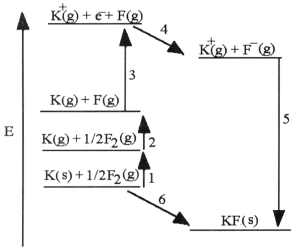 -Which energy change corresponds to the first ionization energy of potassium?
 (Multiple Choice)
4.8/5 (87)
(87) A valid Lewis structure of ________ cannot be drawn without violating the octet rule.
(Multiple Choice)
4.9/5 (75)
(75) Using the table of bond dissociation energies, the ΔH for the following gas-phase reaction is ________ kJ. 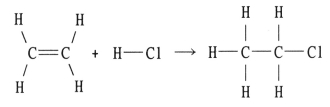
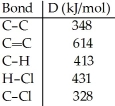
(Multiple Choice)
4.8/5 (85)
(85) Using the table of average bond energies below, the △H for the reaction is ________ kJ. C≡O (g) + 2H2 (g) → H3C-O-H (g)
Bond: C-O C=O C≡O C-H H-H O-H
D (kJ/mol): 358 799 1072 413 436 463
(Multiple Choice)
4.8/5 (75)
(75) For a given arrangement of ions, the lattice energy increases as ionic radius ________ and as ionic charge ________.
(Multiple Choice)
4.8/5 (84)
(84) Which of the following would have to lose three electrons in order to achieve a noble gas electron configuration? Si Mg Al Cl P
(Multiple Choice)
4.9/5 (67)
(67) The central atom in ________ does not violate the octet rule.
(Multiple Choice)
4.9/5 (87)
(87) The diagram below is the Born-Huber cycle for the formation of crystalline potassium fluoride.
-Which energy change corresponds to the electron affinity of fluorine?
-Which energy change corresponds to the electron affinity of fluorine? (Multiple Choice)
4.7/5 (84)
(84) Electropositivity ________ from left to right within a period and ________ from top to bottom within a group.
(Multiple Choice)
4.8/5 (66)
(66) Most transition metals do not form ions with a noble gas configuration.
(True/False)
4.7/5 (75)
(75) Which of the following does not have eight valence electrons?
(Multiple Choice)
4.8/5 (86)
(86) Of the possible bonds between carbon atoms (single, double, and triple), ________.
(Multiple Choice)
4.9/5 (77)
(77) 
Filters
- Essay(0)
- Multiple Choice(0)
- Short Answer(0)
- True False(0)
- Matching(0)