



 Chat with AI
Exam 5: Thermochemistry

Exam 1: Introduction: Matter and Measurement163 Questions
Exam 2: Atoms, Molecules, and Ions250 Questions
Exam 3: Stoichiometry: Calculations With Chemical Formulas and Equations178 Questions
Exam 4: Aqueous Reactions and Solution Stoichiometry180 Questions
Exam 5: Thermochemistry154 Questions
Exam 6: Electronic Structure of Atoms186 Questions
Exam 7: Periodic Properties of the Elements176 Questions
Exam 8: Basic Concepts of Chemical Bonding147 Questions
Exam 9: Molecular Geometry and Bonding Theories183 Questions
Exam 10: Gases175 Questions
Exam 11: Liquids and Intermolecular Forces124 Questions
Exam 12: Solids and Modern Materials84 Questions
Exam 13: Properties of Solutions160 Questions
Exam 14: Chemical Kinetics134 Questions
Exam 15: Chemical Equilibrium97 Questions
Exam 16: Acid-Base Equilibria139 Questions
Exam 17: Additional Aspects of Aqueous Equilibria116 Questions
Exam 18: Chemistry of the Environment126 Questions
Exam 19: Chemical Thermodynamics125 Questions
Exam 20: Electrochemistry114 Questions
Exam 21: Nuclear Chemistry178 Questions
Exam 22: Chemistry of the Nonmetals194 Questions
Exam 23: Transition Metals and Coordination Chemistry165 Questions
Exam 24: The Chemistry of Life: Organic and Biological Chemistry131 Questions
Select questions type


The value of ΔH° for the reaction below is -72 kJ. ________ kJ of heat are released when 80.9 grams of HBr is formed in this reaction. H2 (g) + Br2 (g) → 2HBr (g)
(Multiple Choice)
4.8/5  (83)
(83) The kinetic energy of a 7.3 kg steel ball traveling at 18.0 m/s is ________ J.
(Multiple Choice)
4.9/5 (84)
(84) The value of ΔH° for the reaction below is -1107 kJ: 2Ba (s) + O2 (g) → 2BaO (s)
How many kJ of heat are released when 5.75 g of Ba (s)reacts completely with oxygen to form BaO (s)?
(Multiple Choice)
4.8/5 (77)
(77) The kinetic energy of a 23.2-g object moving at a speed of 98.7 m/s is ________ J.
(Multiple Choice)
4.9/5 (70)
(70) A chemical reaction that absorbs heat from the surroundings is said to be ________ and has a ________ ΔH at constant pressure.
(Multiple Choice)
4.9/5 (87)
(87) Given the data in the table below, ΔH° for the reaction 2CO (g) + O2 (g) → 2CO2 (g)
Is ________ kJ. 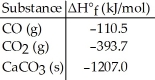
(Multiple Choice)
5.0/5 (82)
(82) The value of ΔH° for the reaction below is -6535 kJ. ________ kJ of heat are released in the combustion of 16.0 g of C6H6 (l)? 2C6H6 (l) + 15O2 (g) → 12CO2 (g) + 6 H2O (l)
(Multiple Choice)
4.8/5 (77)
(77) For which one of the following reactions is the value of ΔH°rxn equal to ΔH°f for the product?
(Multiple Choice)
4.8/5 (80)
(80) The temperature of a 24.3 g sample of gold increases from 23.7 °C to 31.5 °C. If the specific heat of gold is 0.129 J/g-K, how many joules of heat are absorbed?
(Multiple Choice)
4.8/5 (75)
(75) For which one of the following reactions is the value of ΔH°rxn equal to ΔH°f for the product?
(Multiple Choice)
4.9/5 (72)
(72) The value of ΔH° for the reaction below is -186 kJ. Calculate the heat (kJ)released from the reaction of 25 g of Cl2. H2 (g) + Cl2 (g) → 2HCl (g)
(Multiple Choice)
4.8/5 (81)
(81) The temperature of a 35.1 g sample of iron increases from 24.5 °C to 31.8 °C. If the specific heat of iron is 0.450 J/g-K, how many joules of heat are absorbed?
(Multiple Choice)
4.8/5 (72)
(72) The temperature of a 15-g sample of lead metal increases from 22 °C to 37 °C upon the addition of 29.0 J of heat. The specific heat capacity of the lead is ________ J/g-K.
(Multiple Choice)
4.8/5 (94)
(94) Which one of the following conditions would always result in an increase in the internal energy of a system?
(Multiple Choice)
4.8/5 (88)
(88) Given the data in the table below and ΔH°rxn for the reaction SO2Cl2 (g) + 2H2O (l) → H2SO4 (l) + 2HCl (g)ΔH° = -62 kJ
ΔH°f of HCl (g)is ________ kJ/mol. 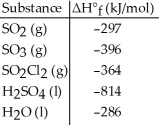
(Multiple Choice)
4.8/5 (69)
(69) Given the following reactions 2NO → N2 + O2 ΔH = -180 kJ
2NO + O2 → 2NO2 ΔH = -112 kJ
The enthalpy of the reaction of nitrogen with oxygen to produce nitrogen dioxide
N2 + 2O2 → 2NO2
Is ________ kJ.
(Multiple Choice)
4.9/5 (90)
(90) The specific heat capacity of liquid water is 4.18 J/g-K. How many joules of heat are needed to raise the temperature of 7.25 g of water from 20.0 °C to 44.1 °C?
(Multiple Choice)
4.8/5 (70)
(70) The average fuel value of sugars is 17 kJ/g. A 2.0 L pitcher of sweetened Kool-Aid® contains 400 g of sugar. What is the fuel value (in kJ)of a 500 mL serving of Kool-Aid®? (Assume that the sugar is the only fuel source.)
(Multiple Choice)
4.8/5 (80)
(80) Calculate the kinetic energy in J of an electron moving at 6.00 × 10⁶ m/s. The mass of an electron is 9.11 × 10⁻²⁸ g.
(Multiple Choice)
4.9/5 (79)
(79) 
Filters
- Essay(0)
- Multiple Choice(0)
- Short Answer(0)
- True False(0)
- Matching(0)