



 Chat with AI
Exam 18: Electrochemistry

Exam 1: Chemistry: the Study of Change168 Questions
Exam 2: Atoms, Molecules, and Ions156 Questions
Exam 3: Mass Relationships in Chemical Reactions194 Questions
Exam 4: Reactions in Aqueous Solutions186 Questions
Exam 5: Gases121 Questions
Exam 6: Thermochemistry118 Questions
Exam 7: Quantum Theory and the Electronic Structure of Atoms136 Questions
Exam 8: Periodic Relationships Among the Elements144 Questions
Exam 9: Chemical Bonding I: Basic Concepts137 Questions
Exam 10: Chemical Bonding Ii: Molecular Geometry and Hybridization of Atomic Orbitals147 Questions
Exam 11: Intermolecular Forces and Liquids and Solids149 Questions
Exam 12: Physical Properties of Solutions122 Questions
Exam 13: Chemical Kinetics130 Questions
Exam 14: Chemical Equilibrium109 Questions
Exam 15: Acids and Bases178 Questions
Exam 16: Acid-Base Equilibria and Solubility Equilibria131 Questions
Exam 17: Entropy Free Energy and Equilibrium128 Questions
Exam 18: Electrochemistry154 Questions
Exam 19: Nuclear Chemistry133 Questions
Exam 20: Chemistry in the Atmosphere50 Questions
Exam 21: Metallurgy and the Chemistry of Metals63 Questions
Exam 22: Nonmetallic Elements and Their Compounds52 Questions
Exam 23: Transition Metal Chemistry and Coordination Compounds92 Questions
Exam 24: Organic Chemistry67 Questions
Exam 25: Synthetic and Natural Organic Polymers50 Questions
Select questions type


How many coulombs would be required to electroplate 35.0 grams of chromium by passing an electrical current through a solution containing CrCl3?
(Multiple Choice)
4.9/5  (86)
(86) How many grams of copper are deposited on the cathode of an electrolytic cell if an electric current of 2.00 A is passed through a solution of CuSO4 for a period of 19.0 min?
(Short Answer)
4.8/5 (84)
(84) The half-cell reaction for the oxidation of H2O(l)to O2(g)is given below. 2H2O(l) O2(g)+ 4H+(aq)+ 4e-
Which choice lists all of the following species that can oxidize H2O to O2(g)under standard-state conditions?
MnO4-(aq), Cl2(g), Pb2+(aq), Cl- (aq), Ag+(aq)
(Multiple Choice)
4.7/5 (79)
(79) Complete and balance the following redox equation.The sum of the smallest whole-number coefficients is MnO4- + H+ + Br- Mn2+ + Br2 + H2O (acidic solution)
(Multiple Choice)
4.8/5 (69)
(69) In an electrolytic cell, electrical energy is used to cause a chemical reaction to occur that would otherwise be nonspontaneous.
(True/False)
4.8/5 (80)
(80) Determine the equilibrium constant for the following reaction at 298 K.
2Fe3+(aq)+ H2O2(aq)  2H+(aq)+ O2(g)+ 2Fe2+(aq).
 (Short Answer)
4.8/5 (90)
(90) For the electrochemical cell Ni(s)| Ni2+(1 M)|| H+(1 M)| H2(1 atm)| Pt(s), which one of the following changes will cause a decrease in the cell voltage?
(Multiple Choice)
4.7/5 (82)
(82) Which one of the following reactions must be carried out in an electrolytic cell rather than in a galvanic cell?
(Multiple Choice)
4.9/5 (72)
(72) Consider the following standard reduction potentials in acid solution: 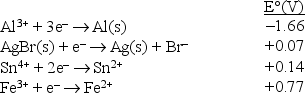 The strongest reducing agent among those shown above is
 (Multiple Choice)
4.8/5 (93)
(93) Complete and balance the following redox equation.What is the coefficient of H2S when the equation is balanced using the set of smallest whole-number coefficients? H2S + MnO4- Mn2+ + SO42- (acidic solution)
(Multiple Choice)
4.9/5 (71)
(71) Given the following cell diagram, Al(s)| Al3+(aq)|| Cd2+(aq)| Cd (s)
What is the balanced overall (net)cell reaction?
(Multiple Choice)
4.8/5 (80)
(80) Complete and balance the following redox equation using the smallest whole-number coefficients.What is the coefficient of Sn in the balanced equation?
Sn + HNO3 SnO2 + NO2 + H2O (acidic solution)
(Multiple Choice)
4.8/5 (76)
(76) For the reaction Ni2+(aq)+ 2Fe2+(aq) Ni(s)+ 2Fe3+(aq), the standard cell potential E°cell is
(Multiple Choice)
4.8/5 (91)
(91) Calculate the cell voltage for the following reaction: Cu2+ (0.010 M)+ H2(1 atm) Cu(s)+ 2H+( pH = 7.0)
(Multiple Choice)
4.8/5 (71)
(71) Write the balanced overall redox equation for the following cell diagram:
Cr(s)| Cr3+(aq)|| Sn4+(aq),Sn2+(aq)| Pt(s)
(Essay)
4.8/5 (79)
(79) Consider the following standard reduction potentials in acid solution:  The weakest reducing agent listed above is
 (Multiple Choice)
4.8/5 (83)
(83) Many different ways have been proposed to make batteries.One cell is set up with copper and lead electrodes in contact with CuSO4(aq)and Pb(NO3)2 (aq), respectively.If the Pb2+ and Cu2+ concentrations are each 1.0 M, what is the overall cell potential? 
(Short Answer)
4.9/5 (84)
(84) A battery is constructed by placing copper and lead electrodes in contact with 1.0 molar CuSO4(aq)and Pb(NO3)2 (aq)solutions, respectively.If sulfuric acid is then added to the Pb(NO3)2 solution, thereby forming a precipitate of PbSO4, what will happen to the cell potential?
(Short Answer)
4.9/5 (80)
(80) The half-reaction that should occur at the anode during electrolysis of an aqueous potassium bromide solution is
(Multiple Choice)
4.8/5 (72)
(72) 
Filters
- Essay(0)
- Multiple Choice(0)
- Short Answer(0)
- True False(0)
- Matching(0)