



 Chat with AI
Exam 10: Chemical Bonding II: Molecular Geometry and Hybridization of Atomic

Exam 1: Chemistry: The Study of Change175 Questions
Exam 2: Atoms Molecules and Ions156 Questions
Exam 3: Mass Relationships in Chemical Reactions194 Questions
Exam 4: Reactions in Aqueous Solutions192 Questions
Exam 5: Gases130 Questions
Exam 6: Thermochemistry119 Questions
Exam 7: Quantum Theory and the Electronic Structure of Atoms135 Questions
Exam 8: Periodic Relationships Among the Elements144 Questions
Exam 9: Chemical Bonding I: Basic Concepts136 Questions
Exam 10: Chemical Bonding II: Molecular Geometry and Hybridization of Atomic146 Questions
Exam 11: Intermolecular Forces and Liquids and Solids149 Questions
Exam 12: Physical Properties of Solutions122 Questions
Exam 13: Chemical Kinetics131 Questions
Exam 14: Chemical Equilibrium119 Questions
Exam 15: Acids and Bases178 Questions
Exam 16: Acid-Base Equilibria and Solubility Equilibria145 Questions
Exam 17: Entropy Free Energy and Equilibrium128 Questions
Exam 18: Electrochemistry154 Questions
Exam 19: Nuclear Chemistry128 Questions
Exam 20: Chemistry in the Atmosphere50 Questions
Exam 21: Metallurgy and the Chemistry of Metals63 Questions
Exam 22: Nonmetallic Elements and Their Compounds52 Questions
Exam 23: Transition Metals Chemistry and Coordination Compounds92 Questions
Exam 24: Organic Chemistry66 Questions
Exam 25: Synthetic and Natural Organic Polymers46 Questions
Select questions type


According to the VSEPR theory, the molecular geometry of boron trichloride is
(Multiple Choice)
4.9/5  (75)
(75) The electrons in the delocalized molecular orbitals of benzene (C6H6)
(Multiple Choice)
5.0/5 (94)
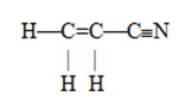
(94) 
Give the number of lone pairs around the central atom and the molecular geometry of XeF4.
(Multiple Choice)
4.9/5 (78)
(78) The C-N-O bond angle in nitromethane, CH3NO2, is expected to be approximately
(Multiple Choice)
4.8/5 (83)
(83) According to Valence Bond Theory which orbital is left vacant in the molecule BF3
(Multiple Choice)
4.8/5 (80)
(80) According to Molecular Orbital Theory, two separate px orbitals interact about the x-axis to form what molecular orbitals
(Multiple Choice)
4.9/5 (57)
(57) According to Valence Bond Theory, which orbital is left vacant in the molecule BH3
(Multiple Choice)
4.7/5 (82)
(82) Which of the following species has the largest dipole moment (i.e., is the most polar)
(Multiple Choice)
4.9/5 (82)
(82) Which of the following correctly lists species in order of increasing bond length
(Multiple Choice)
4.8/5 (72)
(72) The geometry of the hybrid orbitals about a central atom with sp2 hybridization is:
(Multiple Choice)
4.8/5 (79)
(79) Give the number of lone pairs around the central atom and the geometry of the ion ClO2-.
(Multiple Choice)
4.9/5 (85)
(85) What bond angles are predicted by VSEPR theory for the F -P -F bonds in PF5
(Multiple Choice)
4.8/5 (70)
(70) A molecule with 5 single bonds (and any number of lone pairs) could have which type of molecular geometry
I. Trigonal bipyramidal
II. Seesaw
III. T-shaped
IV. Square pyramidal
(Multiple Choice)
4.8/5 (75)
(75) What is the hybridization of the As atom in the AsF5 molecule
(Multiple Choice)
4.9/5 (84)
(84) Two px orbitals from two different atoms can interact to form a sigma bonding molecular orbital.
(True/False)
4.8/5 (87)
(87) A sp3 hybridized central nitrogen atom with 1 lone pair of electrons has what type of bonding
(Multiple Choice)
4.9/5 (76)
(76) Which of the following molecules is polar
CH3OH
H2O
CH3OCH3
(Multiple Choice)
4.9/5 (75)
(75) 
Filters
- Essay(0)
- Multiple Choice(0)
- Short Answer(0)
- True False(0)
- Matching(0)