



 Chat with AI
Exam 10: Chemical Bonding II: Molecular Geometry and Hybridization of Atomic

Exam 1: Chemistry: The Study of Change175 Questions
Exam 2: Atoms Molecules and Ions156 Questions
Exam 3: Mass Relationships in Chemical Reactions194 Questions
Exam 4: Reactions in Aqueous Solutions192 Questions
Exam 5: Gases130 Questions
Exam 6: Thermochemistry119 Questions
Exam 7: Quantum Theory and the Electronic Structure of Atoms135 Questions
Exam 8: Periodic Relationships Among the Elements144 Questions
Exam 9: Chemical Bonding I: Basic Concepts136 Questions
Exam 10: Chemical Bonding II: Molecular Geometry and Hybridization of Atomic146 Questions
Exam 11: Intermolecular Forces and Liquids and Solids149 Questions
Exam 12: Physical Properties of Solutions122 Questions
Exam 13: Chemical Kinetics131 Questions
Exam 14: Chemical Equilibrium119 Questions
Exam 15: Acids and Bases178 Questions
Exam 16: Acid-Base Equilibria and Solubility Equilibria145 Questions
Exam 17: Entropy Free Energy and Equilibrium128 Questions
Exam 18: Electrochemistry154 Questions
Exam 19: Nuclear Chemistry128 Questions
Exam 20: Chemistry in the Atmosphere50 Questions
Exam 21: Metallurgy and the Chemistry of Metals63 Questions
Exam 22: Nonmetallic Elements and Their Compounds52 Questions
Exam 23: Transition Metals Chemistry and Coordination Compounds92 Questions
Exam 24: Organic Chemistry66 Questions
Exam 25: Synthetic and Natural Organic Polymers46 Questions
Select questions type


Which of the following correctly lists species in order of increasing bond length
(Multiple Choice)
4.9/5  (77)
(77) Ibuprofen is used as an analgesic for the relief of pain, and also to help reduce fever. What is the hybridization state of carbon indicated by the arrow in the structure of ibuprofen shown below 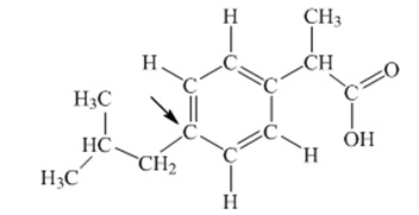
(Multiple Choice)
4.8/5 (74)
(74) An sp3 hybridized central carbon atom with no lone pairs of electrons has what type of bonding
(Multiple Choice)
4.9/5 (68)
(68) Pi bonds are covalent bonds in which the electron density is concentrated above and below a plane containing the nuclei of the bonding atoms.
(True/False)
5.0/5 (77)
(77) A sp hybridized terminal oxygen atom (bonded to one other atom only) with 1 lone pair of electrons has what type of bonding
(Multiple Choice)
4.8/5 (70)
(70) In which of the following would the bonding be weakened with the addition of an electron to form the negative molecular ion
(Multiple Choice)
4.8/5 (75)
(75) A molecule with 3 single bonds (and any number of lone pairs) could have which of the following molecular geometries
I. Trigonal planar
II. Trigonal pyramidal
III. Seesaw
IV. T-shaped
(Multiple Choice)
4.8/5 (85)
(85) A bonding molecular orbital is of lower energy (more stable) than the atomic orbitals from which it was formed.
(True/False)
4.9/5 (78)
(78) Ozone (O3) is an allotropic form of oxygen. According to VSEPR theory the shape of the ozone molecule is bent.
(True/False)
4.8/5 (83)
(83) The N - N - H bond angles in hydrazine N2H4 are 112 . What is the hybridization of the nitrogen orbitals predicted by valence bond theory
(Multiple Choice)
4.8/5 (95)
(95) Ibuprofen is used as an analgesic for the relief of pain, and also to help reduce fever. 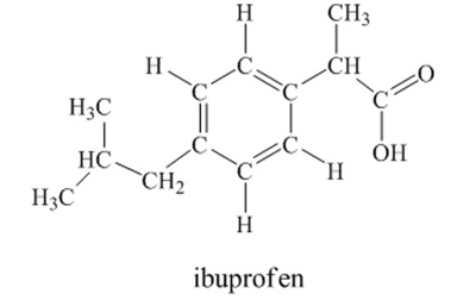 How many sigma bonds and pi bonds are contained in an ibuprofen molecule
33 sigma bonds and 4 pi bonds
How many sigma bonds and pi bonds are contained in an ibuprofen molecule
33 sigma bonds and 4 pi bonds (True/False)
4.8/5 (89)
(89) N,N-diethyl-m-tolumide (DEET) is the active ingredient in many mosquito repellents. What is the hybridization state of carbon indicated by the arrow in the structure of DEET shown below 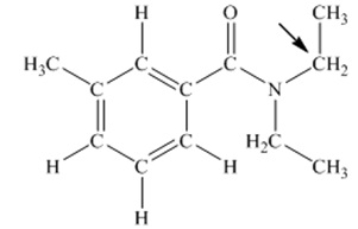
(Multiple Choice)
4.8/5 (78)
(78) N,N-diethyl-m-tolumide (DEET) is the active ingredient in many mosquito repellents. 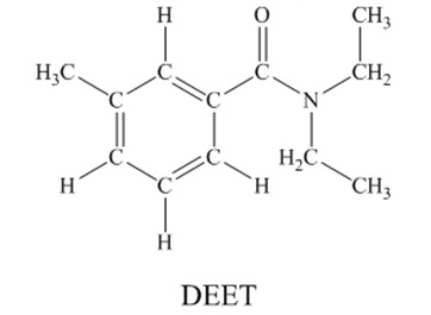 There are 30 sigma bonds and 4 pi bonds are contained in a DEET molecule.
 (True/False)
5.0/5 (83)
(83) Which one of the following molecules has tetrahedral geometry
(Multiple Choice)
4.7/5 (81)
(81) 
Filters
- Essay(0)
- Multiple Choice(0)
- Short Answer(0)
- True False(0)
- Matching(0)