



 Chat with AI
Exam 10: Chemical Bonding II: Molecular Geometry and Hybridization of Atomic

Exam 1: Chemistry: The Study of Change175 Questions
Exam 2: Atoms Molecules and Ions156 Questions
Exam 3: Mass Relationships in Chemical Reactions194 Questions
Exam 4: Reactions in Aqueous Solutions192 Questions
Exam 5: Gases130 Questions
Exam 6: Thermochemistry119 Questions
Exam 7: Quantum Theory and the Electronic Structure of Atoms135 Questions
Exam 8: Periodic Relationships Among the Elements144 Questions
Exam 9: Chemical Bonding I: Basic Concepts136 Questions
Exam 10: Chemical Bonding II: Molecular Geometry and Hybridization of Atomic146 Questions
Exam 11: Intermolecular Forces and Liquids and Solids149 Questions
Exam 12: Physical Properties of Solutions122 Questions
Exam 13: Chemical Kinetics131 Questions
Exam 14: Chemical Equilibrium119 Questions
Exam 15: Acids and Bases178 Questions
Exam 16: Acid-Base Equilibria and Solubility Equilibria145 Questions
Exam 17: Entropy Free Energy and Equilibrium128 Questions
Exam 18: Electrochemistry154 Questions
Exam 19: Nuclear Chemistry128 Questions
Exam 20: Chemistry in the Atmosphere50 Questions
Exam 21: Metallurgy and the Chemistry of Metals63 Questions
Exam 22: Nonmetallic Elements and Their Compounds52 Questions
Exam 23: Transition Metals Chemistry and Coordination Compounds92 Questions
Exam 24: Organic Chemistry66 Questions
Exam 25: Synthetic and Natural Organic Polymers46 Questions
Select questions type


The geometry of the hybrid orbitals about a central atom with sp3d hybridization is:
(Multiple Choice)
4.8/5  (82)
(82) More energy is required to break a bond with an order of 3/2 than is required to break a bond of order 2.
(True/False)
4.9/5 (80)
(80) Indicate the type of hybrid orbitals used by the central atom in BrF3.
(Multiple Choice)
4.9/5 (67)
(67) N,N-diethyl-m-tolumide (DEET) is the active ingredient in many mosquito repellents. What is the hybridization state of the nitrogen atom in the structure of DEET shown below 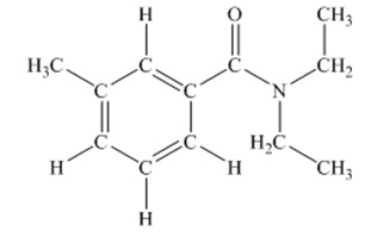
(Multiple Choice)
4.8/5 (89)
(89) N,N-diethyl-m-tolumide (DEET) is the active ingredient in many mosquito repellents. What is the hybridization state of carbon indicated by the arrow in the structure of DEET shown below 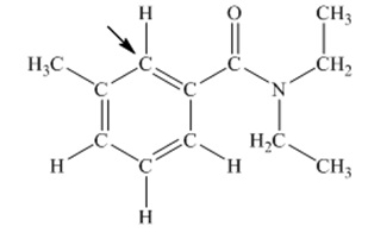
(Multiple Choice)
4.8/5 (82)
(82) The geometry of the hybrid orbitals of the central atom of a molecule is always the same as molecular geometry.
(True/False)
4.7/5 (76)
(76) The hybridization of the central nitrogen atom in the molecule N2O is
(Multiple Choice)
4.8/5 (81)
(81) In which of the following would the bonding be strengthened with the addition of an electron to form the negative molecular ion
(Multiple Choice)
4.9/5 (72)
(72) Indicate the type of hybrid orbitals used by the central atom in SF6.
(Multiple Choice)
4.8/5 (96)
(96) Which of the following molecules has polar bonds but is a nonpolar molecule PCl5, PCl3, NCl3, CO2
(Multiple Choice)
4.8/5 (93)
(93) A central atom with 5 electron pairs (single bonds and/or lone pairs of electrons) could have which of the following molecular geometries
I. Trigonal bipyramidal
II. Seesaw
III. T-shaped
IV. Linear
(Multiple Choice)
4.7/5 (61)
(61) A central atom with 4 electron pairs (single bonds and/or lone pairs of electrons) could have which of the following molecular geometries
I. Trigonal bipyramidal
II. Tetrahed ral
III. Trigonal pyramidal
IV. Bent
(Multiple Choice)
5.0/5 (76)
(76) Give the number of lone pairs around the central atom and the molecular geometry of SCl2.
(Multiple Choice)
5.0/5 (84)
(84) In VSEPR theory the molecular geometry of SF4 (sulfur tetrafluoride) is distorted tetrahedron (seesaw).
(True/False)
4.9/5 (77)
(77) A sp2 hybridized central atom has what angles between its hybrid orbitals
(Multiple Choice)
5.0/5 (78)
(78) Indicate the type of hybrid orbitals used by the central atom in PCl3.
(Multiple Choice)
4.8/5 (86)
(86) 
Filters
- Essay(0)
- Multiple Choice(0)
- Short Answer(0)
- True False(0)
- Matching(0)