



 Chat with AI
Exam 19: Nuclear Chemistry

Exam 1: Chemistry: The Study of Change175 Questions
Exam 2: Atoms Molecules and Ions156 Questions
Exam 3: Mass Relationships in Chemical Reactions194 Questions
Exam 4: Reactions in Aqueous Solutions192 Questions
Exam 5: Gases130 Questions
Exam 6: Thermochemistry119 Questions
Exam 7: Quantum Theory and the Electronic Structure of Atoms135 Questions
Exam 8: Periodic Relationships Among the Elements144 Questions
Exam 9: Chemical Bonding I: Basic Concepts136 Questions
Exam 10: Chemical Bonding II: Molecular Geometry and Hybridization of Atomic146 Questions
Exam 11: Intermolecular Forces and Liquids and Solids149 Questions
Exam 12: Physical Properties of Solutions122 Questions
Exam 13: Chemical Kinetics131 Questions
Exam 14: Chemical Equilibrium119 Questions
Exam 15: Acids and Bases178 Questions
Exam 16: Acid-Base Equilibria and Solubility Equilibria145 Questions
Exam 17: Entropy Free Energy and Equilibrium128 Questions
Exam 18: Electrochemistry154 Questions
Exam 19: Nuclear Chemistry128 Questions
Exam 20: Chemistry in the Atmosphere50 Questions
Exam 21: Metallurgy and the Chemistry of Metals63 Questions
Exam 22: Nonmetallic Elements and Their Compounds52 Questions
Exam 23: Transition Metals Chemistry and Coordination Compounds92 Questions
Exam 24: Organic Chemistry66 Questions
Exam 25: Synthetic and Natural Organic Polymers46 Questions
Select questions type


In order to balance the equation an alpha particle must be added to the right side.
(True/False)
4.8/5  (84)
(84) How many 14C atoms are in a charcoal sample that has a decay rate of 3,500 disintegrations per min? (For 14C, t1/2 = 5,730 yr.)
(Multiple Choice)
4.8/5 (94)
(94) Naturally occurring uranium contains approximately 1% U-235 and 99% U-238. Of these, the isotope that undergoes fission in a nuclear reactor is U-238.
(True/False)
4.8/5 (80)
(80) The isotope with the greatest nuclear binding energy per nucleon is
(Multiple Choice)
4.9/5 (82)
(82) Radium-226 decays by alpha emission. What is its decay product
(Multiple Choice)
4.9/5 (71)
(71) Carbon-11 is a radioactive isotope of carbon. Its half-life is 20.3 minutes. What fraction of the initial number of carbon-11 atoms in a sample will remain after 81 minutes
(Multiple Choice)
4.7/5 (67)
(67) The blood volume of a patient can be measured by using chromium-51, a positron emitter, administered as a solution of sodium chromate. The nuclear equation for the decay of chromium-51 is:
(True/False)
4.8/5 (72)
(72) The heaviest known isotope of hydrogen is called tritium, H . It decays by beta emission, and has a half-life of 12.3 years. What fraction of a tritium sample will remain after 5.20 years
(Multiple Choice)
4.7/5 (100)
(100) Consider the following decay series: 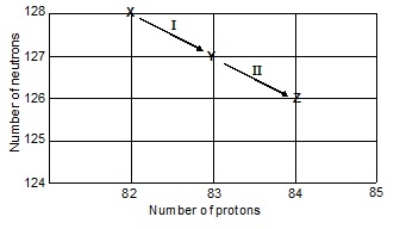 What is the complete element symbol for the product labeled Y
 (Multiple Choice)
4.7/5 (87)
(87) The type of nuclear process illustrated below is called neutron emission.
(True/False)
4.8/5 (73)
(73) A sample of a radioisotope shows an activity of 999 disintegrations per minute due to beta decay. If after 1.10 years the activity is 952 disintegrations per minute, what is the half-life of this radioisotope
(Multiple Choice)
4.8/5 (87)
(87) Tritium is a radioisotope of hydrogen having a half-life of 12.3 years. If you initially had 1.0 * 10-7 mole of tritium, calculate the decay rate of the sample.
(Multiple Choice)
4.7/5 (78)
(78) The radioisotope potassium-40 decays to argon-40 by positron emission with a half-life of 1.3 * 109 yr. A sample of moon rock was found to contain 78 argon-40 atoms for every 22 potassium-40 atoms. The age of the rock is
(Multiple Choice)
4.8/5 (68)
(68) When a 162Re nucleus emits an alpha particle, the nuclear species that results is _____________.
(Multiple Choice)
4.9/5 (84)
(84) Rubidium-87 decays by beta decay with a half-life of 4.9 * 1010 yr. How many 87Rb atoms are in a moon rock sample that has a rubidium decay rate of 3,500 disintegrations per hour
(Multiple Choice)
4.8/5 (82)
(82) Strontium-90 has a half-life of 28.8 years. How much strontium-90 was present initially, if after 144 years 10.0 g remain
(Multiple Choice)
4.9/5 (77)
(77) Find the nuclear binding energy of uranium-234 (atomic mass = 234.040947 amu) in units of joules per nucleon. [Data: neutron mass = 1.674928 * 10-24 g; proton mass = 1.672623 * 10-24 g; electron mass = 9.109387 * 10-28 g; NA = 6.0221367 * 1023 /mol; c = 2.99792458 * 108 m/s]
(Multiple Choice)
4.9/5 (82)
(82) A balanced nuclear equation representing the beta emission of iodine-131 is which of the following
(Multiple Choice)
4.7/5 (84)
(84) 
Filters
- Essay(0)
- Multiple Choice(0)
- Short Answer(0)
- True False(0)
- Matching(0)