



 Chat with AI
Exam 17: Project Management

Exam 1: Introduction to Operations Management74 Questions
Exam 2: Competitiveness, Strategy, and Productivity72 Questions
Exam 3: Forecasting164 Questions
Exam 4: Product and Service Design76 Questions
Exam 4: Extension: Reliability12 Questions
Exam 5: Strategic Capacity Planning for Products and Services106 Questions
Exam 5: Extension: Decision Theory123 Questions
Exam 6: Process Selection and Facility Layout150 Questions
Exam 7: Work Design and Measurement151 Questions
Exam 7: Extension: Learning Curves68 Questions
Exam 8: Location Planning and Analysis80 Questions
Exam 8: Extension: The Transportation Model20 Questions
Exam 9: Management of Quality102 Questions
Exam 10: Quality Control141 Questions
Exam 10: Extension: Acceptance Sampling65 Questions
Exam 11: Aggregate Planning and Master Scheduling88 Questions
Exam 12: MRP and ERP89 Questions
Exam 13: Inventory Management161 Questions
Exam 14: Jit and Lean Operations87 Questions
Exam 14: Extension: Maintenance38 Questions
Exam 15: Supply Chain Management89 Questions
Exam 16: Scheduling134 Questions
Exam 17: Project Management137 Questions
Exam 18: Management of Waiting Lines81 Questions
Exam 19: Linear Programming111 Questions
Select questions type


A project is represented by the following diagram: 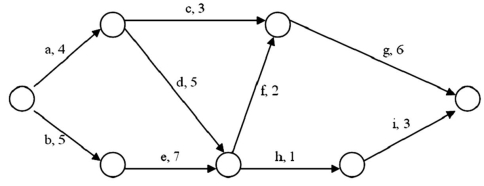 The expected duration of this project is:
 (Multiple Choice)
4.8/5  (67)
(67) Consider the following work breakdown structure: Activity Precedes Normal Time (wks) Crashing Cost week) week) Start A, B - - - A C, D 6 8 - B G 4 5 6 C E 4 - - D F 5 6 6 E H 6 8 8 F H 6 7 10 G I 8 3 5 H End 5 12 15 I End 6 5 - What is the total cost of reducing the project to 18 weeks?
(Short Answer)
4.9/5 (78)
(78) Activity J has a duration of 7 and an earliest finish time of 21. If J's latest start time is 16, this must mean that J's slack is:
(Multiple Choice)
4.9/5 (70)
(70) Which of the following is not an element of the project management triangle?
(Multiple Choice)
4.7/5 (88)
(88) The main function of dummy activities is to clarify relationships in network diagrams.
(True/False)
4.8/5 (69)
(69) In a project network, the critical path is the sequence of activities which has the:
(Multiple Choice)
4.9/5 (83)
(83) Project management differs from management of more traditional activities mainly because of:
(I) its limited time frame.
(II) its unique, defined set of activities.
(III) the requirement for use of the appropriate resources.
(IV) the need for planning and execution.
(Multiple Choice)
4.8/5 (85)
(85) A project consists of nine major activities, as shown below. There are three separate paths in the network: a-c-f, b-d-g, and e-h-i.
(A) What is expected project duration time?
(B) Determine the probability that the project will take more than 35 weeks to complete. (All times are in weeks.)
Activity Exp. Duration Std.Dev. a 7 1 b 10 1 c 9 2 d 11 2 e 16 2 f 14 2 g 10 2 h 8 1 I 8 2 
(Essay)
4.9/5 (77)
(77) Some organizations use a matrix organization to integrate the activities of specialists within a functional framework.
(True/False)
4.9/5 (72)
(72) Consider the following work breakdown structure: Time Estimates (days) Activity Precedes Optimistic Most Likely Pessimistic Start A, B - - - A C, D 44 50 56 B D 45 60 75 C E 42 45 48 D F 31 40 49 E F 27 36 39 F End 58 70 82 What is the estimated expected (mean) time for activity E?
(Multiple Choice)
4.8/5 (83)
(83) Once a project is underway, the project manager usually is not responsible for effectively managing:
(Multiple Choice)
4.8/5 (77)
(77) Deterministic networks use three time estimates-shortest, most likely, and longest-for each activity in order to best determine the activity's estimated time.
(True/False)
4.9/5 (79)
(79) Consider the following work breakdown structure: Start Finish Duration (Days) Activity Node Node Optimistic Most Likely Pessimistic A 1 2 41 50 59 B 1 3 54 60 66 C 2 4 58 70 82 D 3 4 32 41 44 What is the estimated expected (mean) time for project completion?
(Multiple Choice)
4.9/5 (72)
(72) Consider the following work breakdown structure: Time Estimates (wks) Start Finish Activity Node Node A 1 2 11 20 29 B 2 3 2 5 8 C 2 4 18 30 42 D 3 4 7 10 13 E 1 4 31 40 43 What is the estimated slack time for activity E?
(Multiple Choice)
4.9/5 (70)
(70) In the probabilistic approach to project network analysis, the time estimate annotated tm for any activity is the:
(Multiple Choice)
4.8/5 (80)
(80) Which of the following is not typically treated as part of a project life cycle?
(Multiple Choice)
4.7/5 (79)
(79) The probability that the project will go beyond the desired time is equal to one minus the joint probability that all paths will be completed within the desired time.
(True/False)
5.0/5 (69)
(69) 
Filters
- Essay(0)
- Multiple Choice(0)
- Short Answer(0)
- True False(0)
- Matching(0)