



 Chat with AI
Exam 17: Project Management

Exam 1: Introduction to Operations Management74 Questions
Exam 2: Competitiveness, Strategy, and Productivity72 Questions
Exam 3: Forecasting164 Questions
Exam 4: Product and Service Design76 Questions
Exam 4: Extension: Reliability12 Questions
Exam 5: Strategic Capacity Planning for Products and Services106 Questions
Exam 5: Extension: Decision Theory123 Questions
Exam 6: Process Selection and Facility Layout150 Questions
Exam 7: Work Design and Measurement151 Questions
Exam 7: Extension: Learning Curves68 Questions
Exam 8: Location Planning and Analysis80 Questions
Exam 8: Extension: The Transportation Model20 Questions
Exam 9: Management of Quality102 Questions
Exam 10: Quality Control141 Questions
Exam 10: Extension: Acceptance Sampling65 Questions
Exam 11: Aggregate Planning and Master Scheduling88 Questions
Exam 12: MRP and ERP89 Questions
Exam 13: Inventory Management161 Questions
Exam 14: Jit and Lean Operations87 Questions
Exam 14: Extension: Maintenance38 Questions
Exam 15: Supply Chain Management89 Questions
Exam 16: Scheduling134 Questions
Exam 17: Project Management137 Questions
Exam 18: Management of Waiting Lines81 Questions
Exam 19: Linear Programming111 Questions
Select questions type


In order to determine the probability of timely project completion, it is sometimes necessary to take into account paths other than the critical path.
(True/False)
4.7/5  (86)
(86) Consider the following work breakdown structure: Activity Precedes Normal Time (wks) Crashing Cost week) week) Start A, B - - - A C, D 6 8 - B G 4 5 6 C E 4 - - D F 5 6 6 E H 6 8 8 F H 6 7 10 G I 8 3 5 H End 5 12 15 I End 6 5 - What is the total cost of reducing this project by two weeks?
(Short Answer)
4.8/5 (79)
(79) The total cost of crashing any one activity should never exceed 20 percent of the total cost of the original project.
(True/False)
4.8/5 (82)
(82) Activities not on the critical path have a slack time equal to zero.
(True/False)
4.8/5 (65)
(65) The advantage a precedence diagram has over a Gantt chart is:
(Multiple Choice)
4.8/5 (74)
(74) Which of the following leads to simulation being a useful tool with uncertain activity times?
(Multiple Choice)
4.9/5 (65)
(65) In the execution phase of a project's life cycle, activities are guided by decisions that were made in the __________ phase.
(Multiple Choice)
4.9/5 (82)
(82) Consider the following work breakdown structure: Duration Estimate (Days) Start Finish Activity Node Node Optimistic Most Likely Pessimistic A 1 2 9 15 21 B 1 3 13 21 23 C 2 4 6 9 18 D 2 5 23 35 47 E 3 5 19 26 27 F 4 6 23 29 41 G 5 6 14 20 26 H 6 7 2 5 8 What are the estimated standard deviations (in weeks) in the times for activities A-H?
(Short Answer)
4.8/5 (80)
(80) Which of the following is not one of the six key decisions in project management?
(I) Selecting the project team
(II) Deciding on the project manager's title
(III) Managing and controlling project resources
(IV) Deciding which projects to implement
(V) Selecting the project manager
(Multiple Choice)
4.8/5 (80)
(80) Consider the following work breakdown structure: Time Estimates (days) Activity Precedes Optimistic Most Likely Pessimistic Start A, B, C - - - A D 38 50 62 B E 90 99 108 C End 85 100 115 D F 19 25 31 E End 91 100 115 F End 62 65 68 What is the estimated expected (mean) time for activity E?
(Multiple Choice)
5.0/5 (77)
(77) Consider the following work breakdown structure: Time Estimates (days) Activity Precedes Optimistic Most Likely Pessimistic Start A, B - - - A C, D 44 50 56 B D 45 60 75 C E 42 45 48 D F 31 40 49 E F 27 36 39 F End 58 70 82 What is the estimated slack time for activity D?
(Multiple Choice)
4.9/5 (78)
(78) Once a project is approved and underway, project managers are only responsible for effectively managing time and costs which, if done well, will assure project completion on time and on budget.
(True/False)
4.8/5 (66)
(66) Consider the following work breakdown structure: Time Estimates (days) Activity Precedes Optimistic Most Likely Pessimistic Start A, B - - - A C, D 44 50 56 B D 45 60 75 C E 42 45 48 D F 31 40 49 E F 27 36 39 F End 58 70 82 What is the probability that the critical path for this project will be completed within 210 days?
(Multiple Choice)
4.7/5 (91)
(91) There are four activities on the critical path, and they have standard deviations of 1, 2, 4, and 2 days. The standard deviation of the critical path is:
(Multiple Choice)
5.0/5 (81)
(81) Consider the portion of a project depicted by this graph: 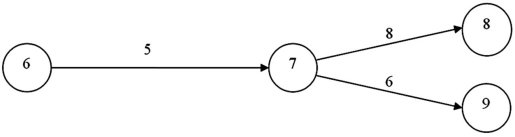 What is the latest start time of activity 6-7 if the latest finish of activity 7-8 is 26, and the latest finish of activity 7-9 is 23?
 (Multiple Choice)
4.9/5 (87)
(87) The project management strategy of injecting additional resources in order to reduce the length of the project is called:
(Multiple Choice)
4.8/5 (86)
(86) Matrix organizations transfer control of workers to project managers for the duration of the project.
(True/False)
4.8/5 (76)
(76) The probability of occurrence of risk events is lower near the beginning of a project and higher near the end of the project since very few activities remain.
(True/False)
4.9/5 (88)
(88) Consider the following work breakdown structure: Time Estimates (wks) Start Finish Activity Node Node A 1 2 11 20 29 B 2 3 2 5 8 C 2 4 18 30 42 D 3 4 7 10 13 E 1 4 31 40 43 What is the estimated standard deviation in the time for activity E?
(Multiple Choice)
4.9/5 (80)
(80) Which of the following stages is that one in which the project's expected costs, benefits, and risks are assessed?
(Multiple Choice)
4.8/5 (69)
(69) 
Filters
- Essay(0)
- Multiple Choice(0)
- Short Answer(0)
- True False(0)
- Matching(0)