



 Chat with AI
Exam 17: Project Management

Exam 1: Introduction to Operations Management74 Questions
Exam 2: Competitiveness, Strategy, and Productivity72 Questions
Exam 3: Forecasting164 Questions
Exam 4: Product and Service Design76 Questions
Exam 4: Extension: Reliability12 Questions
Exam 5: Strategic Capacity Planning for Products and Services106 Questions
Exam 5: Extension: Decision Theory123 Questions
Exam 6: Process Selection and Facility Layout150 Questions
Exam 7: Work Design and Measurement151 Questions
Exam 7: Extension: Learning Curves68 Questions
Exam 8: Location Planning and Analysis80 Questions
Exam 8: Extension: The Transportation Model20 Questions
Exam 9: Management of Quality102 Questions
Exam 10: Quality Control141 Questions
Exam 10: Extension: Acceptance Sampling65 Questions
Exam 11: Aggregate Planning and Master Scheduling88 Questions
Exam 12: MRP and ERP89 Questions
Exam 13: Inventory Management161 Questions
Exam 14: Jit and Lean Operations87 Questions
Exam 14: Extension: Maintenance38 Questions
Exam 15: Supply Chain Management89 Questions
Exam 16: Scheduling134 Questions
Exam 17: Project Management137 Questions
Exam 18: Management of Waiting Lines81 Questions
Exam 19: Linear Programming111 Questions
Select questions type


If two consecutive activities have shared slack, this means that each of them can use only half of the slack without delaying completion of the project.
(True/False)
4.7/5  (83)
(83) Consider the following work breakdown structure: Duration Estimates (Days) Activity Precedes Optimistic Most Likely Pessimistic Start U, V - - - U W 35 50 65 V W, X 28 40 52 W Z 26 35 44 X Y 28 40 52 Y Z 26 29 38 Z End 36 60 84 What is the estimated standard deviation in the time for activity Z?
(Multiple Choice)
4.9/5 (85)
(85) Consider the following work breakdown structure: Duration Estimates (Days) Activity Precedes Optimistic Most Likely Pessimistic Start U, V - - - U W 35 50 65 V W, X 28 40 52 W Z 26 35 44 X Y 28 40 52 Y Z 26 29 38 Z End 36 60 84 What is the estimated expected (mean) time for project completion?
(Multiple Choice)
4.9/5 (83)
(83) Consider the following work breakdown structure: Activity Precedes Normal Time (wks) Crashing Cost week week) Start A, B - - - A C, D 6 8 - B G 4 5 6 C E 4 - - D F 5 6 6 E H 6 8 8 F H 6 7 10 G I 8 3 5 H End 5 12 15 I End 6 5 - In crashing this project to 18 weeks, which activities (in order of selection) will be reduced?
(Essay)
4.9/5 (66)
(66) One upside to terminating a project that is not going as well as planned is that:
(Multiple Choice)
4.7/5 (87)
(87) A node has one entering activity, a, and two leaving activities, b and c. Given the following information, determine the latest starting time for activity a: EFb = 15, EFc = 17, LFb = 24, LFc = 27; activity times are a = 4, b = 6, c = 8.
(Multiple Choice)
4.9/5 (85)
(85) Determine the amount of slack in each of a project's activities (presented below), and identify those that are on the critical path. Activity Precedes Est. Duration (wks) Start a, e 0 a c, d 4 e f 9 f g 5 d g 2 c end 6 g end 3
(Essay)
4.7/5 (90)
(90) Consider the following work breakdown structure: Start Finish Duration (Days) Activity Node Node Optimistic Most Likely Pessimistic A 1 2 41 50 59 B 1 3 54 60 66 C 2 4 58 70 82 D 3 4 32 41 44 What is the estimated expected (mean) time for activity D?
(Multiple Choice)
4.8/5 (73)
(73) Consider the following work breakdown structure: Activity Precedes Normal Time () Crashing Cost week week Start A, B - - - A C, D 6 8 - B G 4 5 6 C E 4 - - D F 5 6 6 E H 6 8 8 F H 6 7 10 G I 8 3 5 H End 5 12 15 I End 6 5 - What activities make up the critical path?
(Essay)
4.9/5 (76)
(76) Good project management is especially important with virtual teams.
(True/False)
4.9/5 (76)
(76) Consider the following work breakdown structure: Duration Estimates (Days) Activity Precedes Optimistic Most Likely Pessimistic Start U, V - - - U W 35 50 65 V W, X 28 40 52 W Z 26 35 44 X Y 28 40 52 Y Z 26 29 38 Z End 36 60 84 What is the probability that the critical path for this project will be completed within 200 days?
(Multiple Choice)
4.8/5 (68)
(68) In "crashing" a project, a manager will generally focus on activities which:
(Multiple Choice)
4.9/5 (85)
(85) Project management software eliminates conflicts when there are shared resources.
(True/False)
4.9/5 (84)
(84) Which of the following is not a limitation of PERT and similar project-scheduling techniques?
(Multiple Choice)
5.0/5 (79)
(79) One way that project management differs from management of more traditional activities is because of the limited lifetime of projects.
(True/False)
4.7/5 (86)
(86) Activity C has an early start time of 8, an early finish time of 12, a latest start time of 13, and a latest finish time of 17. Its slack is:
(Multiple Choice)
4.8/5 (88)
(88) Consider the following work breakdown structure: Start Finish Duration (Days) Activity Node Node Optimistic Most Likely Pessimistic A 1 2 41 50 59 B 1 3 54 60 66 C 2 4 58 70 82 D 3 4 32 41 44 What is the estimated slack time for activity D?
(Multiple Choice)
4.8/5 (81)
(81) Which of the following is determined as a direct result of computing the earliest starting and finishing times for the activities of a project network?
(Multiple Choice)
4.8/5 (83)
(83) Consider the portion of a project depicted by this graph: 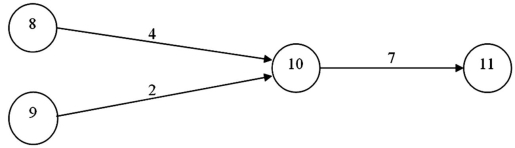 What is the earliest finish time for activity 10-11 (far right-hand side) if the earliest start time of 8-10 (upper left-hand side) is 12 and the earliest start time of 9-10 (lower left-hand side) is 13?
 (Multiple Choice)
4.9/5 (71)
(71) Consider the following work breakdown structure: Duration Estimate (Days) Start Finish Activity Node Node Optimistic Most Likely Pessimistic A 1 2 9 15 21 B 1 3 13 21 23 C 2 4 6 9 18 D 2 5 23 35 47 E 3 5 19 26 27 F 4 6 23 29 41 G 5 6 14 20 26 H 6 7 2 5 8 What are the estimated expected (mean) times (in weeks) for activities A-H?
(Short Answer)
4.9/5 (84)
(84) 
Filters
- Essay(0)
- Multiple Choice(0)
- Short Answer(0)
- True False(0)
- Matching(0)