



 Chat with AI
Exam 10: Externalities

Exam 1: Ten Lessons From Economics149 Questions
Exam 2: Thinking Like an Economist147 Questions
Exam 3: Interdependence and the Gains From Trade153 Questions
Exam 4: The Market Forces of Supply and Demand222 Questions
Exam 5: Elasticity and Its Application181 Questions
Exam 6: Supply, Demand and Government Policies148 Questions
Exam 7: Consumers, Producers and the Efficiency of Markets177 Questions
Exam 8: Application: The Costs of Taxation141 Questions
Exam 9: Application: International Trade161 Questions
Exam 10: Externalities199 Questions
Exam 11: Public Goods and Common Resources182 Questions
Exam 12: The Design of the Tax System154 Questions
Exam 13: The Costs of Production191 Questions
Exam 14: Firms in Competitive Markets200 Questions
Exam 15: Monopoly214 Questions
Exam 16: Business Strategy184 Questions
Exam 17: Competition Policy104 Questions
Exam 18: Monopolistic Competition214 Questions
Exam 19: The Markets for the Factors of Production215 Questions
Exam 20: Earnings, Unions and Discrimination206 Questions
Exam 21: Income Inequity and Poverty111 Questions
Exam 22: The Theory of Consumer Choice161 Questions
Exam 23: Frontiers of Microeconomics120 Questions
Exam 24: Measuring a Nations Income51 Questions
Exam 25: Measuring the Cost of Living52 Questions
Exam 26: Production and Growth62 Questions
Exam 27: Saving, Investment and the Financial System62 Questions
Exam 28: The Natural Rate of Unemployment59 Questions
Exam 29: The Monetary System66 Questions
Exam 30: Inflation: Its Causes and Costs74 Questions
Exam 31: Open-Economy Macroeconomics: Basic Concepts68 Questions
Exam 32: A Macroeconomic Theory of the Open Economy64 Questions
Exam 33: Aggregate Demand and Aggregate Supply82 Questions
Exam 34: The Influence of Monetary and Fiscal Policy on Aggregate Demand73 Questions
Exam 35: The Short-Run Trade-Off Between Inflation and Unemployment58 Questions
Exam 36: Five Debates Over Macroeconomic Policy38 Questions
Select questions type


Graph 10-1
 -Refer to Graph 10-1. This graph reflects the presence of a:
 (Multiple Choice)
4.8/5  (91)
(91) If the government were to limit the release of air pollution produced by a steel mill to 10 000 units, this policy would be considered a:
(Multiple Choice)
4.9/5 (88)
(88) Graph 10-4
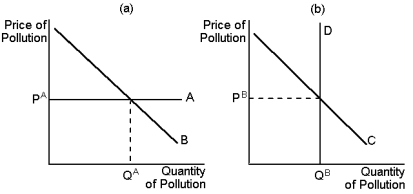 -Referring to Graph 10-4, which curve best represents a Pigovian tax?
 (Multiple Choice)
4.9/5 (96)
(96) Children can be thought of as imposing negative externalities on aeroplane passengers because:
(Multiple Choice)
4.8/5 (80)
(80) Which of the following could be associated with positive consumption externalities? (i) child immunisations (ensuring that the general population is vaccinated against communicable diseases)
(ii) alcohol consumption
(iii) maintaining the appearance of historic buildings
(Multiple Choice)
4.8/5 (90)
(90) Which of the following is one problem that keeps people from privately solving externalities?
(Multiple Choice)
4.7/5 (78)
(78) Graph 10-1
-Refer to Graph 10-1. In the figure shown the marginal:
-Refer to Graph 10-1. In the figure shown the marginal: (Multiple Choice)
4.9/5 (91)
(91) Greenhouse gas emissions are a classic example of a negative production externality.
(True/False)
5.0/5 (74)
(74) Which of the following are characteristics of tradeable pollution permits? (i) they are a scarce resource
(ii) they can be traded in a market governed by supply and demand
(iii) they eventually lead to an efficient elimination of all pollution
(Multiple Choice)
4.8/5 (72)
(72) Nancy loves to landscape her yard, but her neighbour Tom places a low value on his landscaping. When Tom's grass is neglected and gets long, Nancy will mow it for Tom. This is an example of:
(Multiple Choice)
4.8/5 (77)
(77) Negative consumption externalities will have a socially optimal quantity that is smaller than the quantity determined by the private market.
(True/False)
4.8/5 (80)
(80) Graph 10-5
 -Refer to Graph 10-5. Which of the graphs shown best depicts the case of a positive consumption externality?
 (Multiple Choice)
4.9/5 (77)
(77) Suppose that water pollution creates a negative production externality on a local fishing firm. This means:
(Multiple Choice)
4.8/5 (75)
(75) Some economists believe that technology spillovers are pervasive and industries with the largest spillovers should be encouraged.
(True/False)
4.8/5 (75)
(75) In the absence of public policies, markets will ensure that:
(Multiple Choice)
4.9/5 (79)
(79) Pigovian taxes are typically advocated to correct for the effects of:
(Multiple Choice)
4.8/5 (83)
(83) 
Filters
- Essay(0)
- Multiple Choice(0)
- Short Answer(0)
- True False(0)
- Matching(0)