



 Chat with AI
Exam 10: Externalities

Exam 1: Ten Lessons From Economics149 Questions
Exam 2: Thinking Like an Economist147 Questions
Exam 3: Interdependence and the Gains From Trade153 Questions
Exam 4: The Market Forces of Supply and Demand222 Questions
Exam 5: Elasticity and Its Application181 Questions
Exam 6: Supply, Demand and Government Policies148 Questions
Exam 7: Consumers, Producers and the Efficiency of Markets177 Questions
Exam 8: Application: The Costs of Taxation141 Questions
Exam 9: Application: International Trade161 Questions
Exam 10: Externalities199 Questions
Exam 11: Public Goods and Common Resources182 Questions
Exam 12: The Design of the Tax System154 Questions
Exam 13: The Costs of Production191 Questions
Exam 14: Firms in Competitive Markets200 Questions
Exam 15: Monopoly214 Questions
Exam 16: Business Strategy184 Questions
Exam 17: Competition Policy104 Questions
Exam 18: Monopolistic Competition214 Questions
Exam 19: The Markets for the Factors of Production215 Questions
Exam 20: Earnings, Unions and Discrimination206 Questions
Exam 21: Income Inequity and Poverty111 Questions
Exam 22: The Theory of Consumer Choice161 Questions
Exam 23: Frontiers of Microeconomics120 Questions
Exam 24: Measuring a Nations Income51 Questions
Exam 25: Measuring the Cost of Living52 Questions
Exam 26: Production and Growth62 Questions
Exam 27: Saving, Investment and the Financial System62 Questions
Exam 28: The Natural Rate of Unemployment59 Questions
Exam 29: The Monetary System66 Questions
Exam 30: Inflation: Its Causes and Costs74 Questions
Exam 31: Open-Economy Macroeconomics: Basic Concepts68 Questions
Exam 32: A Macroeconomic Theory of the Open Economy64 Questions
Exam 33: Aggregate Demand and Aggregate Supply82 Questions
Exam 34: The Influence of Monetary and Fiscal Policy on Aggregate Demand73 Questions
Exam 35: The Short-Run Trade-Off Between Inflation and Unemployment58 Questions
Exam 36: Five Debates Over Macroeconomic Policy38 Questions
Select questions type


Graph 10-3
 This graph reflects the market for kiwifruit, where pesticide used by kiwifruit orchardists also unintentionally kills honey bees.
-Refer to Graph 10-3. At the private market outcome, the equilibrium price of kiwifruit will be:
This graph reflects the market for kiwifruit, where pesticide used by kiwifruit orchardists also unintentionally kills honey bees.
-Refer to Graph 10-3. At the private market outcome, the equilibrium price of kiwifruit will be: (Multiple Choice)
4.8/5  (70)
(70) Graph 10-3
This graph reflects the market for kiwifruit, where pesticide used by kiwifruit orchardists also unintentionally kills honey bees.
-Refer to Graph 10-3. Assume that the kiwifruit orchardists must purchase a pesticide application permit (the cost for the permit is included in private cost) before spraying their fruit. What criteria should the government use in determining whether or not to issue a permit?
This graph reflects the market for kiwifruit, where pesticide used by kiwifruit orchardists also unintentionally kills honey bees.
-Refer to Graph 10-3. Assume that the kiwifruit orchardists must purchase a pesticide application permit (the cost for the permit is included in private cost) before spraying their fruit. What criteria should the government use in determining whether or not to issue a permit? (Multiple Choice)
4.8/5 (86)
(86) Using a supply-demand diagram, demonstrate how a positive consumption externality leads to market inefficiency.
(Essay)
4.8/5 (73)
(73) Assume that your housemate is very messy. Suppose he gets a $200 benefit from being messy but imposes a $100 cost on you. The Coase theorem would suggest that an efficient solution would be for you to:
(Multiple Choice)
4.9/5 (86)
(86) If the marginal consumer values timber less than the social cost of harvesting it , the timber market will be characterised by a negative production externality.
(True/False)
4.8/5 (90)
(90) In which of the following situations may tradeable pollution permits be preferred to Pigovian taxes? (i) where they internalise the externality of pollution
(ii) where regulatory agencies do not know the demand curve for pollution
(iii) where the government is not interested in generating maximum revenue from polluting firms
(Multiple Choice)
4.8/5 (82)
(82) Despite the appealing logic of the Coase theorem, private actors often fail to resolve on their own the problems caused by externalities.
(True/False)
4.9/5 (72)
(72) Encouraging firms to increase production via a subsidy will tend to be socially optimal when:
(Multiple Choice)
4.8/5 (92)
(92) Which of the following best defines the situation where one firm's research yields knowledge that is used by society as a whole?
(Multiple Choice)
4.9/5 (84)
(84) If the government were to impose a fee of $10 000 for each unit of air pollution released by a steel mill, this policy would be considered a:
(Multiple Choice)
4.9/5 (83)
(83) Paul owns a mushroom farm. The smell from the farm reduces the value of adjacent houses by a total of $30 000. Suppose that the benefit of the mushroom farm to Paul is $20 000. Assuming that Paul has the legal right to own the farm, a possible private solution to this problem is that:
(Multiple Choice)
4.9/5 (71)
(71) The impact of one person's actions on the wellbeing of a bystander is called:
(Multiple Choice)
4.8/5 (82)
(82) Graph 10-4
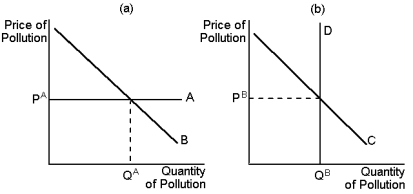 -Refer to Graph 10-4. The equivalence of a Pigovian tax and a pollution permit would require that:
 (Multiple Choice)
4.7/5 (76)
(76) Explain the difference between market equilibrium and social optimum.
(Essay)
4.9/5 (75)
(75) When weighing the costs and benefits of pollution, the costs always exceed the benefits because the benefit equals zero.
(True/False)
4.8/5 (66)
(66) If alcohol creates negative consumption externalities then the market equilibrium level of alcohol consumption will be:
(Multiple Choice)
4.9/5 (97)
(97) Irrespective of whether an externality is positive or negative, all solutions share the same goal of:
(Multiple Choice)
4.9/5 (76)
(76) 
Filters
- Essay(0)
- Multiple Choice(0)
- Short Answer(0)
- True False(0)
- Matching(0)